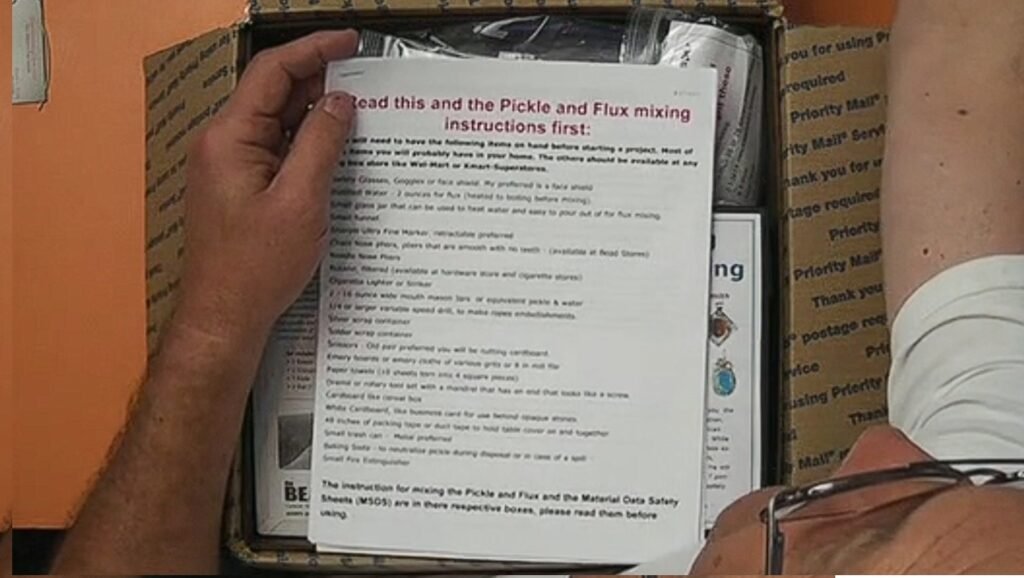
If you’ve read anything about silversmithing, you may have come across references to hot pickle — a heated acid solution used to clean oxidation and flux residue off metal after soldering. It’s a common technique in many workshops. It’s also something David specifically doesn’t use in his classes, and the reason is worth understanding before you decide how to set up your own pickle station.
What pickle does
Pickle is a mild acid — sodium bisulfate, the same compound in some pool pH-down products — dissolved in water. After soldering, your metal comes out of the torch covered in oxidation (fire scale) and flux residue. Both need to be removed before you can continue working. Pickle does that cleaning work quickly and effectively.
The acid is mild enough that it’s not immediately dangerous with normal precautions, but it does need to be handled carefully. It will put small holes in clothing if spilled in dry form, cause minor skin irritation if left on the skin, and produce fumes that need ventilation if heated.
The difference between hot and cold
Hot pickle refers to heating the pickle solution, usually in a small slow cooker or dedicated pickle pot. Heat speeds up the cleaning process significantly — a piece that takes several minutes in cold pickle might be clean in under a minute in hot pickle. For production silversmiths doing high volume work, the speed advantage is real.
The tradeoff is fumes. Hot pickle produces vapors that spread through the work area. In a professional studio with dedicated ventilation directly over the pickle station, this is manageable. In a home workshop, a classroom, or any space with general ventilation rather than dedicated extraction, hot pickle fumes create an ongoing air quality problem.
Cold pickle takes longer — typically a few minutes to ten minutes or more depending on how much oxidation is on the piece — but produces essentially no fumes at room temperature. You still need to avoid breathing vapors when you’re mixing the solution initially, but once it’s in the jar and at room temperature, it’s significantly easier to work with safely.
Why David made the decision for cold pickle in class
The classroom environment made hot pickle impractical. Multiple students working simultaneously, a space that’s ventilated but not equipped with extraction hoods over each workstation, and beginners who are still learning the basics of chemical handling — hot pickle adds risk and complexity that cold pickle avoids entirely.
For students taking the course at home, the same logic often applies. Most home workshops don’t have dedicated ventilation over the workbench. The few minutes of extra wait time with cold pickle is a reasonable tradeoff for not filling your workspace with acid vapor.
Setting up your cold pickle station
Two wide-mouth mason jars — one marked with red tape, paint, or fingernail polish for the pickle, one for rinse water. The red marking matters because you never want to mix them up.
Fill the pickle jar to two inches with water, then add pickle powder to the two-and-a-half-inch mark. Always add the powder to the water, never the reverse. Keep baking soda nearby — it neutralizes pickle quickly in case of a spill. Keep your rinse water jar next to the pickle jar so the tong movement from one to the other is a single simple motion.
That’s the cold pickle setup. Simple, safe, and effective for everything you’ll do in the beginning series and well beyond.