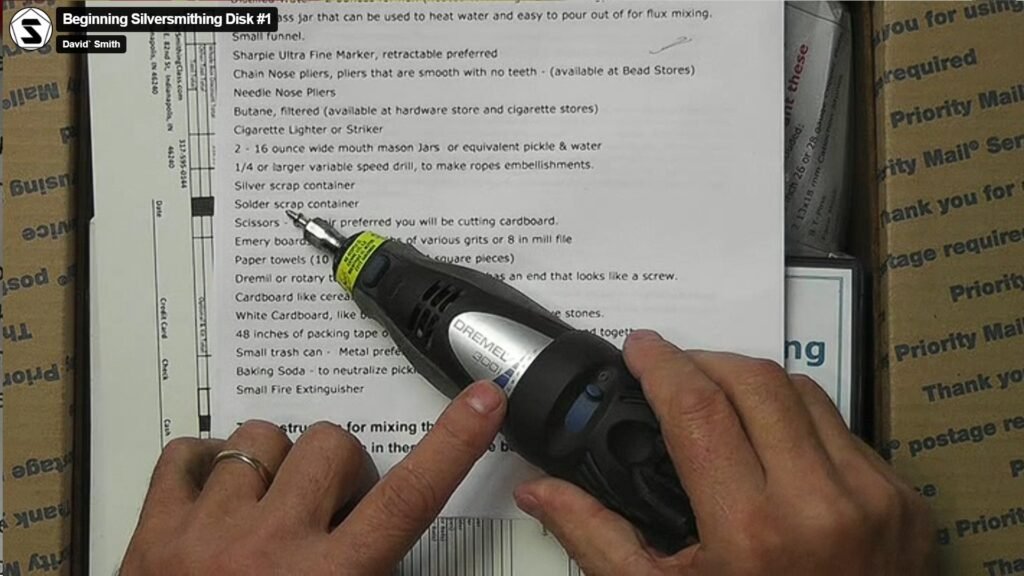
There are dozens of rotary tools on the market at a wide range of price points. Generic alternatives to the Dremel brand are everywhere, often significantly cheaper. So why does David specifically recommend the Dremel brand in his beginning silversmithing series — and is the preference actually justified?
The short answer is yes, and the reasons are practical rather than brand loyalty.
What a rotary tool does in silversmithing
The rotary tool — Dremel or otherwise — is used for grinding, polishing, and finishing silver. You’ll use it with polishing wheels, grinding wheels, and a screw mandrel that holds those accessories. The quality and consistency of the tool directly affects the finish on your work.
In polishing silver, you’re working with compounds applied to small cloth or felt wheels, buffing the metal to progressively finer finishes. The tool needs to spin consistently at controlled speeds, respond accurately to variable speed inputs, and do this reliably over many sessions.
The specific Dremel recommendation
David recommends the corded Dremel, models in the 3000 series or larger. Older models were the 300 series — the 3000 and above are the current equivalent.
Two things he specifically advises against:
Battery-powered Dremels. They work fine initially but performance drops as the battery drains, which means inconsistent speed during a polishing session. For occasional use this might be acceptable, but for any sustained work it creates problems.
Generic rotary tools. The issue isn’t necessarily power — many generics are powerful enough. The issue is the quality of the variable speed system and the consistency of the chuck that holds accessories. A loose or inconsistent chuck causes wobble in the polishing wheel, which creates uneven results on the metal surface.
The screw mandrel
The Dremel kit includes a screw mandrel — a small shaft with a screw at the end that attaches polishing and grinding wheels. This is the standard attachment method for most of the wheels you’ll use in silversmithing. When you’re shopping for accessories, make sure they’re designed for the screw mandrel system.
The mandrel is included in the standard Dremel kit. If you have a different brand of rotary tool, check that it accepts the same screw mandrel accessories — compatibility varies.
Dremel orientation and safety
As covered in the eye protection discussion, the Dremel should be held in your left hand when grinding. The rotation direction of the tool throws debris away from your face in that orientation. In your right hand, it throws material toward you.
This is specific to grinding and polishing work with the rotary tool — not to other uses. And it’s in addition to, not instead of, wearing eye protection.
The practical recommendation
If you’re buying a rotary tool specifically for silversmithing, the corded Dremel 3000 or higher is the recommendation. It’s widely available, the accessories are standardized, and the performance is consistent. The price premium over generics is modest in the context of the tool’s role in your workflow.
If you already have a corded rotary tool from another brand and it has a reliable variable speed system and a solid chuck, it may work fine. The test is consistency — if the speed varies unpredictably or the accessory wobbles, you’ll see it in your finished work.