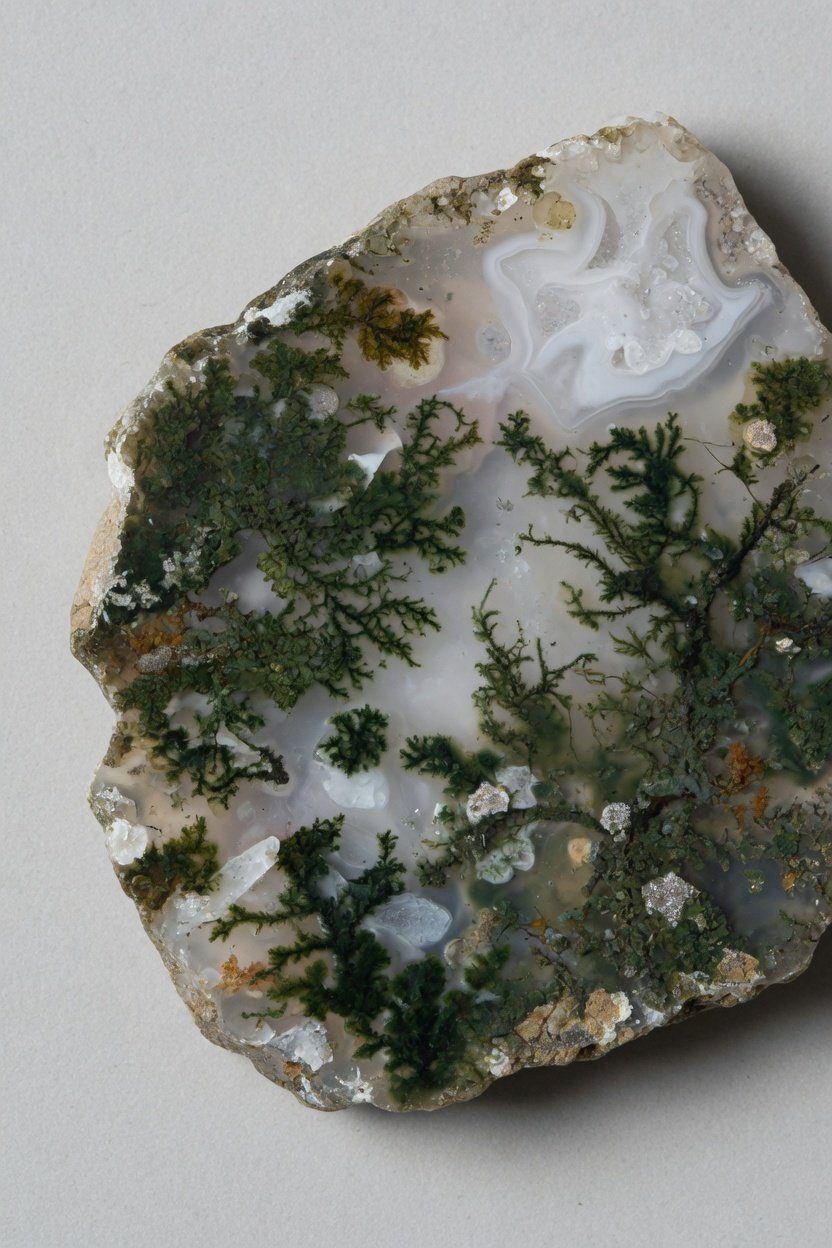
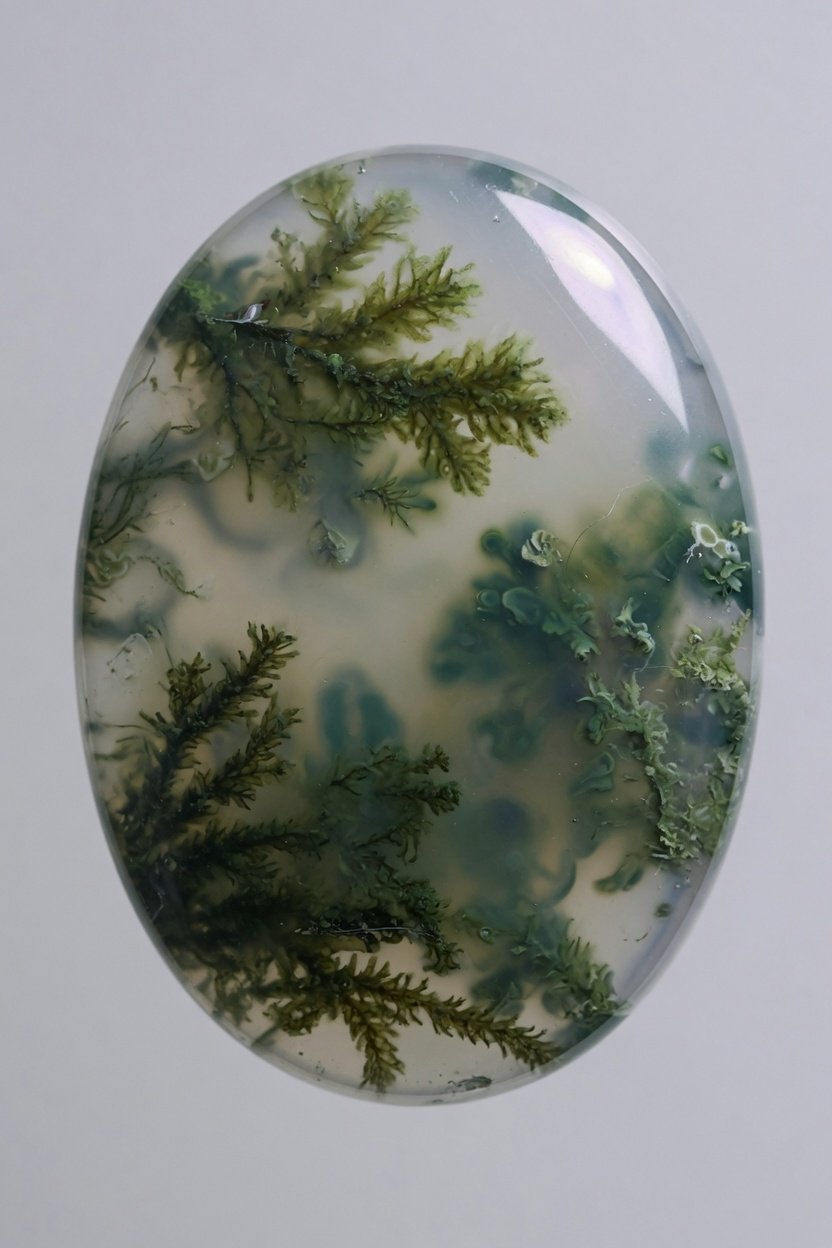
Moss agate draws the eye with its translucent chalcedony matrix interrupted by intricate green dendritic inclusions that mimic miniature forests frozen in time. These natural patterns evoke quiet landscapes rather than flashy sparkle, making the stone a favorite among silversmiths who seek organic depth in their work. The gem rewards close inspection, revealing branching forms that shift subtly with light and angle.
Physical Properties Moss agate is a cryptocrystalline variety of quartz whose base body shows a milky white to pale gray translucency. The signature green “moss” results from chlorite or iron oxide inclusions that form delicate, fern-like dendrites suspended within the silica. Hardness registers 6.5–7 on the Mohs scale, sufficient for everyday wear yet requiring care against sharp impacts. Specific gravity falls between 2.58 and 2.64, and the stone exhibits a waxy to vitreous luster. Because the material can contain microscopic water pockets, prolonged heat exposure risks internal fracturing; therefore the stone must always be set after all soldering and torch work is complete. Avoid ultrasonic cleaners and sudden temperature changes to preserve the integrity of both the chalcedony and its delicate inclusions.
Origin and Sourcing Primary deposits occur in India’s Deccan Plateau, Brazil’s Rio Grande do Sul region, and Montana’s alluvial gravels in the United States. The stone forms when silica-rich fluids fill cavities in volcanic or sedimentary host rock, allowing mineral solutions to precipitate the characteristic dendritic patterns over geological time. Artisanal miners typically work shallow open pits or screen river gravels, recovering nodules that range from fist-sized to larger boulders. Rough material is sorted on-site before export to lapidary workshops, where orientation of the moss patterns dictates the final cabochon shape.
History and Significance Ancient traders carried moss agate along caravan routes from India into the Mediterranean, where Roman artisans carved it into seals and amulets believed to grant safe passage through wooded terrain. Medieval European lapidaries later associated the stone with gardeners and farmers, citing its vegetative inclusions as symbols of growth and renewal. Indigenous North American cultures collected Montana moss agate for ceremonial objects, valuing the stone’s resemblance to prairie grasses and river moss. Across these traditions the gem served as a tangible link between human craft and the living landscape.
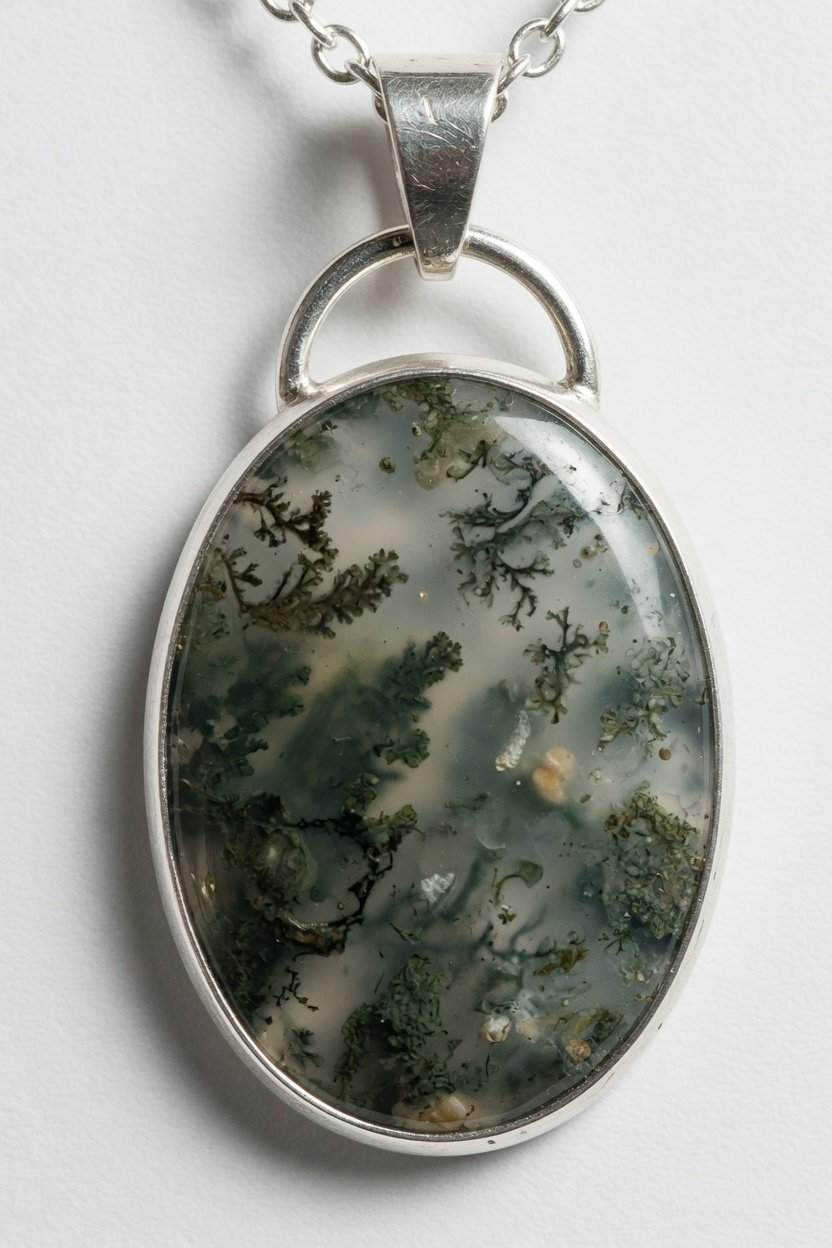
In Jewelry and Silversmithing Silversmiths favor moss agate for its ability to complement both minimalist and ornate designs. The stone is almost always cut en cabochon to display the full dendritic scene, then seated in a protective bezel that shields the edges from chipping. Because heat can fracture water-bearing inclusions, the cabochon is set only after every soldering operation has cooled. Traditional care cautions include removing pieces before gardening or heavy manual work and wiping with a soft cloth rather than submerging in detergents. The resulting jewelry pieces range from quiet pendants that rest against the skin to statement cuffs whose silver frames echo the stone’s branching motifs.
Identifying Moss Agate in the Field Field identification begins with the stone’s distinctive translucency and the presence of green or black dendritic inclusions that do not follow concentric banding. A hand lens reveals the moss-like forms branching in three dimensions rather than lying flat on the surface. Hardness testing with a steel file produces a faint white powder without scratching the chalcedony itself. Fresh fractures display a conchoidal pattern and a slightly greasy feel. Collectors note that true moss agate lacks the vivid color zoning of dyed material and maintains a consistent waxy luster across both the matrix and inclusions.
Quick Facts
Common names: Moss Agate, Mocha Stone, Dendritic Agate
Chemical formula: SiO₂ with chlorite or iron-oxide inclusions
Mohs hardness: 6.5–7
Specific gravity: 2.58–2.64
Color: Milky white to gray with green to black dendritic inclusions
Crystal system: Trigonal (cryptocrystalline quartz)
Luster: Waxy to vitreous
Transparency: Translucent to opaque
Common cuts: Cabochon
Common treatments: Rarely dyed or stabilized; most material left untreated
Best silver setting: Classic Silver Bezel Pendant
Birthstone month (if any): None
Main sources: India, Brazil, United States (Montana)
Meaning & Intentions
GROUNDING GROWTH
Moss agate anchors scattered energy by mirroring the steady, rooted patterns of ancient forests within its silica matrix. Wearers carry the stone during seasonal transitions or new projects to maintain calm focus while allowing organic expansion. The dendritic inclusions act as visual reminders that growth occurs through patient layering rather than force.
Chakra: Root — stability and connection to physical surroundings NATURE AWARENESS
The stone heightens perception of living systems by presenting miniature ecosystems frozen in stone. Meditators place it on an altar or hold it during outdoor observation to sharpen attention to subtle environmental cues. Its inclusions encourage recognition of interconnection between self and surrounding landscape.
Chakra: Heart — compassion and kinship with the natural world PROTECTIVE BOUNDARIES
Moss agate forms an energetic perimeter that filters intrusive influences while permitting beneficial exchange. Travelers and sensitive individuals keep the stone in pockets or desk drawers to maintain personal space amid demanding environments. The branching patterns symbolize resilient yet permeable limits that adapt without breaking.
Chakra: Root — protective foundation and energetic containment Affirmation: "I grow steadily within clear, living boundaries." AT A GLANCE: Chakra: Root Element: Earth Energy: Receptive Zodiac: Virgo Planet: Mercury Affirmation: "I grow steadily within clear, living boundaries."
Related Stones
Explore more stones from the Gemstone Library: Agate · Picture Jasper · Tourmaline