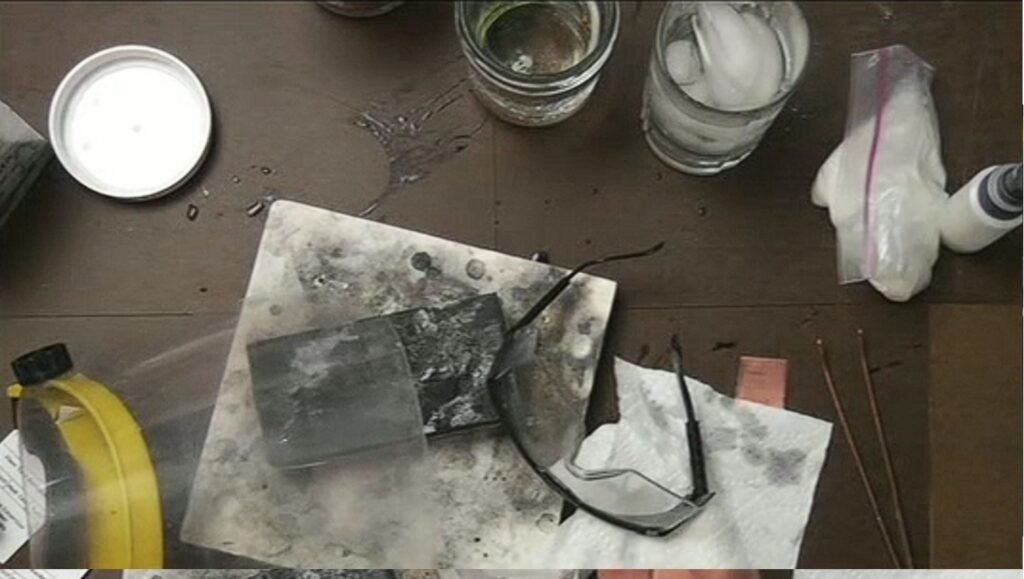
Eye protection is one of those things that’s easy to skip when you’re getting started, especially when you’re focused on learning technique and the idea of something going wrong feels abstract. But the risks that make eye protection necessary in silversmithing are real, specific, and worth understanding before your first session.
What you’re protecting against
Two activities in silversmithing create the most risk for your eyes: soldering and grinding.
When you’re soldering, flux and metal can splash. It doesn’t happen every session, but it happens — especially when flux heats up quickly or a piece shifts unexpectedly on the charcoal block. A splash of hot flux toward your face is a serious risk to unprotected eyes.
Grinding is where the risk becomes even more immediate. When you use a Dremel or rotary tool to grind or polish silver, the wheel throws debris. The direction depends on how the tool is oriented, which is why David teaches a specific technique for Dremel use — but regardless of technique, grinding produces fine particles that travel fast in unpredictable directions. Eye protection during grinding is mandatory, not optional.
What’s acceptable
Any of these three options work for beginning silversmithing:
A face mask, safety goggles, or safety glasses. David uses his regular prescription glasses while soldering and grinding because they qualify as safety lenses. If your everyday glasses are safety-rated, they count.
The minimum requirement is that whatever you’re wearing is impact-resistant and covers your eyes from the front. Sunglasses don’t qualify — they’re not built to the same standard.
The long-term upgrade: a welding face shield
For anyone who plans to do a significant amount of silversmithing over years rather than months, David recommends eventually getting a level one welding face shield. These have a slight tint that filters certain wavelengths of light produced by the torch — not enough to affect your visibility during soldering, but enough to provide cumulative protection over many hours of work.
The long-term eye health argument for this upgrade is the same as the long-term ventilation argument for chemicals: the data on chronic low-level exposure isn’t always available, and the precautionary approach costs relatively little compared to the potential downside. A level one welding face shield is inexpensive and widely available at welding supply stores and online.
The Dremel rule
David covers Dremel orientation in detail in the tools section of the beginning series, but the relevant point for eye protection is this: the Dremel should be held in your left hand when grinding, because the rotation direction throws debris away from your face in that orientation. In your right hand, it throws debris toward you.
This is a technique rule, not a substitute for eye protection. Even with correct Dremel orientation, protective eyewear is required.
Before your first session
Make sure you have eye protection in place before you pick up the torch. Safety glasses are inexpensive and widely available. If you already wear prescription glasses with safety-rated lenses, you’re covered. There’s no reason to start without protection, and no technique reason to delay — eye protection doesn’t interfere with any part of the silversmithing process.