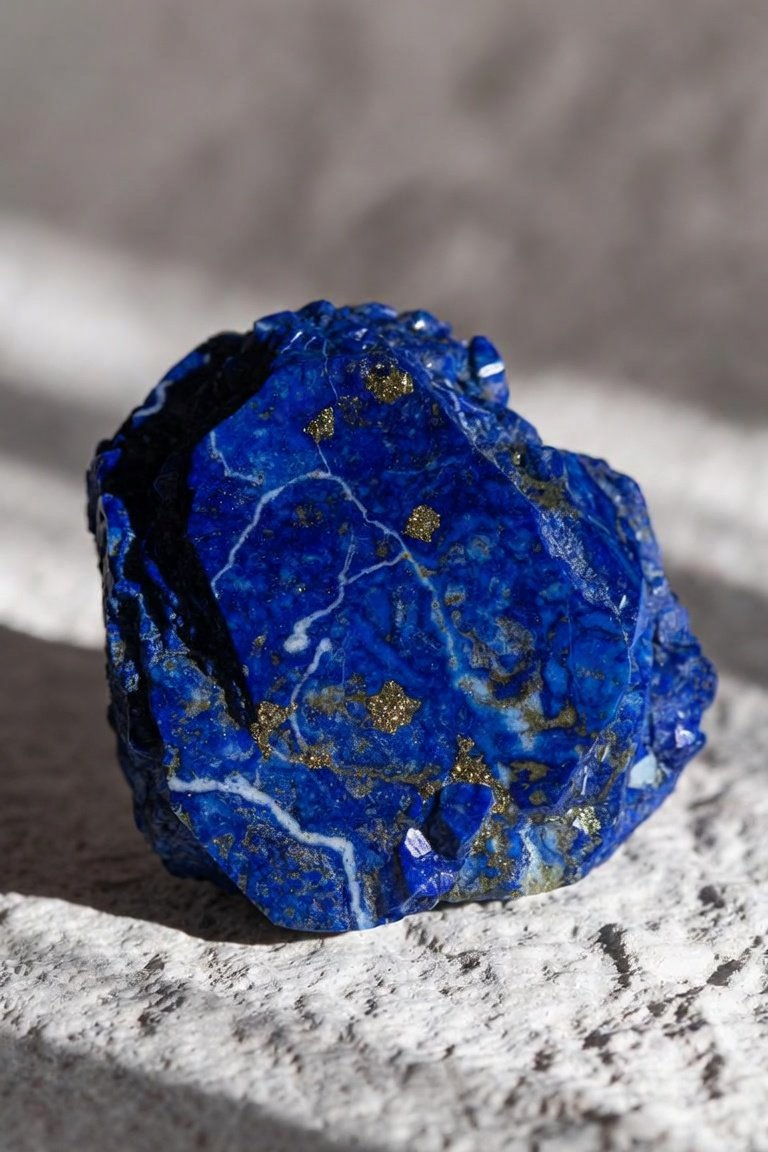
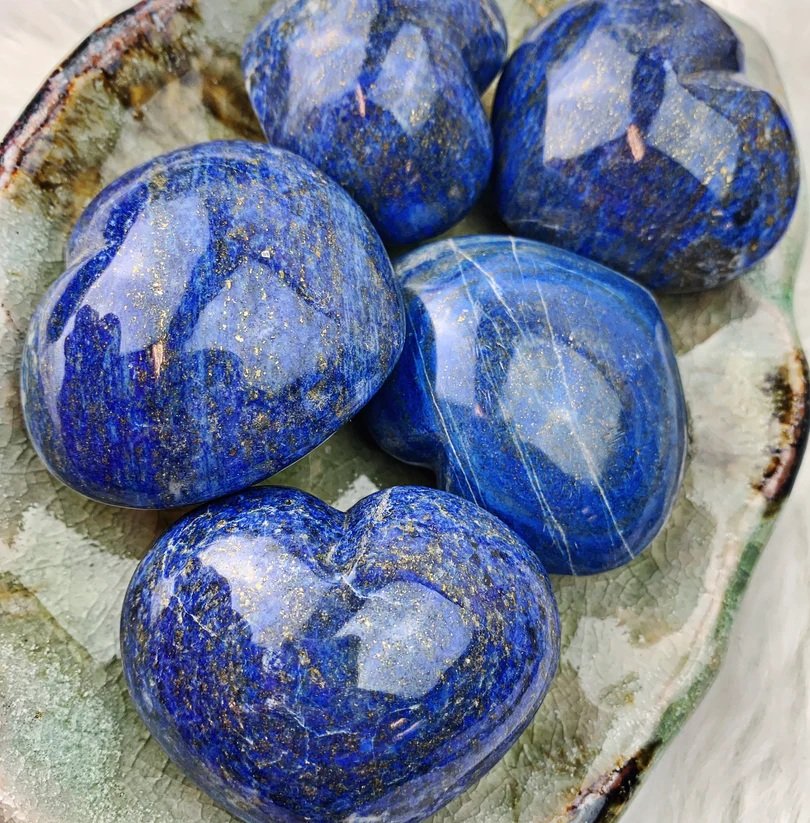
Lapis lazuli is one of the oldest and most storied gemstones in human history. Its deep, celestial blue — flecked with sparkling gold pyrite and veined with white calcite — has been treasured for more than six thousand years. The name comes from the Latin lapis, meaning stone, and the Persian lazhward, meaning blue, the same root that gives us the word azure. Unlike most gems, lapis is not a single mineral but a rock, made of several minerals together. Its main coloring mineral is lazurite, mixed with pyrite that looks like flecks of gold and calcite that appears as white streaks. The finest lapis is an intense, even, deep blue with just a scattering of golden pyrite, like a night sky full of stars.
Physical Properties
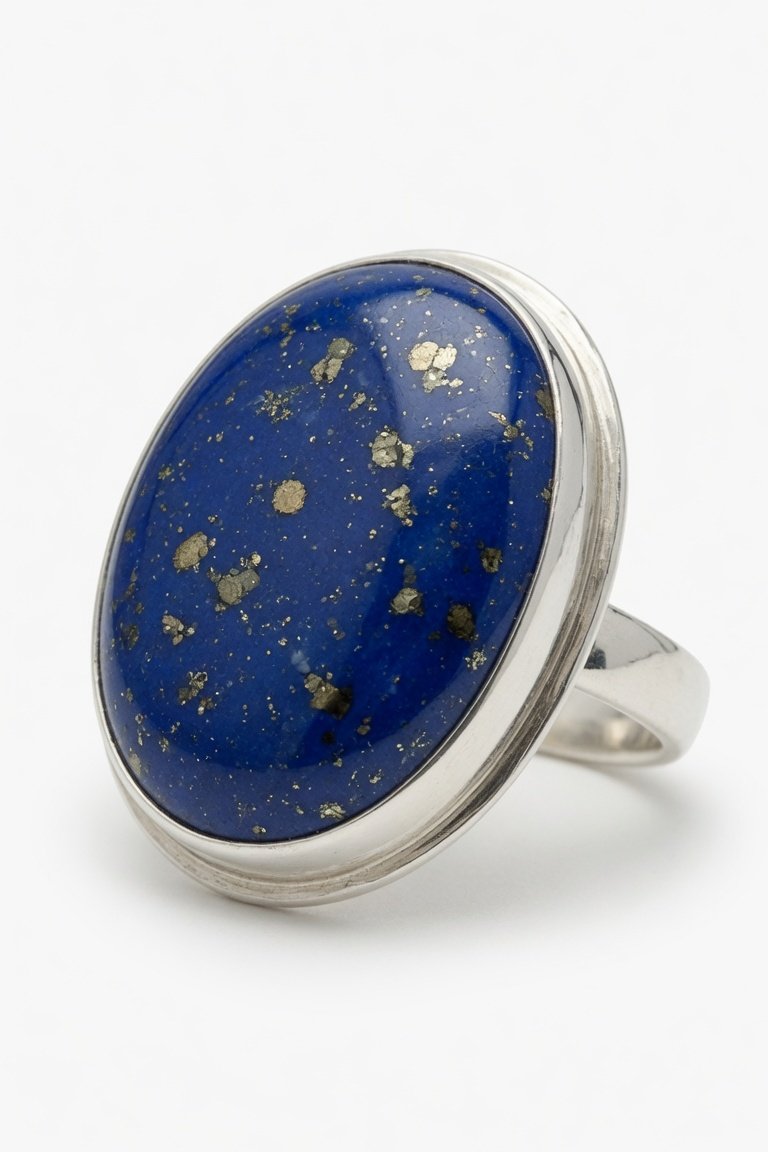
Lapis lazuli is a relatively soft stone, ranking about 5 to 5.5 on the Mohs hardness scale. That softness made it workable by hand with simple tools even in ancient times, which is part of why it was carved and polished so early in history. It is opaque, with a dull to vitreous luster that takes a beautiful polish. Because it is soft and somewhat porous, lapis needs gentle care — it can scratch, and harsh chemicals or prolonged water exposure can dull its surface. For silversmithing it is almost always cut as a cabochon, where its rich color and golden flecks can be shown off in a protective setting.
What Makes Lapis Special
The magic of lapis is its color and its history together. That deep blue was so prized in the ancient and medieval world that lapis was ground into a powder to make ultramarine, the most expensive pigment a painter could buy — more costly than gold. Renaissance masters reserved it for the robes of the Virgin Mary. The golden pyrite flecks that run through good lapis are not flaws but part of its character, giving each stone the look of stars scattered across a midnight sky. The white calcite veining varies from piece to piece; collectors generally prize stones with less calcite and a deep, uniform blue.
Origin and Sourcing
The heart of the lapis world is Afghanistan. The Sar-e-Sang mines in the Badakhshan province, high in the Hindu Kush mountains, have produced the finest lapis on earth for over six thousand years — the oldest continuously worked gem mines known. More than ninety percent of the world's fine lapis still comes from this remote, rugged region along the Kokcha River valley. The mines sit at punishing altitude in a narrow mountain defile, accessible only part of the year. Lapis is also found in smaller quantities in Chile, which tends to have more calcite, and in Russia near Lake Baikal, with minor deposits in the United States, Canada, and elsewhere. But Afghan lapis remains the standard against which all other lapis is judged.
History and Significance
Few stones carry the weight of history that lapis does. It traveled thousands of miles along ancient trade routes from Afghanistan to the great civilizations of the ancient world. The Sumerians used it in the Royal Cemetery at Ur. The Egyptians treasured it above almost all stones — Tutankhamun's famous golden burial mask is inlaid with lapis, and powdered lapis was used in cosmetics and ceremonial objects. It appears in the breastplate of the high priest described in the Bible. Through every age, lapis has been associated with royalty, wisdom, truth, and the heavens themselves. To work a piece of lapis in silver today is to hold a direct link to six thousand years of human reverence for this one blue stone.
In Jewelry and Silversmithing
Lapis is a beautiful and rewarding stone for silver work, though its softness calls for care. It is almost always set as a cabochon in a protective bezel, which shields the relatively soft, porous stone from knocks and wear. The deep blue against bright silver is a classic, regal combination, and the golden pyrite flecks echo gold accents beautifully. As with all stones, set lapis after every bit of soldering and heat work is done — heat and harsh pickle solutions can damage it. Clean it only with a soft, slightly damp cloth, never with ultrasonic cleaners or harsh chemicals, and keep it away from prolonged moisture. Treated kindly, a lapis cabochon holds its midnight-blue beauty for a lifetime.
Identifying Lapis in the Field
True lapis lazuli forms in metamorphosed limestone, where blue lazurite develops alongside white calcite and golden pyrite. The identifying signs are its components together: a deep blue body color, scattered metallic-gold flecks of pyrite that catch the light, and irregular white or gray veins of calcite. The blue is unmistakable and even — not banded like some other blue stones. Lapis is opaque, never transparent, with a hardness around 5 to 5.5, so it can be scratched by a steel knife. Its specific gravity of about 2.7 to 2.9 gives it a modest heft. Be aware that dyed howlite and synthetic imitations are common in the marketplace; genuine lapis shows natural variation in its pyrite and calcite, while fakes often have an unnaturally uniform color or visible dye in cracks.
Quick Facts
Common names: Lapis Lazuli, Lapis, Afghan Lapis
Chemical formula: Rock: lazurite (Na,Ca)₈(AlSiO₄)₆(S,SO₄,Cl)₂ + pyrite + calcite
Mohs hardness: 5–5.5
Specific gravity: 2.7–2.9
Color: Deep blue with gold pyrite flecks and white calcite veins
Crystal system: A rock (lazurite is cubic); no single crystal form
Luster: Dull to vitreous; takes a good polish
Transparency: Opaque
Common cuts: Almost always cabochon; also beads and carvings
Common treatments: Sometimes waxed, dyed, or color-enhanced
Best silver setting: Bezel (protects the soft, porous stone)
Birthstone month: September (traditional alternate)
Anniversary: 7th and 9th wedding anniversary
Main sources: Afghanistan (Sar-e-Sang), Chile, Russia
Meaning & Metaphysical Properties
Lapis lazuli has been the stone of wisdom and truth since the dawn of civilization. Pharaohs, priests, and philosophers wore it as a symbol of knowledge and honesty. It is used by those seeking deeper understanding, clearer judgment, and the courage to speak and live their truth. Many keep lapis close when studying, making important decisions, or searching for insight, trusting its ancient association with the higher mind and inner knowing.
Chakra: Third Eye chakra (Ajna) — insight, wisdom, intuition
Also associated with: Throat chakra — truth and honest expression
Lapis was the stone of kings and queens, worn as a mark of royalty and inner authority. It is used to strengthen self-confidence, encourage clear self-expression, and help a person step into their own quiet power. Those facing situations that call for dignity and composure — speaking up, leading, standing firm — turn to lapis for its steadying, regal energy. It is a reminder that true authority comes from wisdom and integrity, not force.
Chakra: Throat chakra (Vishuddha) — confident, honest self-expression
With its deep celestial blue, lapis has always been linked to the heavens and the realm of spirit. It is used to quiet the mind, deepen meditation, and foster a sense of serene connection to something larger than oneself. Its calming color soothes worry and invites reflection. Many use lapis to find inner peace during difficult times and to strengthen their sense of meaning and spiritual purpose.
Affirmation: "I see clearly, I speak my truth, and I carry the quiet
wisdom of ages within me."
At a Glance
Chakra: Throat, Third Eye
Element: Air, Water
Energy: Wisdom, truth, inner power, peace
Zodiac: Sagittarius, Libra, Taurus
Planet: Jupiter, Venus
Affirmation: I see clearly and I speak my truth
Related Stones
Explore more stones from the Gemstone Library: LABRADORITE · AMETHYST · TURQUOISE