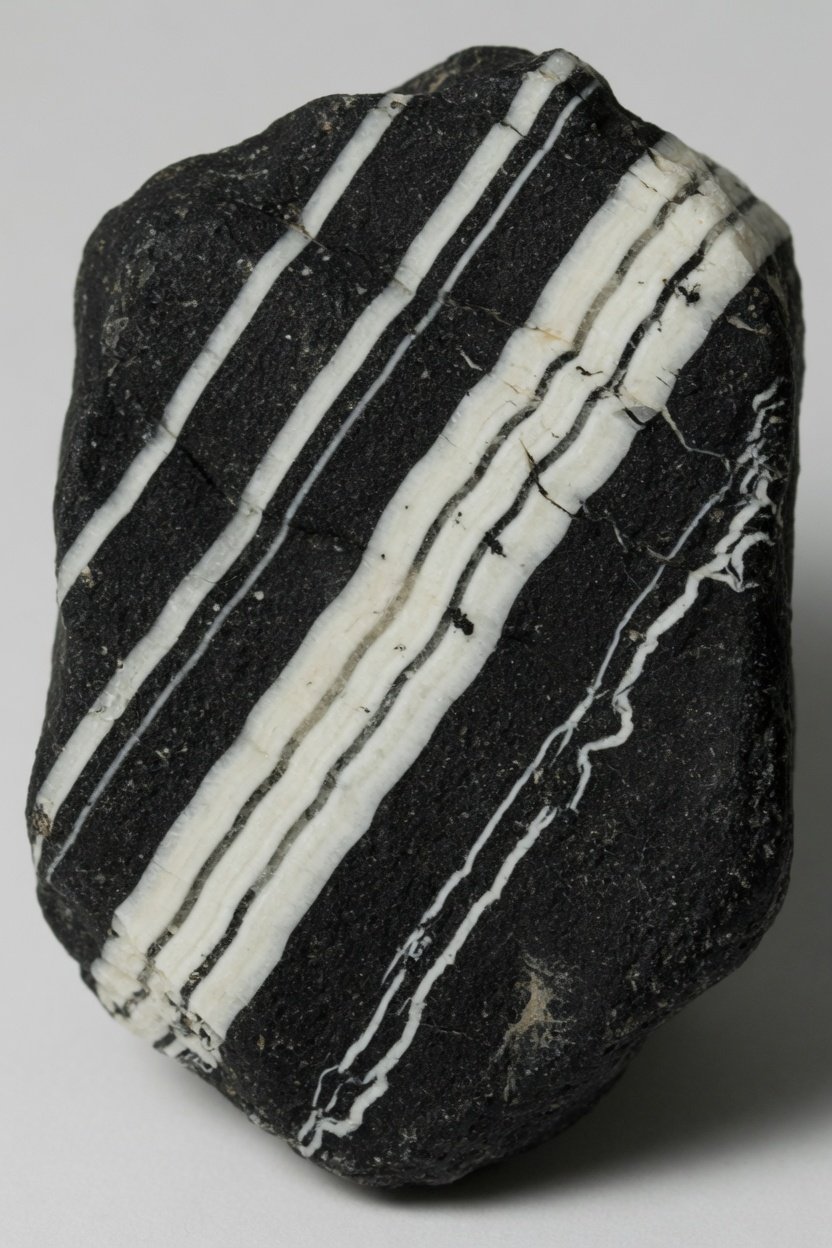
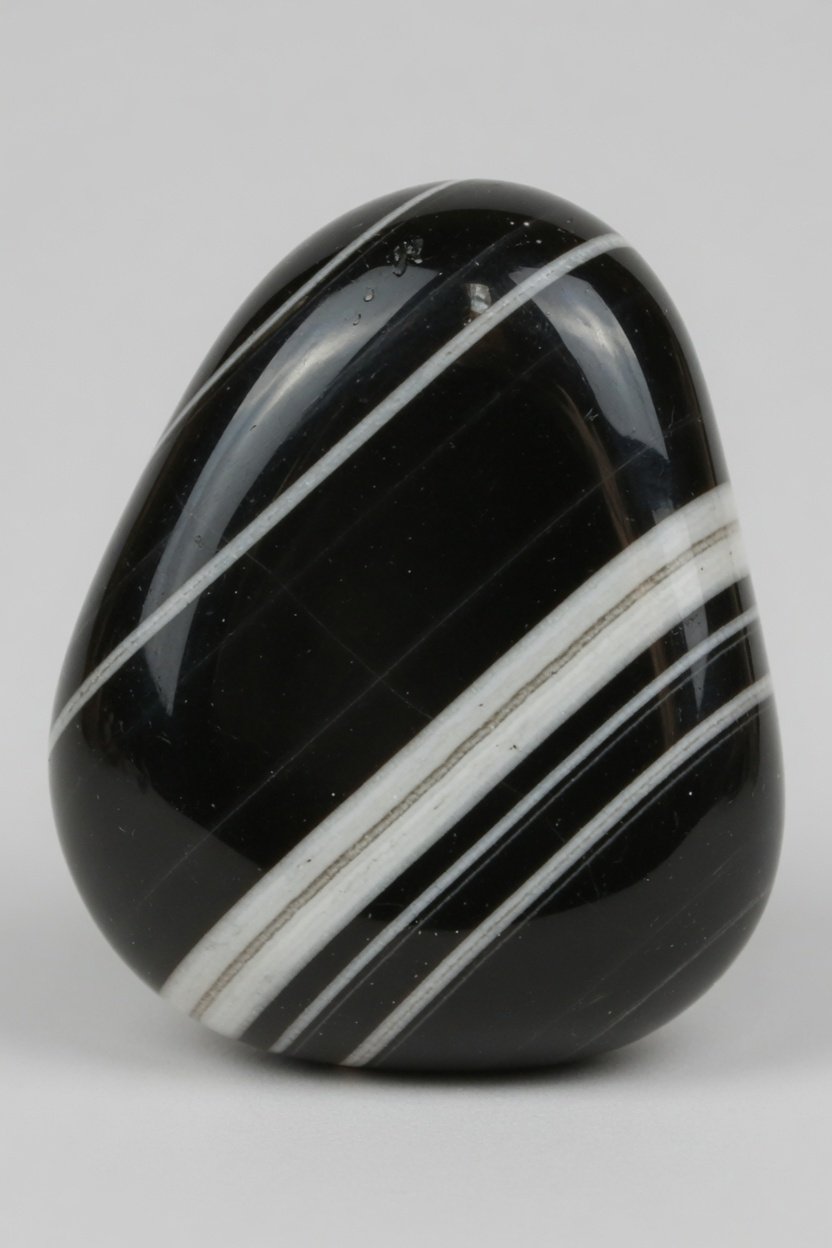
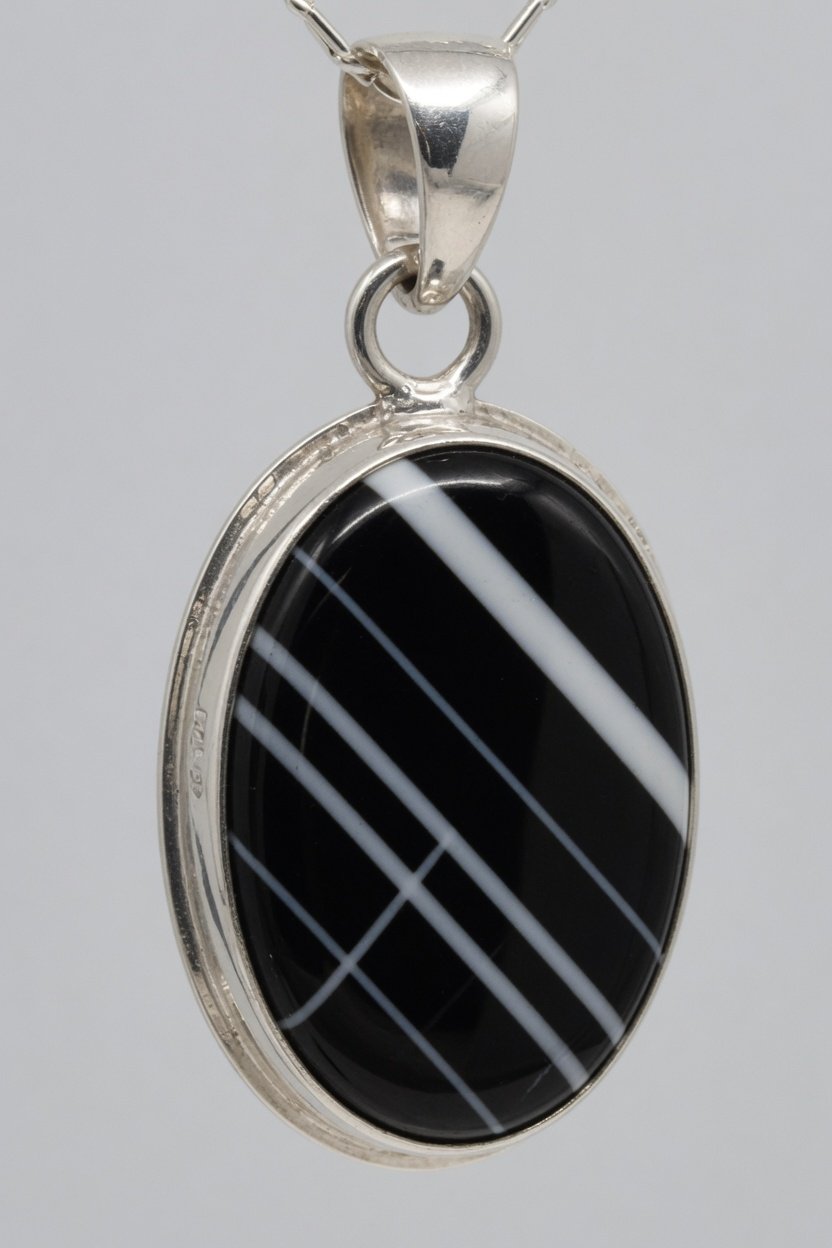
Onyx draws the eye with its deep, velvety black surface interrupted by crisp white bands that run in parallel lines, creating a striking contrast that feels both ancient and modern. This banded chalcedony has long been prized for its ability to hold a high polish while remaining durable enough for everyday wear in silver jewelry. Silversmithing students quickly learn that its optical depth makes even simple bezel settings appear sophisticated.
Physical Properties Onyx is a microcrystalline variety of quartz with the chemical formula SiO₂. It registers 6.5–7 on the Mohs scale, giving it sufficient hardness for rings and bracelets yet requiring care during setting. Specific gravity ranges from 2.55 to 2.70, and the stone exhibits a vitreous to waxy luster with translucency limited to thin edges. Parallel banding results from successive silica deposition, and the material accepts a mirror polish that highlights the contrast between black and white zones. Because onyx is heat-sensitive, it must be set only after all soldering operations are complete; exposure to torch temperatures can cause cracking or discoloration along the bands. Care cautions include avoiding ultrasonic cleaners and prolonged sunlight, which may fade lighter layers over decades.
Origin and Sourcing Commercial onyx is mined primarily from hard-rock deposits in India, Brazil, Mexico, and Madagascar. Veins form in cavities within volcanic or sedimentary host rock, extracted through adits and drifts where miners follow the banded seams. Rough material is sawn into slabs at the mine or cutting centers, then graded for color uniformity and band straightness before export. Ethical sourcing programs now track blocks from these regions to ensure fair labor practices and minimal environmental disturbance in surrounding communities.
History and Significance Ancient Romans carved onyx into cameos and intaglios for seals and jewelry, believing the stone conferred courage in battle and eloquence in speech. During the Renaissance, European silversmiths paired onyx with silver filigree for reliquaries and devotional objects. In Victorian mourning jewelry, polished black onyx symbolized enduring memory. Across cultures the stone has represented grounding and protection, its layered structure interpreted as a record of time itself.
In Jewelry and Silversmithing Onyx performs best in closed-back or low-bezel settings that protect its edges while allowing light to graze the polished surface. Contemporary pieces often feature 8 × 10 mm or larger cabochons in sterling silver, with the stone seated only after final soldering and pickling to prevent thermal shock. Prong settings are avoided because they expose vulnerable band edges; instead, smooth bezels or channel mounts distribute pressure evenly. Students are taught to inspect each cabochon for internal fractures before setting and to apply a light coat of mineral oil after polishing to enhance depth. With proper care, onyx jewelry retains its contrast for generations.
Identifying Onyx in the Field In outcrop, onyx appears as dark, fine-grained veins with visible white stripes running parallel to the walls. A streak test yields white powder, and the material feels cool and dense compared with surrounding limestone or basalt. Broken surfaces show conchoidal fracture with a waxy sheen rather than the sugary texture of coarser quartz. When held to light, only the thinnest edges transmit a smoky glow, confirming its microcrystalline structure.
Quick Facts
Common names: Onyx, Black Onyx, Banded Chalcedony
Chemical formula: SiO₂
Mohs hardness: 6.5–7
Specific gravity: 2.55–2.70
Color: Black with parallel white bands
Crystal system: Trigonal
Luster: Vitreous to waxy
Transparency: Opaque
Common cuts: Cabochon, cameo, intaglio, bead
Common treatments: Dyeing (rare on true black material)
Best silver setting: Classic Silver Bezel Pendant
Birthstone month: None (sometimes associated with Leo)
Main sources: India, Brazil, Mexico, Madagascar
Meaning & Intentions
GROUNDING
Onyx anchors scattered energy by linking the wearer to the steady rhythm of the earth through its dense silica layers. Silversmiths set the stone after all heat work is finished so the finished piece can serve as a daily reminder to remain centered during creative or emotional turbulence. The parallel bands visually reinforce stability, helping the user return to a calm baseline whenever the jewelry is worn.
Chakra: Root — foundation and physical presence CLARITY
The stark contrast between black and white zones on onyx encourages mental focus by cutting through distraction and revealing essential patterns. Wearers keep the stone close during decision-making or study, allowing its polished surface to act as a mirror for honest self-assessment. When set in silver, the reflective metal amplifies this clarifying effect without overpowering the stone’s quiet strength.
Chakra: Third Eye — insight and perception PROTECTION
Onyx forms an energetic boundary that deflects negativity while preserving the wearer’s own vitality, a property long recognized in talismanic jewelry. Artisans choose sturdy bezels that fully encase the edges so the protective function remains intact through daily wear. The stone’s natural opacity visually signals containment, offering quiet reassurance without ostentation.
Chakra: Root — shielding and endurance Affirmation: "I stand steady and clear." AT A GLANCE: Chakra: Root Element: Earth Energy: Receptive Zodiac: Capricorn Planet: Saturn Affirmation: "I stand steady and clear."
Related Stones
Explore more stones from the Gemstone Library: Jasper · Agate · Bloodstone