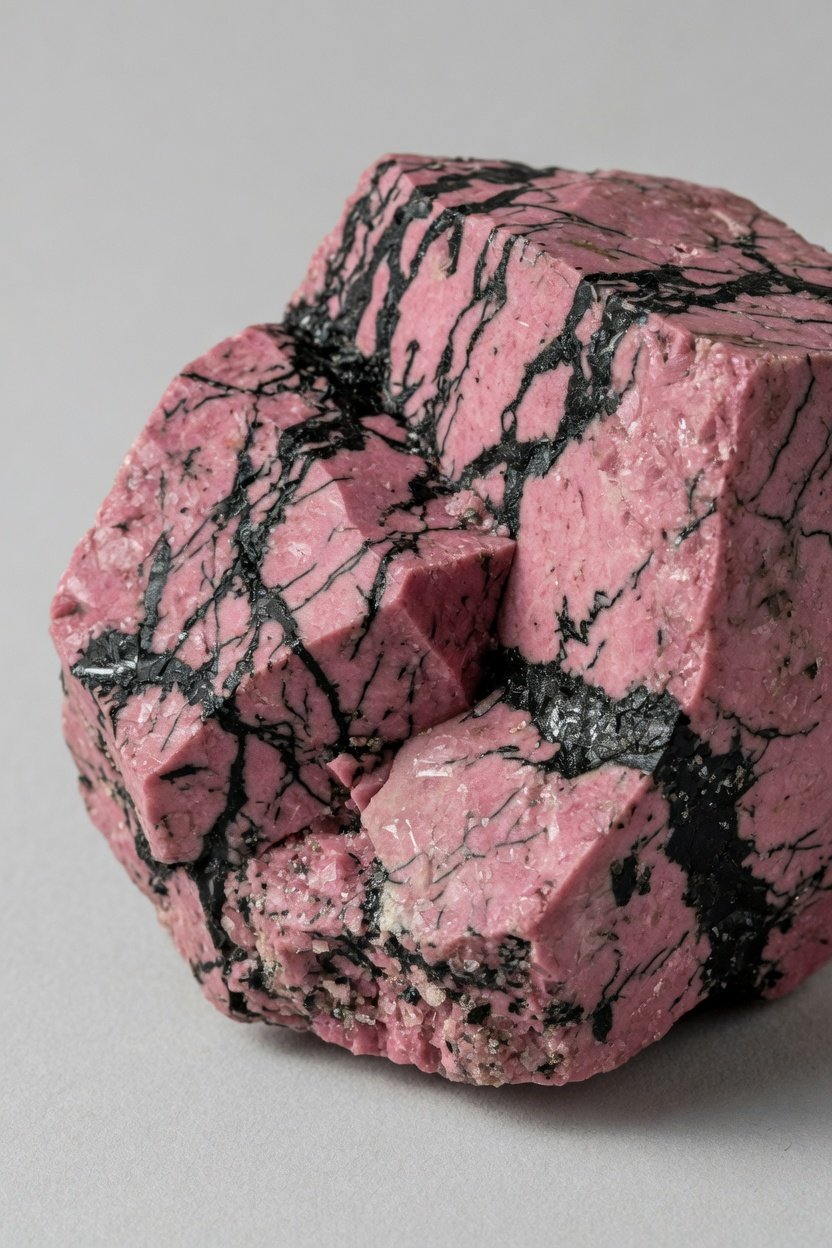
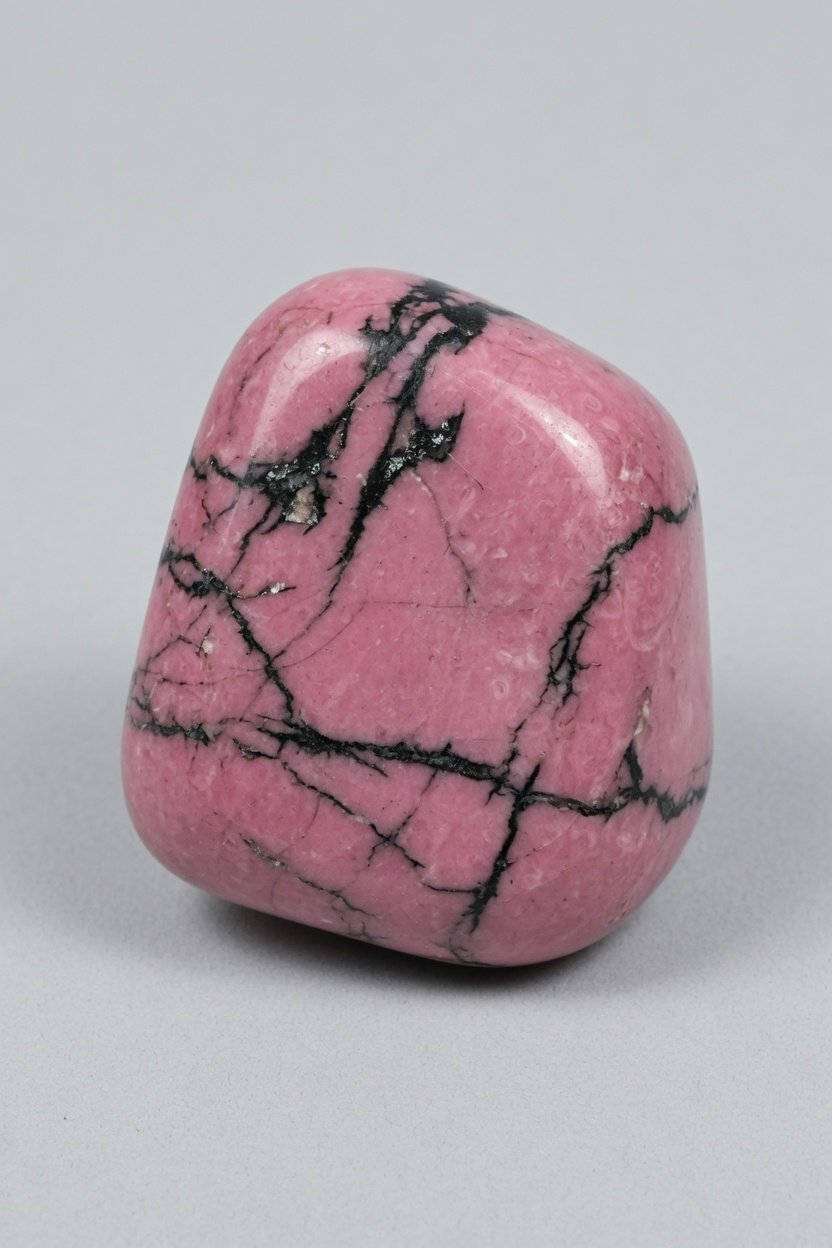
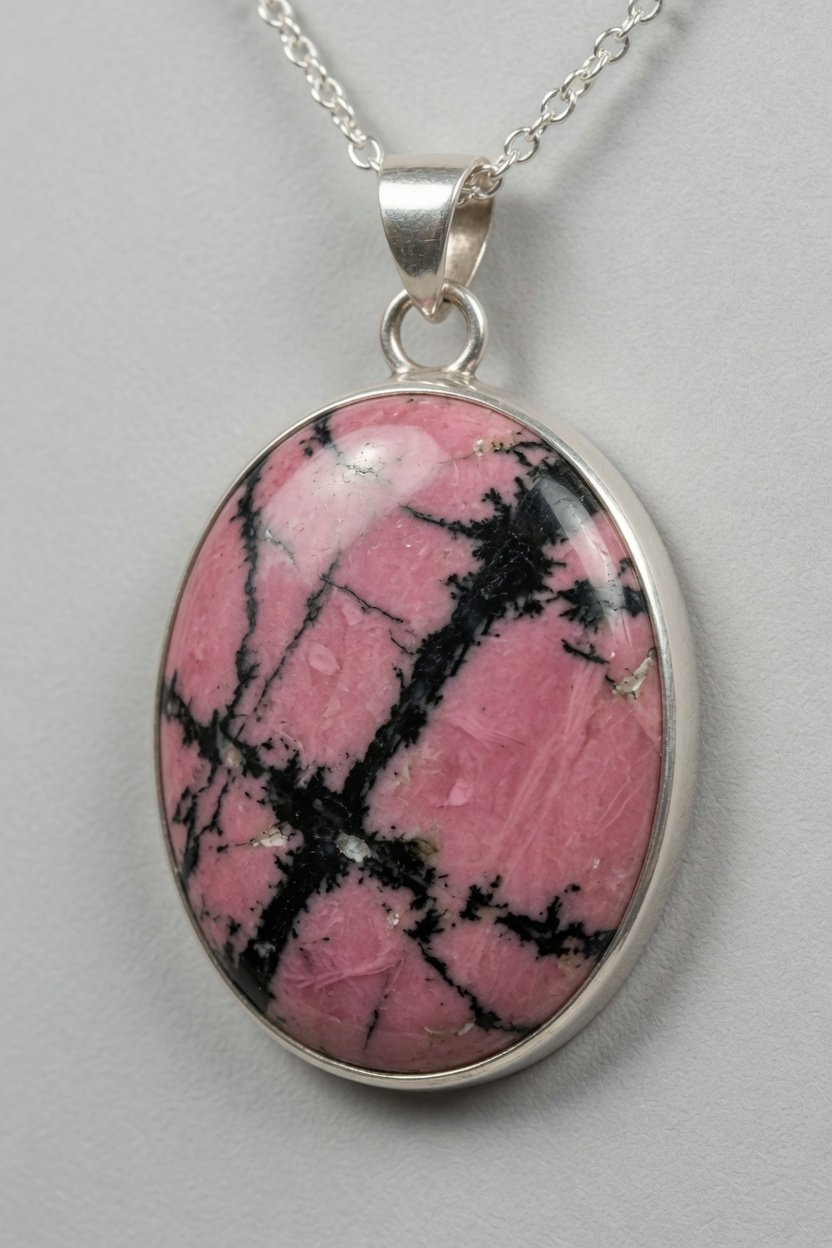
Rhodonite draws the eye with its vivid pink-to-red body laced by bold black veins, a stone that feels both tender and resolute in any silversmith’s hand. Its gentle color and grounding matrix make it a favorite for pieces meant to steady the wearer through daily life.
Physical Properties Rhodonite is a manganese inosilicate with the formula (Mn,Fe,Mg,Ca)SiO3. It registers 5.5–6.5 on the Mohs scale, hard enough for everyday jewelry yet soft enough to require care during setting. Specific gravity ranges from 3.4 to 3.7, giving cabochons a satisfying heft. The stone is almost always opaque, showing a vitreous to slightly pearly luster once polished. Because heat from soldering can fracture the manganese oxides that create its signature veining, the gem must be set only after all torch work is complete. Avoid ultrasonic cleaners and harsh chemicals; warm soapy water and a soft cloth are safest.
Origin and Sourcing Major deposits occur in Russia’s Ural Mountains, the Franklin district of New Jersey, Australia’s Broken Hill, and parts of Sweden and Brazil. Most material is recovered from hard-rock mines where narrow veins are followed underground. Miners work by headlamp, loading ore carts that carry the rough to the surface for sorting. The black veining that defines fine rhodonite forms through oxidation of manganese during the stone’s geological history, so each parcel must be examined for color saturation and pattern continuity before export.
History and Significance Rhodonite entered European lapidary circles in the early nineteenth century after Russian miners uncovered large masses in the Urals. Local artisans carved the stone into decorative objects and later into protective amulets for travelers. In the twentieth century it gained a following among silversmiths who valued its warm palette against oxidized silver. Today the stone is still associated with emotional steadiness, though its primary appeal remains visual rather than mystical.
In Jewelry and Silversmithing Cabochons are the standard cut; the black veins become graphic lines against polished silver. Bezel settings are preferred because they protect the edges and eliminate the need for prongs that could catch. After soldering is finished and the piece has cooled, the stone is gently pressed into place and the bezel burnished. Because rhodonite can fade slightly under prolonged direct sunlight, finished pieces are best stored away from strong UV sources. Its modest hardness also means it should not be worn during heavy manual labor.
Identifying Rhodonite in the Field In outcrop the stone appears as dense pink masses within metamorphic rocks, often accompanied by black manganese staining on weathered surfaces. A hardness test with a steel point leaves a faint scratch, while the black veins remain harder. The combination of saturated pink and dendritic black veining distinguishes it from rhodochrosite, which lacks the vein network and shows a lower specific gravity.
Quick Facts
Common names: Rhodonite
Chemical formula: (Mn,Fe,Mg,Ca)SiO3
Mohs hardness: 5.5–6.5
Specific gravity: 3.4–3.7
Color: Pink to red with black veins
Crystal system: Triclinic
Luster: Vitreous to pearly
Transparency: Opaque
Common cuts: Cabochon
Common treatments: None
Best silver setting: Classic Silver Bezel Pendant
Birthstone month (if any): None
Main sources: Russia, USA, Australia, Sweden
Meaning & Intentions
EMOTIONAL GROUNDING
Rhodonite is carried or worn to anchor scattered feelings and encourage calm self-awareness during stressful periods. Silversmiths set the stone in pendants that rest near the heart so the pink body and black veins remain in constant contact with the skin, reinforcing a sense of inner steadiness throughout the day.
Chakra: Heart — center of compassion and emotional balance CLEAR PERCEPTION
The stone’s contrasting matrix is said to help the wearer notice patterns in relationships and personal habits that might otherwise remain hidden. When fashioned into a pendant or ring, rhodonite is kept close so its visual structure serves as a quiet reminder to observe situations with both warmth and clarity.
Chakra: Heart — center of compassion and emotional balance PROTECTIVE BOUNDARIES
Rhodonite is used to support healthy limits without closing the heart. Artisans often choose substantial bezels that frame the stone completely, visually echoing the idea of a secure yet open boundary that the wearer can carry through daily interactions.
Chakra: Heart — center of compassion and emotional balance "Affirmation: I remain open while honoring my own steadiness." AT A GLANCE: Chakra: Heart Element: Earth Energy: Receptive Zodiac: Taurus Planet: Venus Affirmation: "I remain open while honoring my own steadiness."
Related Stones
Explore more stones from the Gemstone Library: Aventurine · Rhodochrosite · Malachite