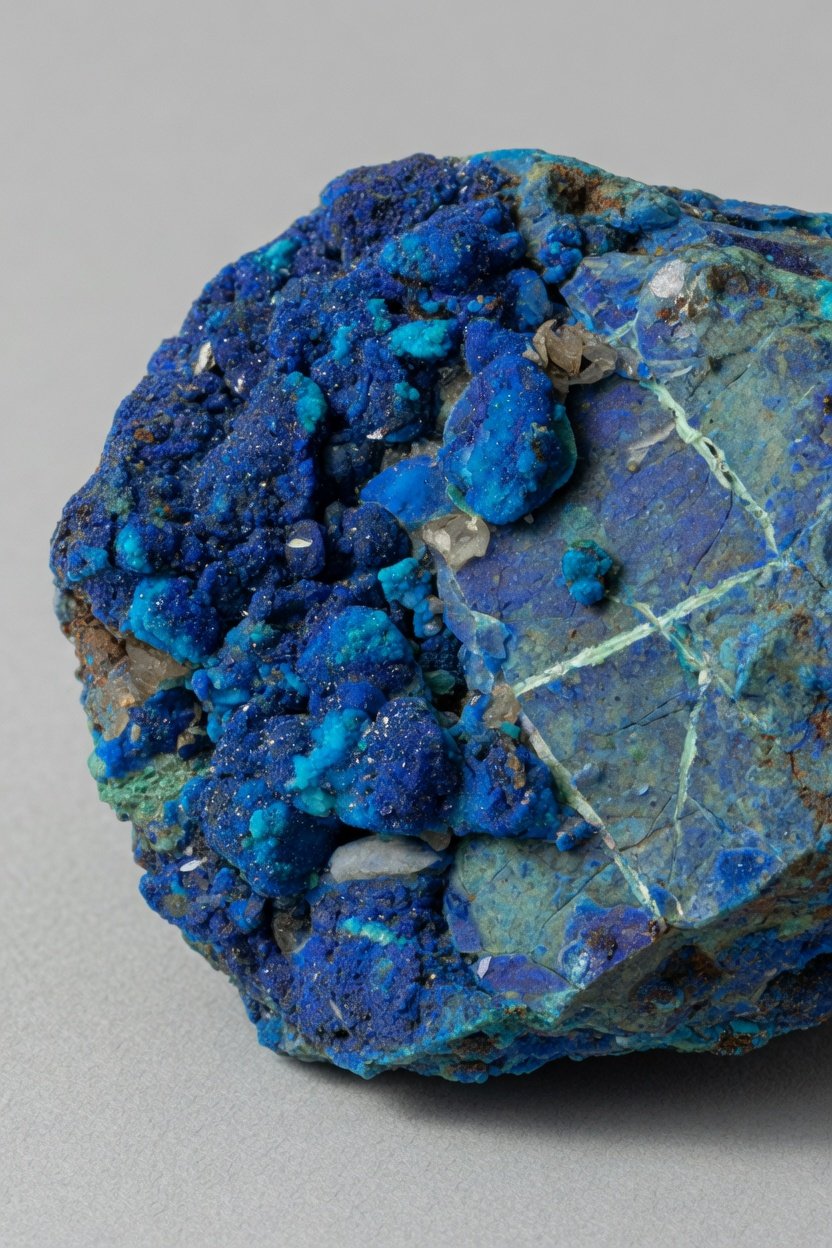
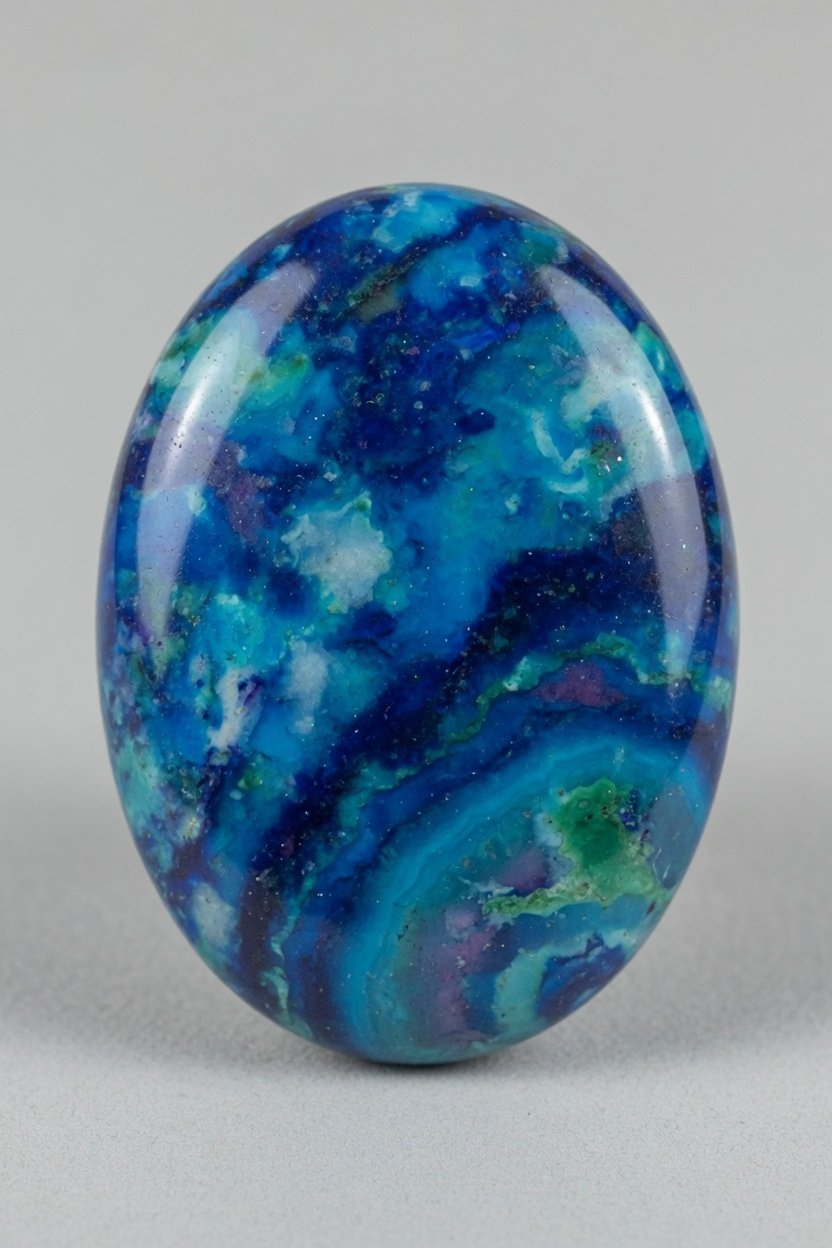
Azurite draws the eye with its intense azure depths, a copper-derived blue that shifts between velvet night and electric sky depending on the light. This mineral forms in the oxidized zones of copper deposits, where groundwater slowly transforms metal into vivid crystalline layers that often intergrow with bright green malachite. Its saturated color and tendency to appear in striking botryoidal or nodular masses have made it a favorite among collectors and artisans for centuries.
Physical Properties Azurite is a hydrated copper carbonate hydroxide with the formula Cu3(CO3)2(OH)2. It registers 3.5–4 on the Mohs scale and possesses perfect cleavage in one direction, making it brittle and prone to fracture under pressure. Specific gravity ranges from 3.77 to 3.89. The stone’s deep blue color arises from copper ions; prolonged exposure to heat or strong light can drive off water molecules and cause the surface to darken or turn green. Because of this sensitivity, the stone must always be set after all soldering and polishing steps are complete. Ultrasonic and steam cleaners are unsafe; warm soapy water and a soft brush remain the only recommended cleaning methods.
Origin and Sourcing Primary deposits occur in Morocco’s Atlas Mountains, Arizona’s copper districts, Mexico’s Sonora and Chihuahua states, and Namibia’s Tsumeb mine. Moroccan material frequently appears in large, velvety nodules with sharp color zoning, while Arizona specimens often show intergrown malachite creating a striking blue-green matrix. Miners extract azurite through hard-rock methods, following narrow veins inside adits with headlamps and ore carts. Careful hand sorting preserves the fragile crystal surfaces that give the stone its prized depth.
History and Significance Ancient Egyptians ground azurite for eye paint and pigment, while medieval European painters used it for the rich blues in illuminated manuscripts. Native American silversmiths of the Southwest incorporated the stone into ceremonial jewelry, valuing its color as a symbol of sky and water. In Victorian times, polished azurite nodules were popular curiosity pieces displayed in natural-history cabinets.
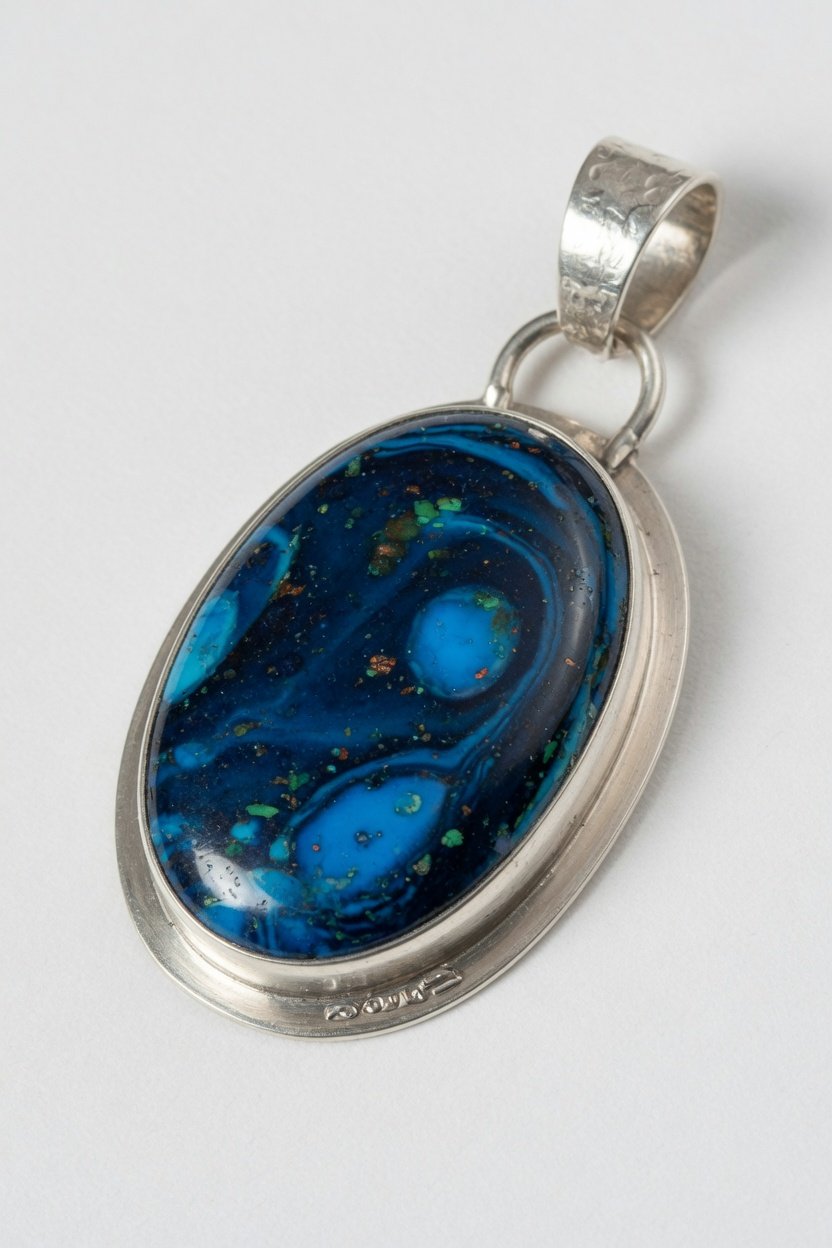
In Jewelry and Silversmithing Azurite’s softness and sensitivity dictate protective settings. Classic Silver Bezel Pendant mountings fully surround the stone, shielding edges from impact while allowing light to play across the polished surface. Because the mineral contains water of hydration, all heat work must finish before the stone is introduced. Once set, the piece should avoid sudden temperature changes that could cause internal cracking along cleavage planes.
Identifying Azurite in the Field In outcrops, azurite appears as deep azure-blue nodules or crusts, often coated with lighter blue powder or accompanied by green malachite. A streak test yields a pale blue mark, and dilute hydrochloric acid produces effervescence. Hardness below a copper penny helps separate it from darker blue minerals such as lazurite. Collectors should note that intense sunlight can fade exposed surfaces over time, so specimens are best stored away from direct light.
Quick Facts
Common names: Azurite, Chessylite
Chemical formula: Cu3(CO3)2(OH)2
Mohs hardness: 3.5–4
Specific gravity: 3.77–3.89
Color: Deep azure blue, often with green malachite
Crystal system: Monoclinic
Luster: Vitreous to dull
Transparency: Opaque to translucent
Common cuts: Cabochons, beads, freeforms
Common treatments: Resin stabilization
Best silver setting: Classic Silver Bezel Pendant
Birthstone month (if any): None
Main sources: Morocco, USA (Arizona), Mexico, Namibia
Meaning & Intentions
INSIGHT
Azurite sharpens inner vision and helps surface buried truths during quiet reflection or creative problem-solving. Silversmiths often set the stone in pendants worn close to the heart so the wearer can carry that clarity throughout the day. The deep blue color is believed to quiet mental static, allowing intuitive signals to rise more clearly.
Chakra: Third Eye — seat of intuition and inner sight CLARITY
When placed on a workspace or worn during design sessions, azurite is said to cut through confusion and reveal the next right step in a project. Its copper-rich chemistry is traditionally linked to focused communication, helping artisans articulate ideas that previously felt tangled.
Chakra: Throat — center of clear expression PROTECTION
Azurite is used as a subtle energetic shield that absorbs scattered influences before they reach the wearer. In jewelry, a low bezel setting keeps the stone secure while maintaining its role as a quiet guardian during travel or demanding social situations.
Chakra: Third Eye — seat of intuition and inner sight Affirmation: "I see clearly and speak my truth with calm confidence." AT A GLANCE: Chakra: Third Eye Element: Water Energy: Receptive Zodiac: Sagittarius Planet: Venus Affirmation: "I see clearly and speak my truth with calm confidence."
Related Stones
Explore more stones from the Gemstone Library: Rhodochrosite · Sodalite · Aventurine