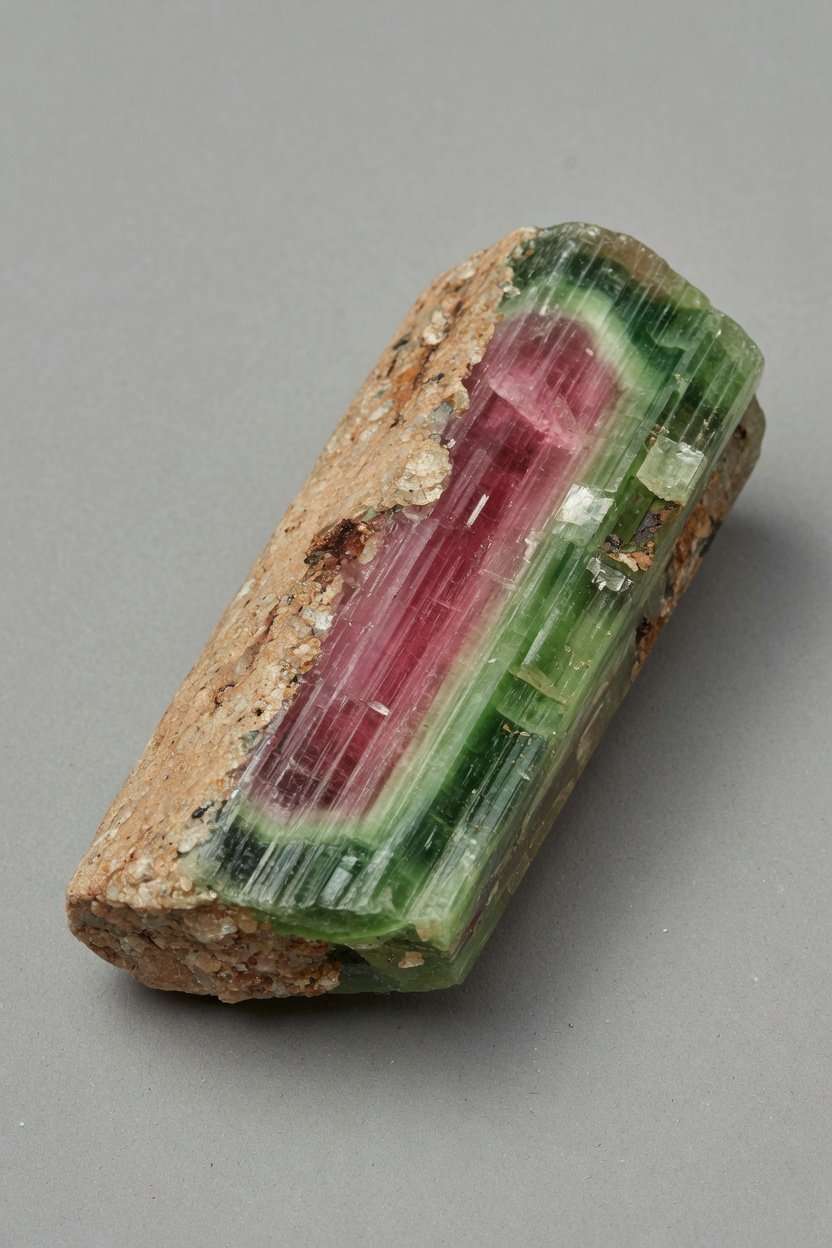
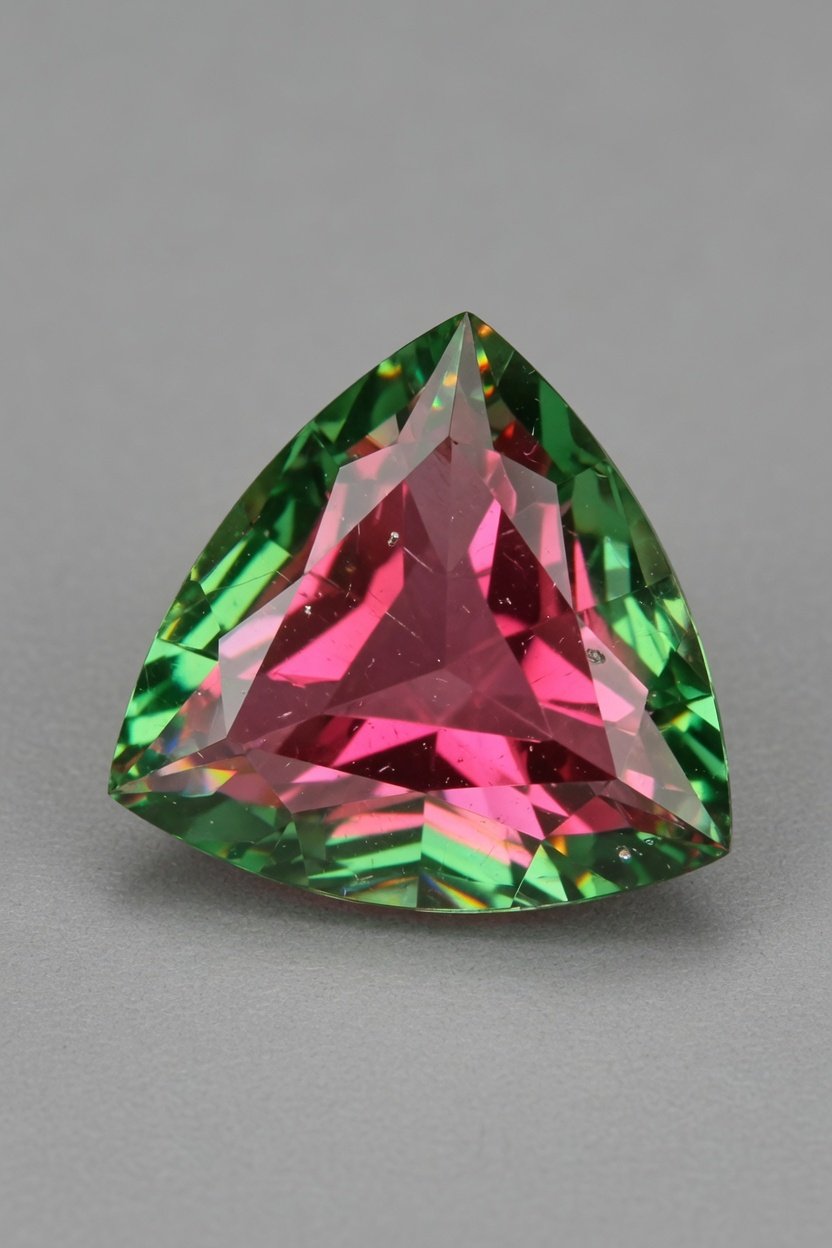
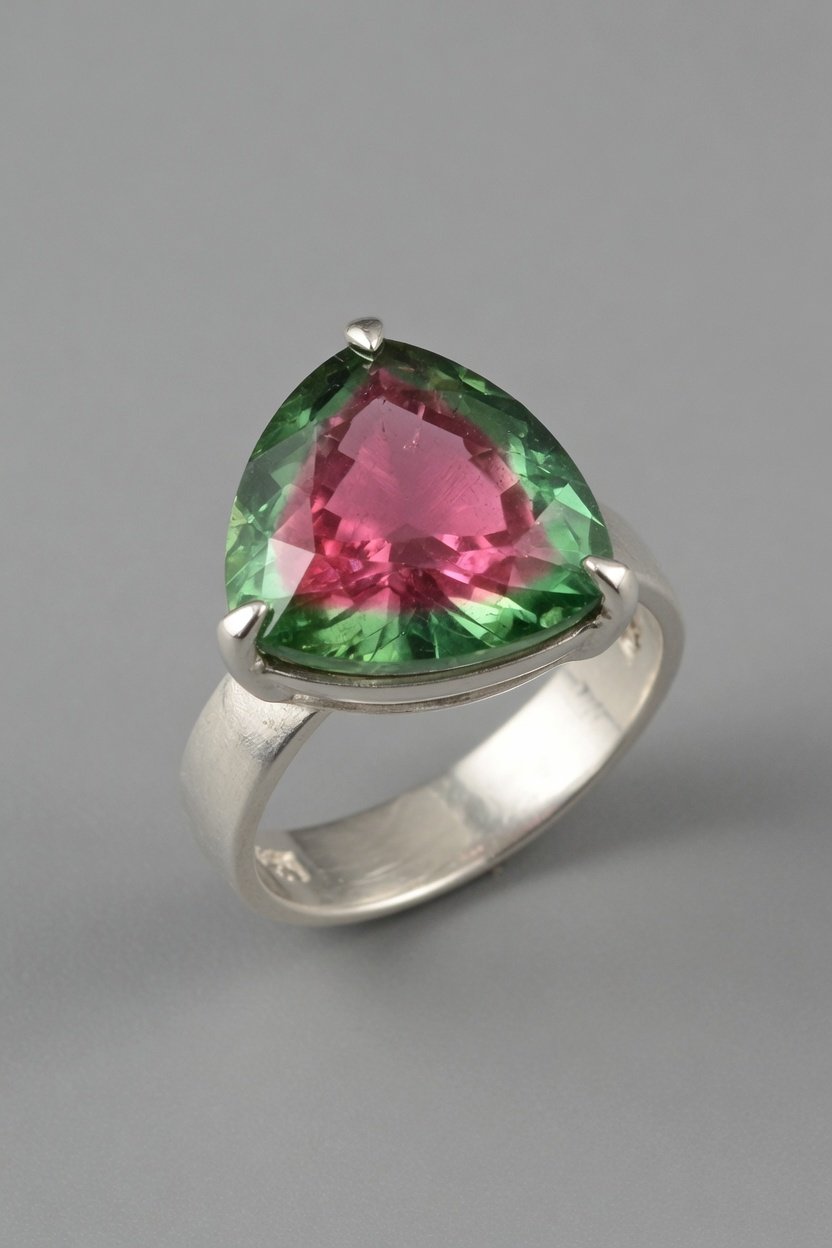
Watermelon Tourmaline captivates with its striking internal color zoning that mimics a freshly cut fruit, drawing gem enthusiasts and silversmiths alike into its layered world of pink cores wrapped in green rims. This natural phenomenon arises from changing chemical conditions during crystal growth, producing stones that seem almost engineered for jewelry. Its vivid contrast and vitreous luster make it a favorite for pieces that celebrate both nature's precision and the silversmith's craft.
Physical Properties Watermelon Tourmaline belongs to the elbaite species of the tourmaline group, with the chemical formula Na(Li,Al)3Al6(BO3)3Si6O18(OH)4. It registers 7 to 7.5 on the Mohs scale, offering good durability for daily wear while remaining workable for faceting. Specific gravity sits between 3.0 and 3.2, and its trigonal crystal system produces long prismatic forms that yield elongated gems. The stone exhibits strong pleochroism, shifting from pink to green depending on viewing angle, and displays a bright vitreous luster with excellent transparency in fine specimens. Always set the stone after all soldering is complete to avoid thermal shock along its cleavage planes; store away from ultrasonic cleaners and sudden temperature changes that could induce fractures.
Origin and Sourcing Primary deposits occur in Brazil's Minas Gerais region, Afghanistan's Nuristan province, and select pegmatites in Nigeria and Maine. These localities formed in lithium-rich granitic pegmatites where boron-rich fluids allowed slow crystallization over millions of years. Miners extract the crystals through hard-rock tunneling, following narrow veins that can pinch out abruptly. Responsible sourcing emphasizes traceable lots from these areas, as color zoning quality varies sharply even within a single pocket.
History and Significance Tourmaline was first recognized as a distinct species in the eighteenth century, though watermelon varieties gained notice only in the late nineteenth century when Brazilian specimens reached European cutters. Indigenous peoples in Brazil had long collected the colorful crystals for adornment and trade. The stone later became associated with emotional balance in metaphysical traditions, its pink and green zones interpreted as symbols of compassion framed by growth.
In Jewelry and Silversmithing Silversmiths prize Watermelon Tourmaline for its ability to catch light through precise faceting that highlights the concentric color bands. Contemporary prong settings allow maximum light return while protecting the girdle. The stone's moderate toughness suits rings, pendants, and earrings when mounted in sterling silver. Always set the stone after all soldering is complete; its cleavage can propagate under prolonged heat. Avoid prolonged exposure to strong acids or mechanical shock during wear.
Identifying Watermelon Tourmaline in the Field In rough form the stone appears as elongated prisms with a dull outer coating that conceals the vivid interior. A clean transverse slice or careful window reveals the diagnostic pink center grading sharply into a green rind. Natural specimens often show triangular cross-sections and striations parallel to the c-axis. Field identification relies on hardness testing against quartz and observation of the distinctive color transition rather than uniform hue.
Quick Facts
Common names: Watermelon Tourmaline, Bi-color Tourmaline
Chemical formula: Na(Li,Al)3Al6(BO3)3Si6O18(OH)4
Mohs hardness: 7-7.5
Specific gravity: 3.0-3.2
Color: Pink core with green rim, sharp zoning
Crystal system: Trigonal
Luster: Vitreous
Transparency: Transparent to translucent
Common cuts: Faceted oval, emerald, trillion
Common treatments: None typical; occasional clarity enhancement
Best silver setting: Contemporary Prong Ring
Birthstone month (if any): None
Main sources: Brazil, Afghanistan, Nigeria
Meaning & Intentions
EMOTIONAL BALANCE
Watermelon Tourmaline supports emotional equilibrium by anchoring the heart in both compassion and growth. Wearers place the stone near the chest during meditation or set it in a pendant that rests against the skin, allowing the pink and green zones to remind the user of inner harmony. The concentric colors mirror the process of nurturing the self while extending outward.
Chakra: Heart — compassion and renewal CLARITY OF VISION
The stone sharpens perception by blending receptive pink energy with protective green boundaries. Practitioners keep a faceted piece on a desk or incorporate it into a brooch worn during decision-making tasks, using the visual transition as a focal point for balanced insight.
Chakra: Third Eye — perception and intuition PERSONAL BOUNDARIES
Watermelon Tourmaline reinforces healthy limits without closing off connection. Users carry a small polished stone or wear it in a ring that touches the hand, invoking the outer green layer as a symbol of protective strength around an open core.
Chakra: Root — grounding and security Affirmation: "I hold space for both tenderness and strength." AT A GLANCE: Chakra: Heart Element: Water Energy: Receptive Zodiac: Libra Planet: Venus Affirmation: "I hold space for both tenderness and strength."
Related Stones
Explore more stones from the Gemstone Library: Chrysoprase · Morganite · Emerald