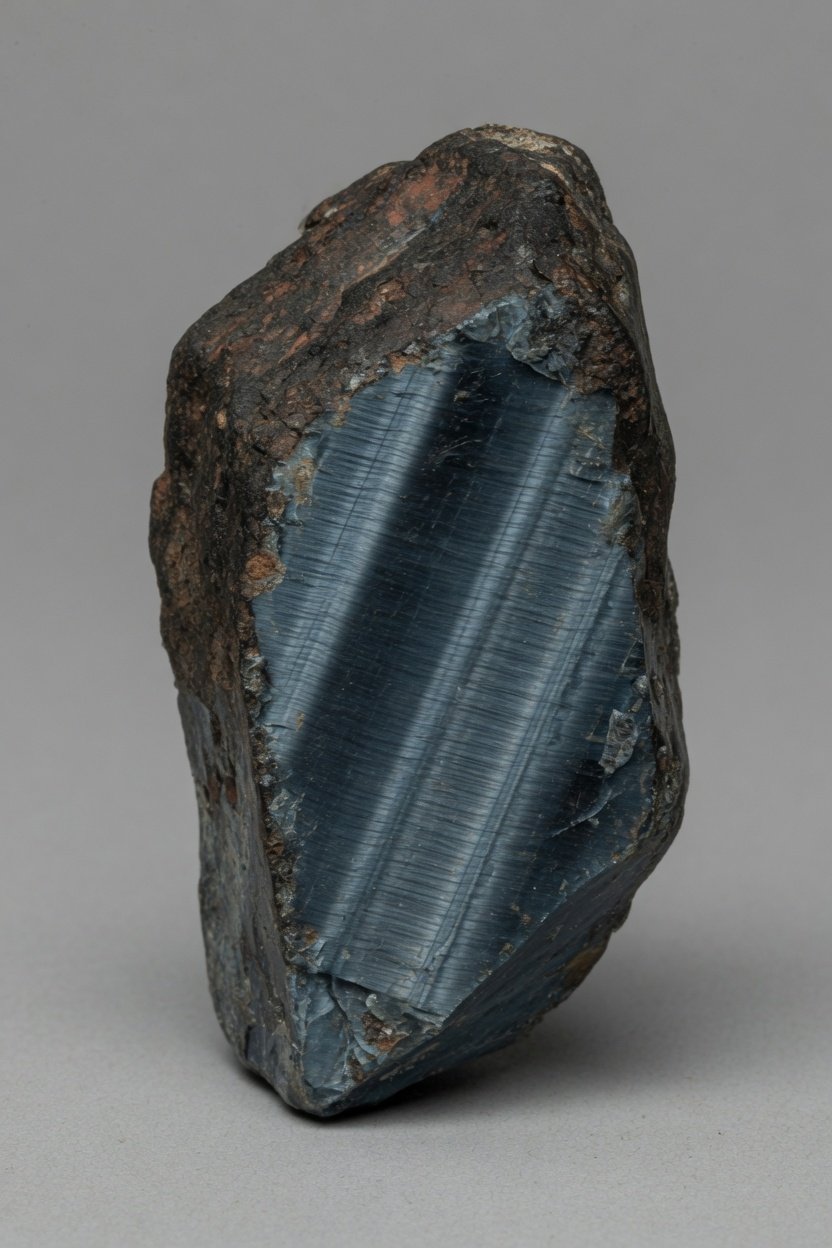
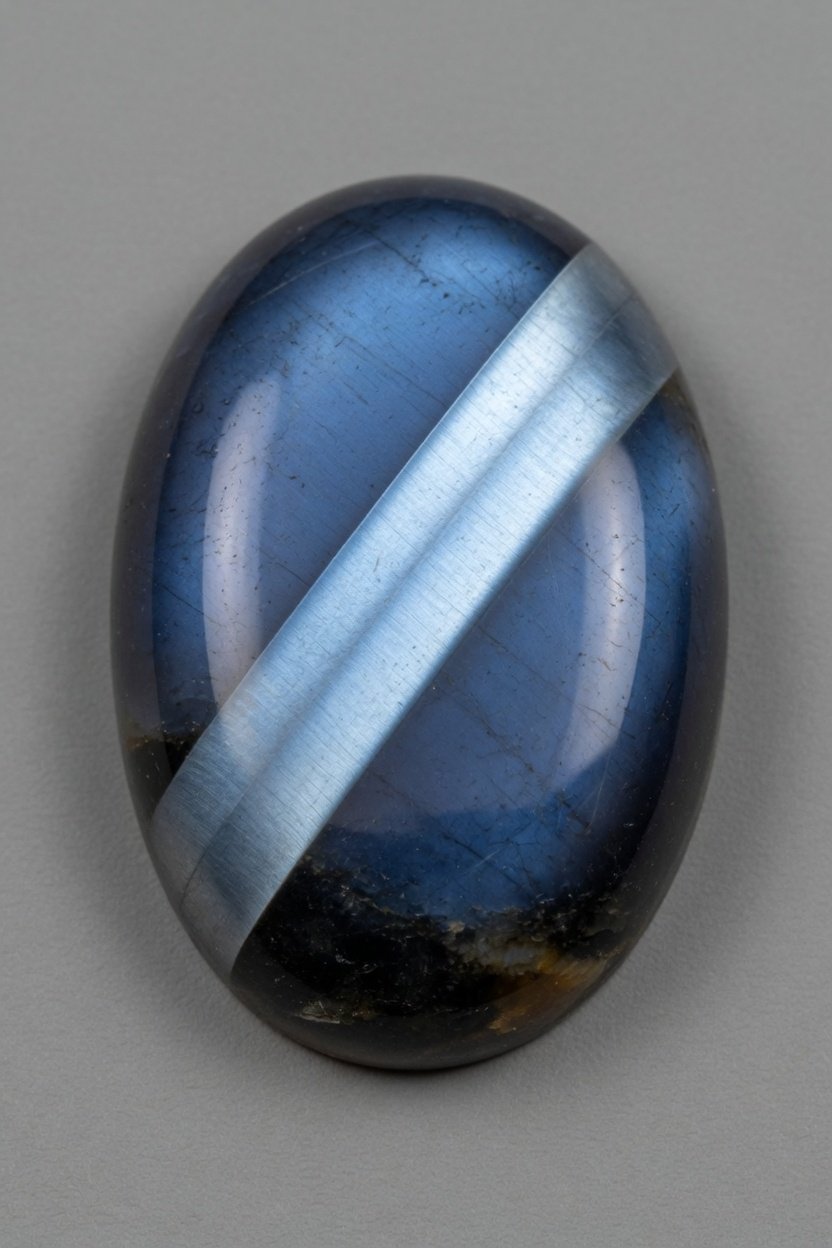
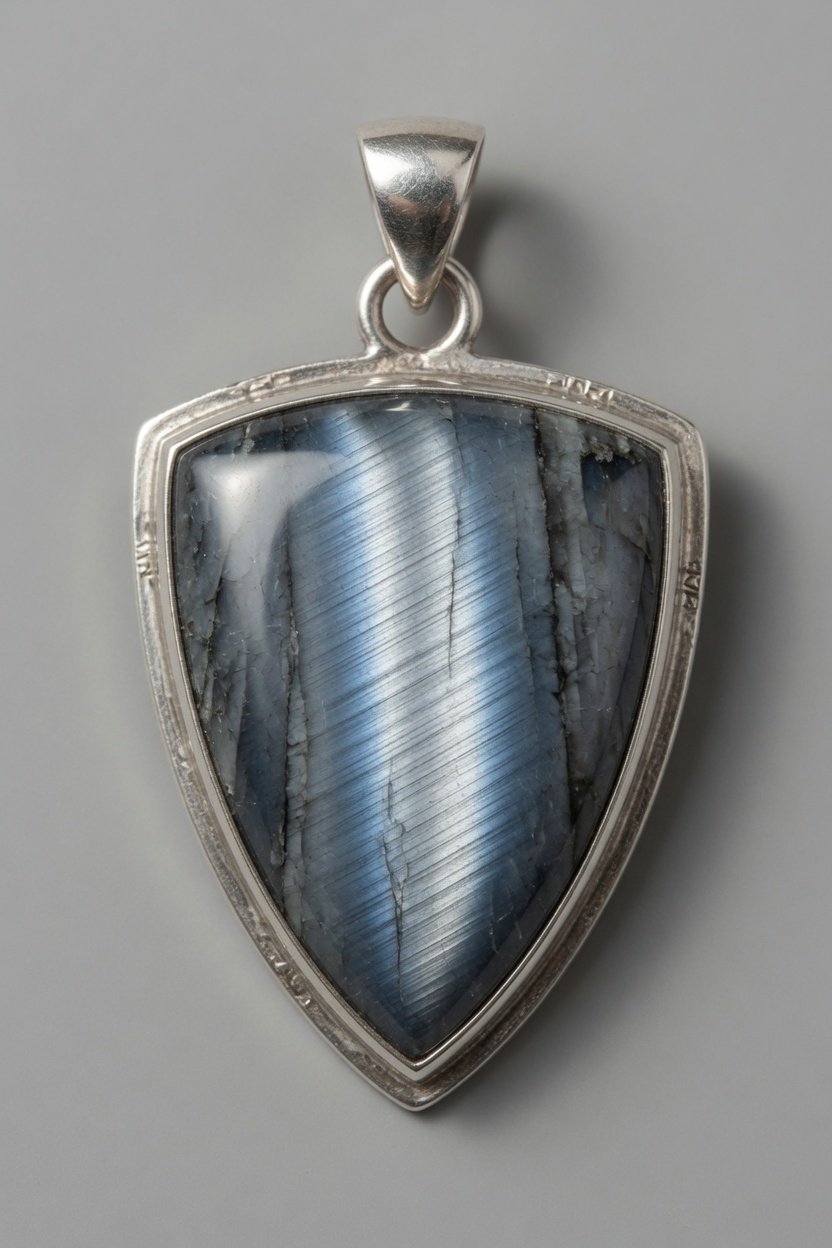
Hawk's Eye draws the eye with its cool, steel-blue chatoyancy that shifts like distant storm light across a hawk's wing. Formed deep in ancient metamorphic rock, this quartz variety captures light in parallel bands that glide across its surface when turned, revealing a depth that feels almost alive under the hand. Silversmiths prize it for the way its quiet luster complements sterling silver without competing for attention.
Physical Properties Hawk's Eye is a pseudomorph of quartz after crocidolite asbestos, resulting in a fibrous structure that produces its signature chatoyancy. On the Mohs scale it registers 7, making it durable for everyday wear yet requiring care to preserve the polish that brings out its silky bands. Specific gravity hovers near 2.64–2.71. The stone shows a vitreous to silky luster and ranges from translucent to opaque, with the finest material displaying sharp, straight blue-gray lines against a darker matrix. Because heat can cloud the fibrous texture, the stone is always set after all soldering is complete. Avoid prolonged ultrasonic cleaning and harsh chemicals that may etch the surface over time.
Origin and Sourcing The primary commercial source remains the Northern Cape of South Africa, where iron-rich bands of altered asbestos were transformed over millions of years into quartz. Smaller deposits occur in India and Western Australia, but South African material supplies most cabochons used in contemporary silversmithing. Miners extract the stone from hard-rock veins, sorting rough by the straightness and intensity of its blue chatoyancy before export.
History and Significance Indigenous San communities in southern Africa recognized the stone's reflective quality long before European traders arrived. In the nineteenth century it entered European lapidary circles alongside tiger's eye, valued for mourning jewelry because its somber blue tones suited the period's somber palette. Today it symbolizes focused perception and quiet strength, qualities that resonate with makers who seek stones that reward close inspection rather than flashy display.
In Jewelry and Silversmithing Hawk's Eye is almost always cut as a cabochon to maximize its chatoyant band. Silversmiths typically choose low, smooth bezels that let the dome rise just above the metal, protecting the edges while allowing light to travel across the surface. Because the fibrous structure can fracture under prolonged torch heat, the stone is always set after all soldering is complete. A light coat of renaissance wax helps maintain the polish; ultrasonic cleaners are avoided.
Identifying Hawk's Eye in the Field In rough form the stone appears as dark, fibrous masses with a faint blue sheen when wet. Broken surfaces show straight, parallel fibers rather than the wavy patterns of tiger's eye. A quick scratch test confirms quartz hardness, while the absence of brown oxidation distinguishes it from its golden cousin. When polished, the chatoyant band remains straight and narrow, moving sharply across the dome rather than broadening like lower-grade material.
Quick Facts
Common names: Hawk's Eye, Falcon's Eye, Blue Tiger's Eye
Chemical formula: SiO₂
Mohs hardness: 7
Specific gravity: 2.64–2.71
Color: Steel-blue to blue-gray with chatoyant bands
Crystal system: Trigonal
Luster: Vitreous to silky
Transparency: Translucent to opaque
Common cuts: Cabochon
Common treatments: None (occasional waxing)
Best silver setting: Low bezel
Birthstone month (if any): None
Main sources: South Africa, India, Australia
Meaning & Intentions
FOCUSED VISION
Hawk's Eye is carried or worn when steady concentration is required. Its straight chatoyant bands act as a visual anchor, helping the user filter distractions and maintain clear sight on a single goal. Silversmiths set the stone in a simple shield-shaped pendant so the band runs vertically, mirroring the intention of directed attention.
Chakra: Third Eye — supports clear perception and mental clarity PERCEPTIVE AWARENESS
The stone's shifting light encourages mindful observation of subtle cues in conversation and environment. Wearers report that gazing into the moving band quiets mental chatter and heightens present-moment awareness during creative or strategic work.
Chakra: Third Eye — heightens intuitive observation STEADY GROUNDING
Hawk's Eye's dense quartz body and cool tones provide a sense of calm stability when decisions feel overwhelming. Set in a cuff or ring, the stone becomes a tactile reminder to remain centered and patient.
Chakra: Root — fosters calm endurance Affirmation: "I see clearly and remain steady." AT A GLANCE: Chakra: Third Eye Element: Earth Energy: Receptive Zodiac: Sagittarius Planet: Saturn Affirmation: "I see clearly and remain steady."
Related Stones
Explore more stones from the Gemstone Library: Sillimanite · Zircon · Cat's Eye Moonstone