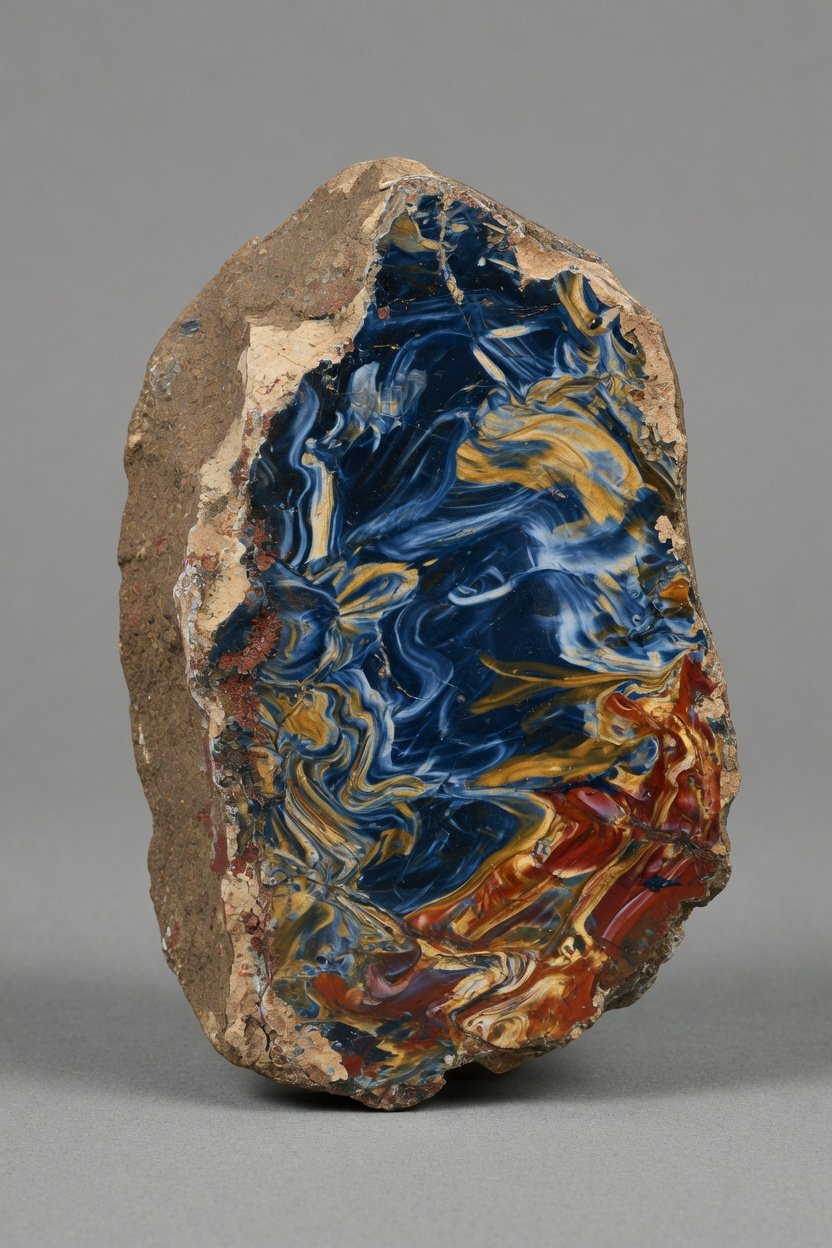
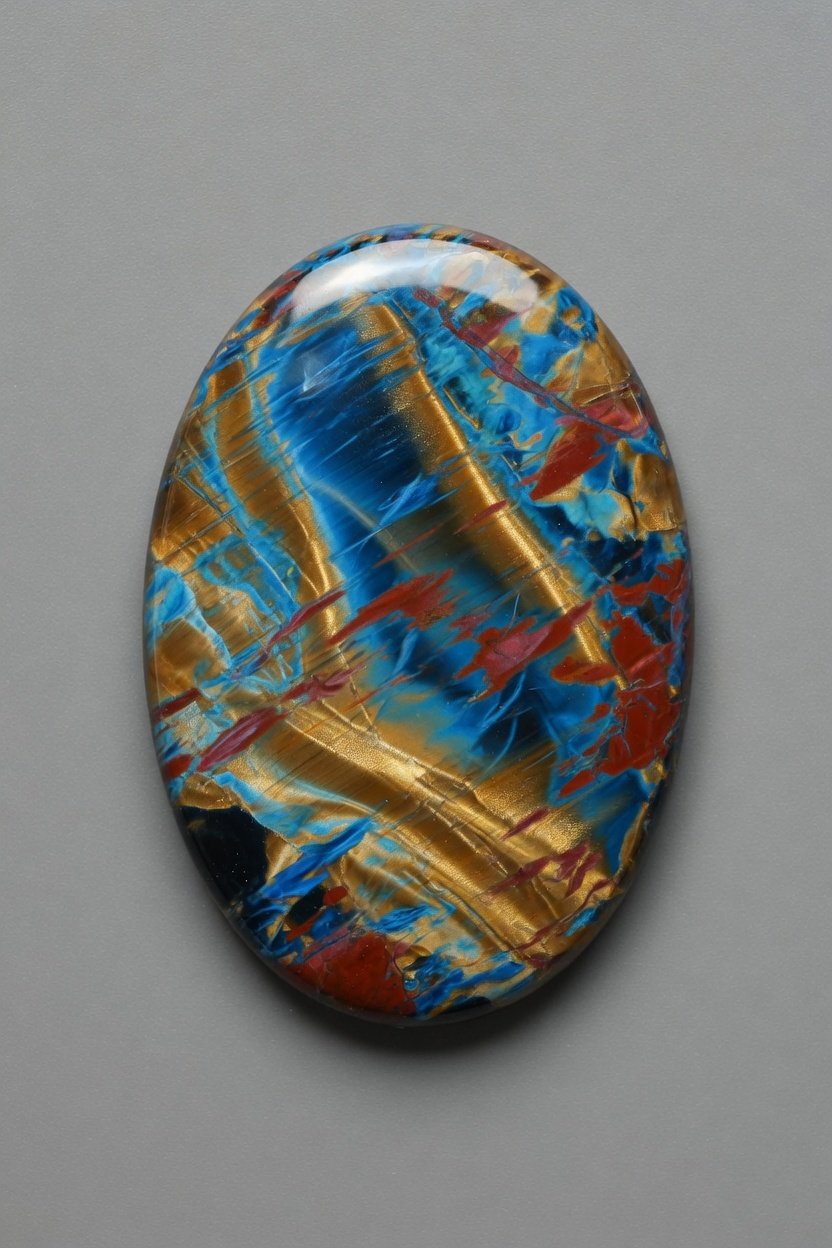
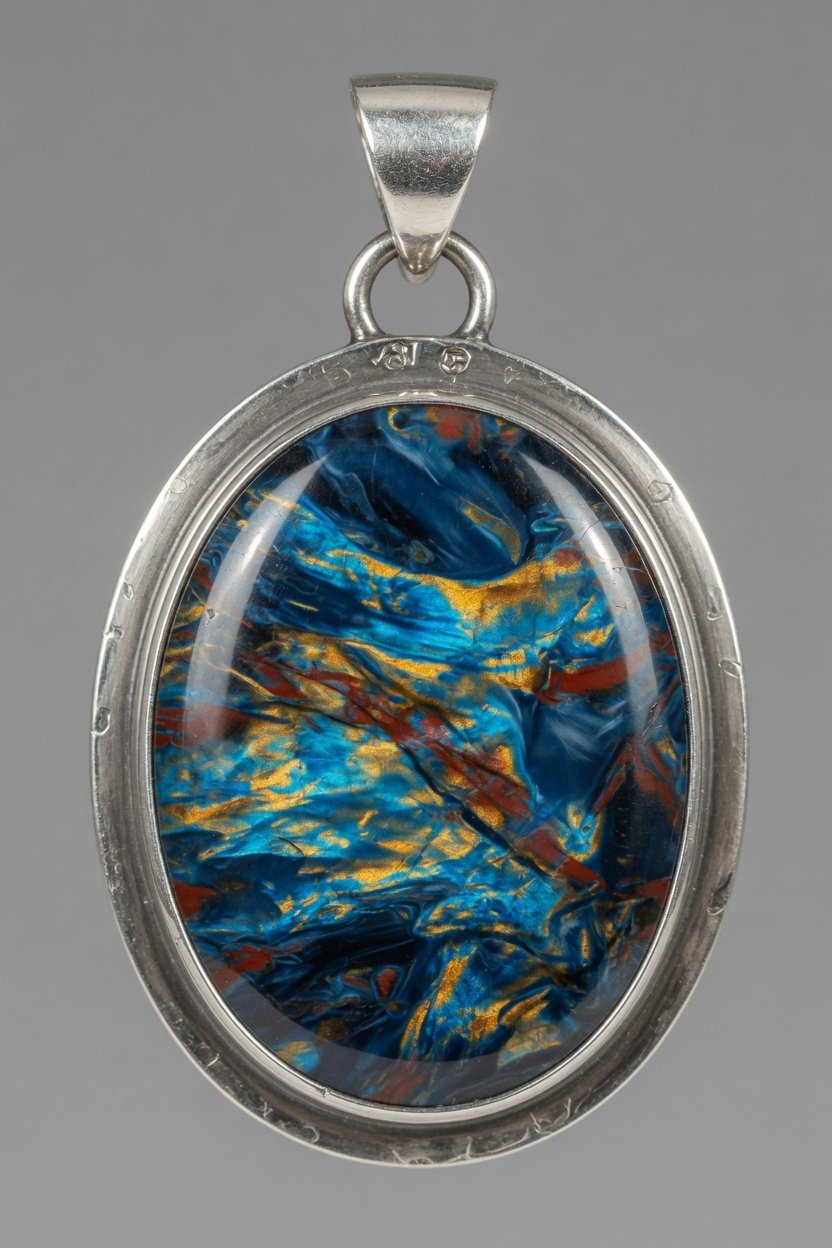
Pietersite erupts from the earth with dramatic swirls of stormy blue, molten gold, and deep russet that seem to capture lightning in stone. This rare chalcedony aggregate forms when quartz replaces fibrous amphibole minerals, creating the signature chatoyant streaks that shift under light like wind-driven clouds across a savanna sky. Silversmiths prize the material for its bold visual energy and the way it rewards careful orientation during cutting.
Physical Properties Pietersite registers 6.5–7 on the Mohs scale, giving it respectable durability for everyday wear yet requiring thoughtful protection in jewelry. Its specific gravity hovers between 2.50 and 2.65, and the stone remains fully opaque with a vitreous-to-silky luster produced by the parallel amphibole fibers. Because the material contains no water of crystallization that would make it heat-sensitive, it tolerates standard bench procedures; however, the stone must always be set after all soldering is complete so that prolonged flame exposure cannot dull its polish or cause micro-fractures along the fibrous zones. Care cautions include avoiding ultrasonic cleaners, which can exploit any internal cleavages, and storing pieces separately to prevent abrasion from harder gems.
Origin and Sourcing Commercial quantities of pietersite come primarily from the Otjozondjupa Region of Namibia and from Hunan Province in China. Namibian material typically shows stronger blue and gold zones, while Chinese specimens often display deeper reds and browns. Both deposits formed through hydrothermal replacement of Precambrian sedimentary sequences, and miners extract the stone from narrow veins using hand tools and light explosives rather than large-scale open-pit methods.
History and Significance Discovered in 1962 by Sid Pieters in Namibia, the stone received its name shortly afterward and quickly gained a following among collectors. Although it lacks ancient lore, pietersite has been adopted by modern lapidary communities as a symbol of inner transformation, its turbulent patterns mirroring the unpredictable forces that shape both landscape and personal growth.
In Jewelry and Silversmithing In silversmithing, pietersite performs best in low-profile bezel settings that shield the vulnerable edges while allowing the full face to display its chatoyancy. The fibrous structure can produce a lively “cat’s-eye” band when the cabochon is oriented correctly, so cutters examine each rough piece under directional light before committing to a shape. Once set, the stone should be polished only with non-abrasive compounds to preserve the silky luster that distinguishes fine specimens.
Identifying Pietersite in the Field In the field, pietersite is recognized by its opaque body and bold, swirling bands of blue, gold, and red that lack the straight parallel lines of tiger’s eye. Broken surfaces reveal a fibrous texture, and the material feels slightly cooler than jasper of similar color. Testing with a loupe shows no crystalline sparkle, only the soft, directional sheen of aligned amphibole fibers.
Quick Facts
Common names: Pietersite, Tempest Stone
Chemical formula: SiO₂ with amphibole inclusions
Mohs hardness: 6.5–7
Specific gravity: 2.50–2.65
Color: Blue, gold, red, brown swirling patterns
Crystal system: Trigonal (aggregate)
Luster: Vitreous to silky
Transparency: Opaque
Common cuts: Cabochon
Common treatments: None
Best silver setting: Bezel
Birthstone month (if any): None
Main sources: Namibia, China
Meaning & Intentions
PROTECTION
Pietersite’s swirling patterns are said to create an energetic buffer that absorbs scattered influences before they reach the wearer. Silversmiths set the stone in substantial bezels so the silver rim reinforces this shielding quality, turning the cabochon into a wearable boundary that remains effective through daily handling.
Chakra: Root — grounding and stability INSIGHT
The stone’s shifting colors are believed to encourage clear perception during periods of change. When cut as a cabochon and worn near the throat or brow, pietersite is thought to help the wearer notice patterns in events that might otherwise remain hidden.
Chakra: Third Eye — intuition and vision STABILITY
Its dense fibrous structure is associated with anchoring scattered energies into coherent form. In jewelry, a low bezel that fully surrounds the stone’s perimeter is said to amplify this steadying effect, offering a tangible reminder of resilience during uncertain times.
Chakra: Solar Plexus — confidence and will Affirmation: "I stand steady amid every storm." AT A GLANCE: Chakra: Root, Third Eye, Solar Plexus Element: Storm Energy: Protective, clarifying, anchoring Zodiac: Leo, Sagittarius Planet: Uranus Affirmation: "I stand steady amid every storm."
Related Stones
Explore more stones from the Gemstone Library: Prehnite · Spectrolite (Finnish Labradorite) · Cat's Eye Chrysoberyl (Cymophane)