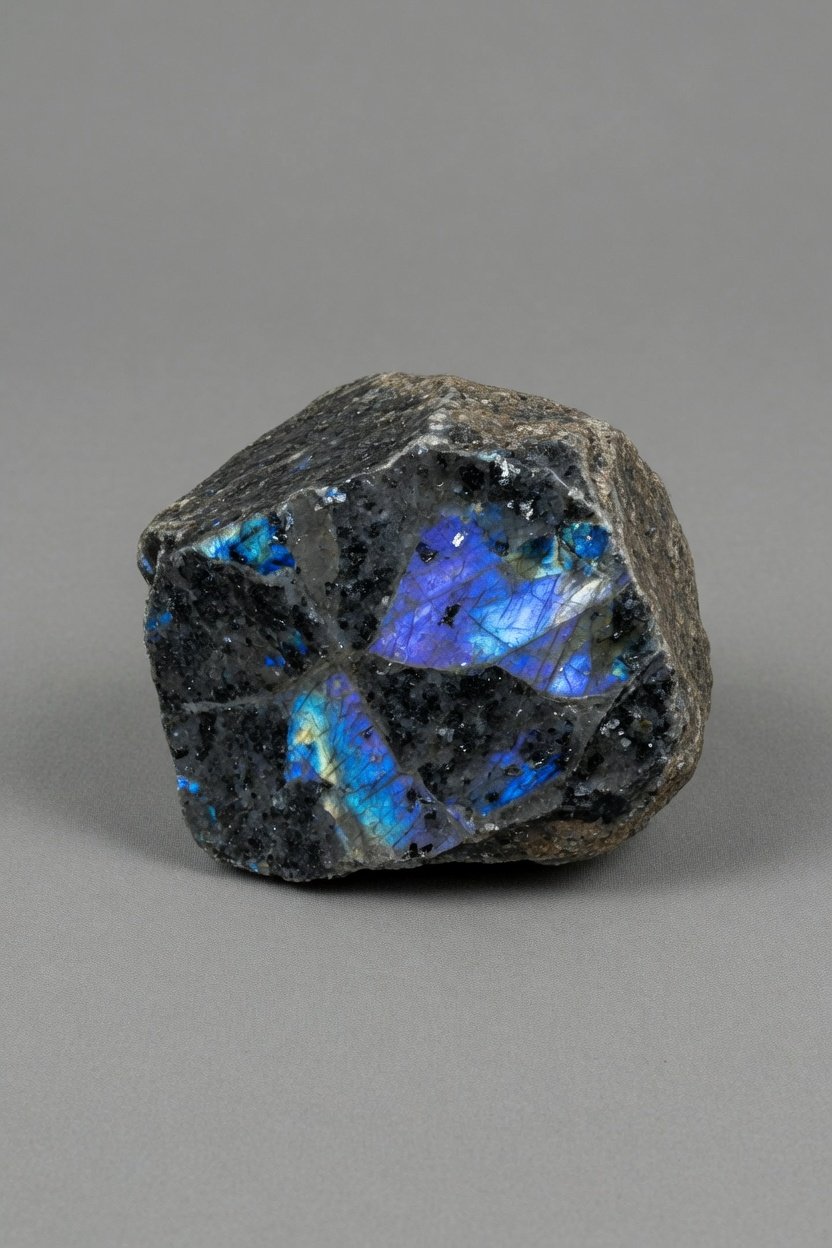
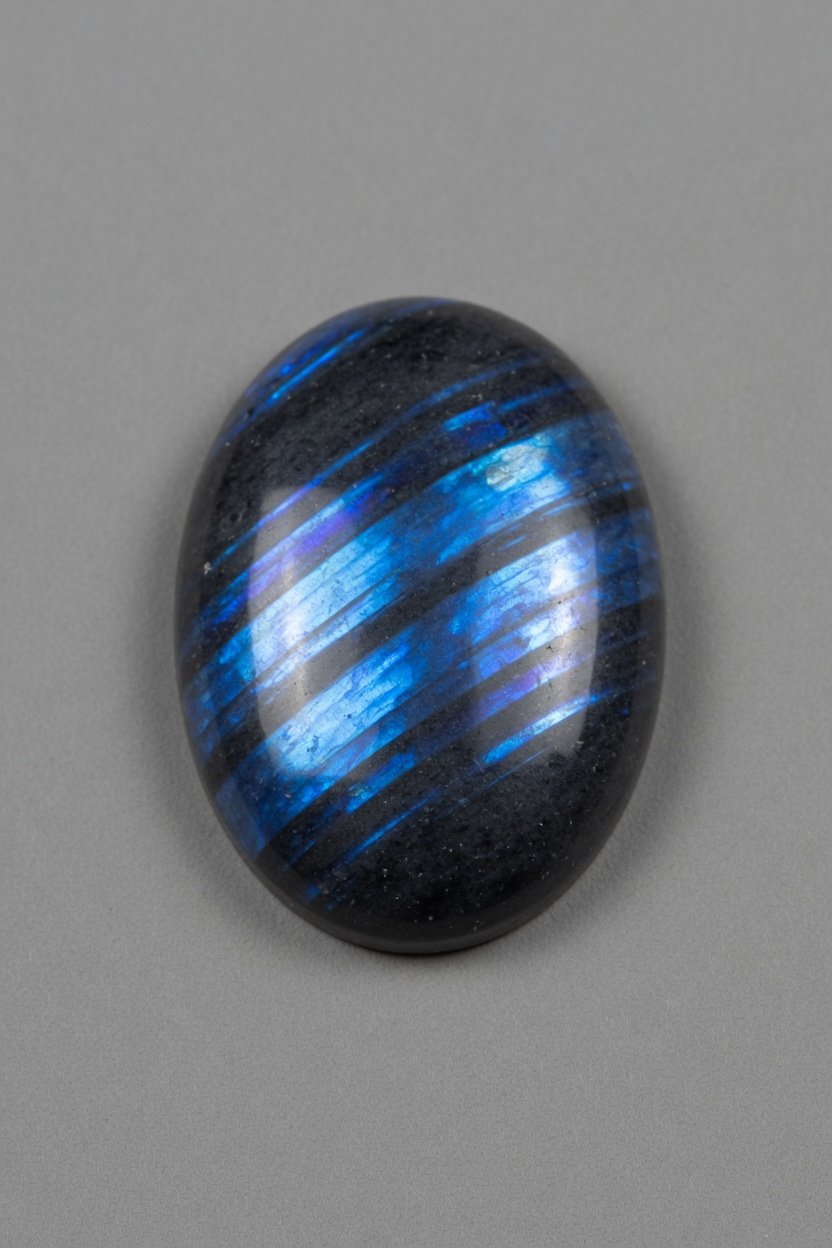
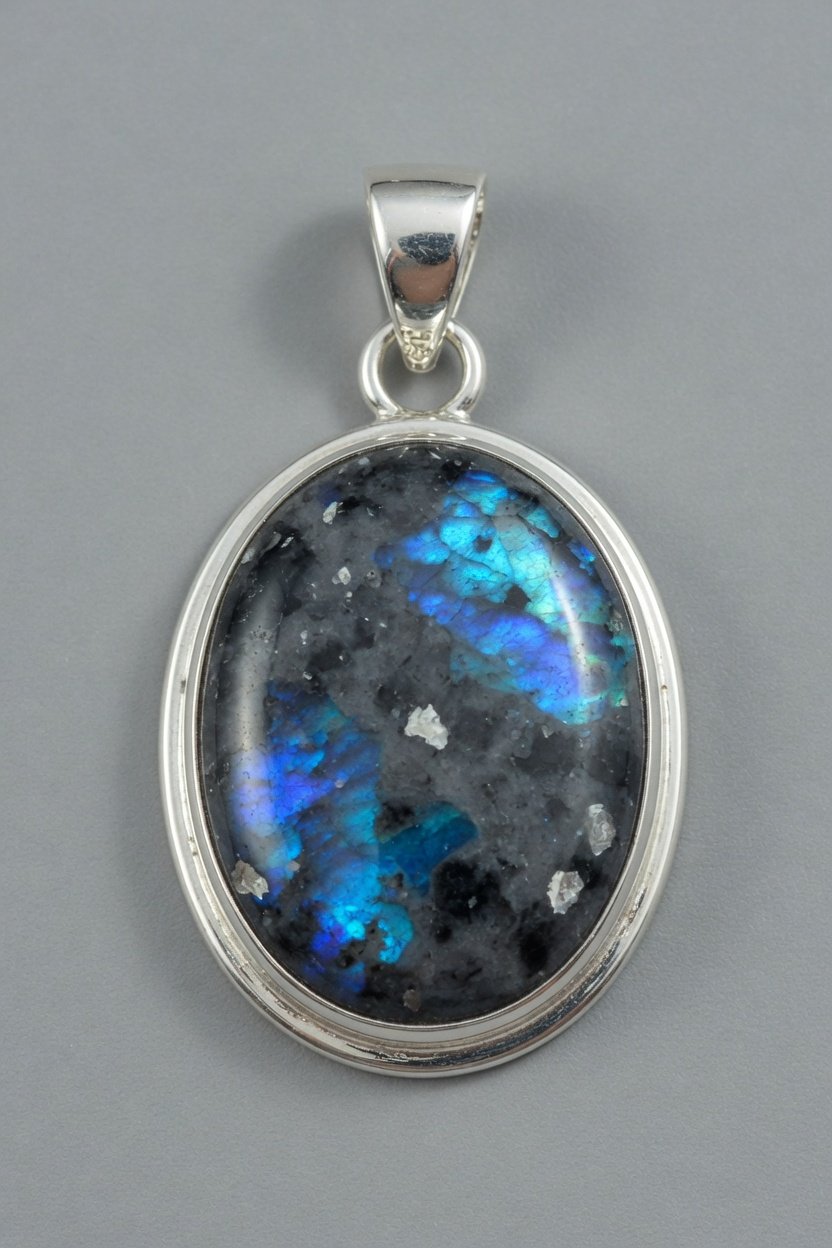
Larvikite emerges from the ancient igneous flows of Norway like a secret kept in stone, its dark surface suddenly alive with electric blue flashes that shift under light. This feldspar-rich rock carries an inner fire that silversmiths prize for its ability to transform a simple setting into something quietly luminous.
Physical Properties Larvikite registers 6 to 6.5 on the Mohs scale and shows a specific gravity near 2.70, making it durable enough for everyday wear yet soft enough to shape without excessive tool wear. Its composition is dominated by ternary feldspar that produces the signature schiller effect through microscopic exsolution lamellae. Because the stone contains no water-bearing minerals that would risk fracture under thermal shock, it can safely enter a setting after all soldering and cooling are complete; still, prolonged exposure to strong acids or ultrasonic cleaners should be avoided to preserve the surface polish and prevent dulling of the blue reflections.
Origin and Sourcing The stone occurs almost exclusively in the Larvik plutonic complex of southeastern Norway, where large anorthosite bodies were intruded during the Permian period. Commercial blocks are extracted from open-pit quarries using controlled blasting and diamond-wire saws, then transported to lapidary workshops for slabbing. Norwegian sources remain the only reliable supply; material marketed from other regions is typically misidentified labradorite or anorthosite lacking the true schiller.
History and Significance Local records from the 18th century note the stone’s use in building façades around Larvik and Oslo, where its reflective qualities caught the Nordic light. In the early 20th century Norwegian lapidaries began cutting cabochons for the European jewelry trade, giving the rock its trade name. Today it is valued both for its geological rarity and for the way its shifting blues evoke the northern sky at dusk.
In Jewelry and Silversmithing Silversmiths most often choose cabochon cuts to display the schiller across a smooth dome. The finished stone is set only after the silver has cooled from soldering; bezel or flush settings protect the edges while allowing light to graze the surface. A light coat of Renaissance wax helps maintain the polish without altering the optical effect.
Identifying Larvikite in the Field In outcrop the rock appears as coarse-grained, dark-gray masses within lighter syenite. Fresh surfaces reveal the diagnostic blue flash when tilted under direct sunlight; unlike labradorite, the flash is usually silver-blue rather than multicolored and is confined to larger feldspar crystals. A simple scratch test with a steel point confirms the expected hardness range.
Quick Facts
Common names: Larvikite, Norwegian Moonstone
Chemical formula: (Na,Ca)(Si,Al)4O8 (ternary feldspar)
Mohs hardness: 6–6.5
Specific gravity: 2.70
Color: Dark gray to black with blue-silver schiller
Crystal system: Triclinic
Luster: Vitreous to pearly on cleavage
Transparency: Opaque
Common cuts: Cabochon
Common treatments: None
Best silver setting: Bezel or flush
Birthstone month (if any): None
Main sources: Norway (Larvik region)
Meaning & Intentions
GROUNDING PRESENCE
Larvikite’s steady dark matrix and sudden blue flashes remind the wearer to remain anchored while staying open to unexpected insight. In meditation it is held or placed at the base of the spine to reinforce a sense of physical stability and quiet resilience against daily pressures.
Chakra: Root — stability and embodiment CLEAR PERCEPTION
The stone’s shifting reflections are used to sharpen inner vision during decision-making or creative work. Practitioners keep a polished specimen on the desk or wear it as a pendant to encourage honest self-assessment without harsh judgment.
Chakra: Third Eye — intuition and mental clarity PROTECTIVE BOUNDARIES
Larvikite is carried or worn when one needs to maintain personal limits amid demanding environments. Its dense feldspar structure is thought to create an energetic buffer that absorbs and disperses external tension before it reaches the wearer.
Chakra: Root — protective containment Affirmation: "I stand steady while the light within me answers." AT A GLANCE: Chakra: Root Element: Earth Energy: Receptive Zodiac: None assigned Planet: None assigned Affirmation: "I stand steady while the light within me answers."
Related Stones
Explore more stones from the Gemstone Library: Andalusite · Howlite · Peach Aventurine