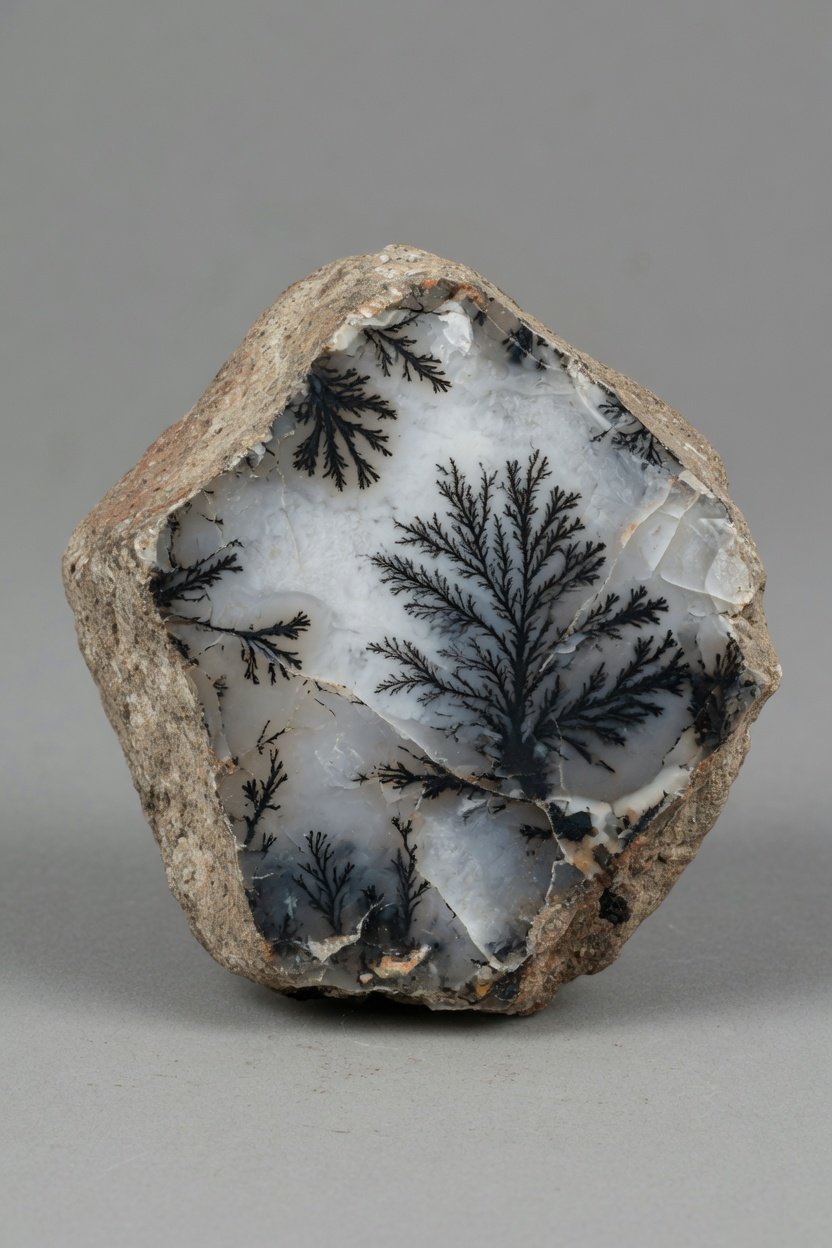
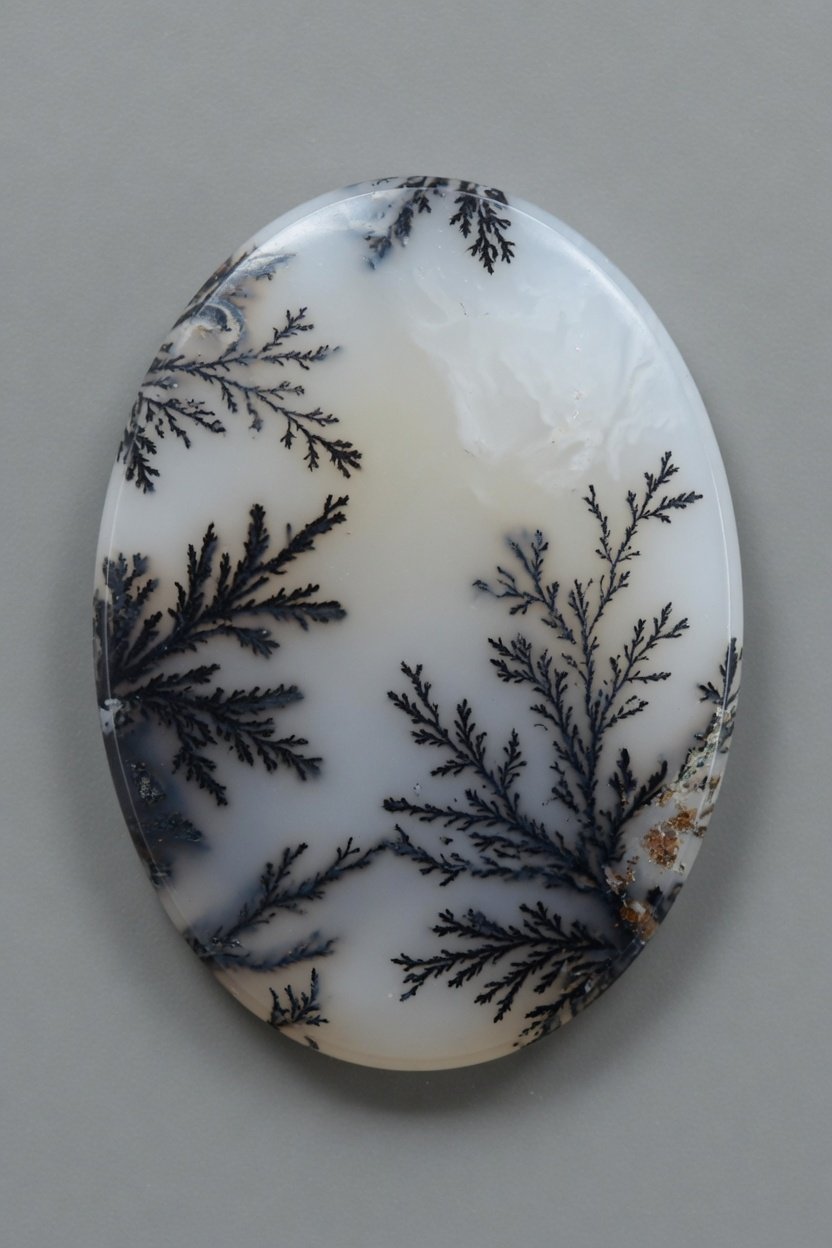
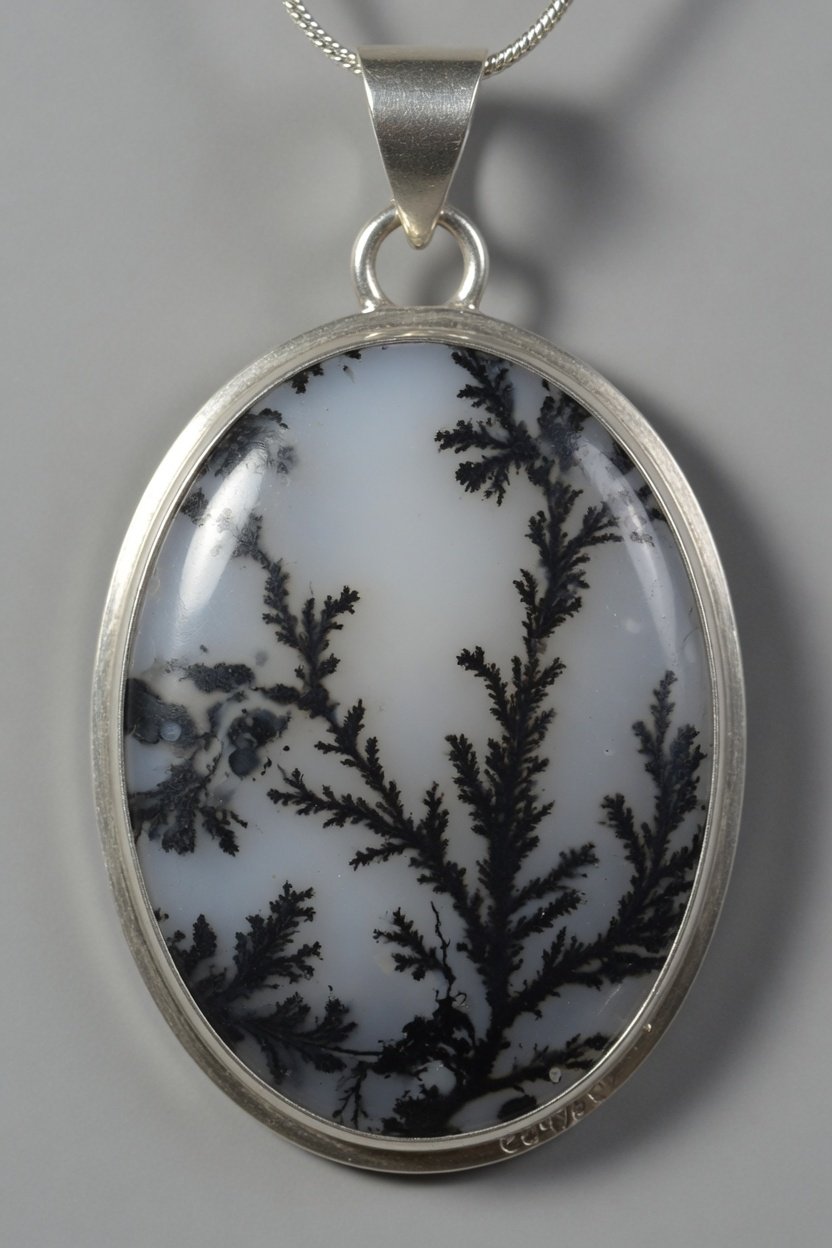
Dendritic agate forms when mineral-rich fluids deposit manganese or iron oxides in branching patterns inside chalcedony, creating stone that resembles miniature winter forests frozen in white or gray. These inclusions grow slowly in volcanic or sedimentary cavities, turning ordinary silica into a canvas of natural line art that silversmiths prize for its graphic contrast. The result is a durable yet visually delicate material that rewards careful observation and precise cutting.
Physical Properties Dendritic agate is a cryptocrystalline variety of quartz with a Mohs hardness of 6.5–7, making it tough enough for everyday jewelry yet soft enough that careless abrasion can dull its waxy surface. Its specific gravity ranges from 2.58 to 2.64, and its fracture is conchoidal, producing sharp edges that must be handled during setting. The stone shows no cleavage, so it withstands moderate pressure once mounted, but prolonged exposure to strong acids or ultrasonic cleaners can etch the surface or loosen inclusions.
Origin and Sourcing Primary commercial sources include the Deccan Plateau of India, the basalt fields of Brazil, and the high-desert regions of the western United States. Material is extracted from shallow open-pit workings or collected from alluvial gravels where erosion has freed nodules from their host rock. Miners sort rough by the clarity of the white matrix and the sharpness of the black or brown dendritic patterns before sending parcels to cutters.
History and Significance Ancient lapidaries in India and Persia valued dendritic agate for amulets believed to protect travelers and encourage growth in new ventures. Victorian collectors assembled cabinets of specimens whose branching lines were likened to fossilized ferns or lightning strikes. Today the stone remains a favorite among silversmiths who appreciate its graphic quality and the way each piece carries a unique natural drawing.
In Jewelry and Silversmithing Because the dendrites are opaque and lie just beneath the surface, the stone is almost always cut as a cabochon to preserve the full pattern. Silversmiths set dendritic agate after all soldering is complete, using a bezel that fully surrounds the stone to protect the soft matrix from flexing or impact. Care cautions include avoiding prolonged sunlight that can fade some iron-based inclusions and keeping the piece away from household chemicals that might stain the white chalcedony background.
Identifying Dendritic Agate in the Field In rough form the stone appears as rounded nodules with a weathered white or gray rind; breaking a small corner reveals the characteristic black branching lines against a translucent chalcedony groundmass. Unlike true fossils or moss agate, the dendrites never show cellular structure or green coloration, and they terminate abruptly rather than fading into the matrix.
Quick Facts
Common names: Dendritic Agate, Tree Agate, Scenic Agate
Chemical formula: SiO₂
Mohs hardness: 6.5–7
Specific gravity: 2.58–2.64
Color: White to gray matrix with black or brown dendritic inclusions
Crystal system: Trigonal (cryptocrystalline)
Luster: Waxy to vitreous
Transparency: Translucent to opaque
Common cuts: Cabochon, freeform, slice
Common treatments: None (natural inclusions only)
Best silver setting: Bezel
Birthstone month (if any): None
Main sources: India, Brazil, United States
Meaning & Intentions
GROWTH
Dendritic agate supports steady personal expansion by mirroring the slow, branching progress of its mineral inclusions. Wearers keep the stone near during planning phases to encourage measured advancement rather than forced leaps, using its visual structure as a reminder that lasting development follows natural pathways. The stone is often placed on a workspace or carried in a pocket when beginning new projects.
Chakra: Root — grounding and steady forward movement CLARITY
The branching black lines against a pale field train the eye to notice patterns within complexity, aiding decision-making when information feels tangled. Practitioners meditate with a polished cabochon held at eye level, tracing the dendrites to quiet mental noise and reveal underlying order. This practice is repeated before important conversations or creative reviews.
Chakra: Third Eye — insight and pattern recognition PROTECTION
The stone’s dense chalcedony matrix combined with its graphic inclusions creates a visual shield that many associate with boundary-setting. Travelers and those entering new environments keep a small cabochon in a pocket or bag as a tactile cue to maintain personal limits while remaining open to experience. Its durability reinforces the intention without requiring special handling.
Chakra: Root — security and containment Affirmation: "I grow steadily, see clearly, and hold my boundaries with grace." AT A GLANCE: Chakra: Root, Third Eye Element: Earth Energy: Receptive Zodiac: Virgo, Capricorn Planet: Saturn Affirmation: "I grow steadily, see clearly, and hold my boundaries with grace."
Related Stones
Explore more stones from the Gemstone Library: Onyx · Hessonite · Sillimanite