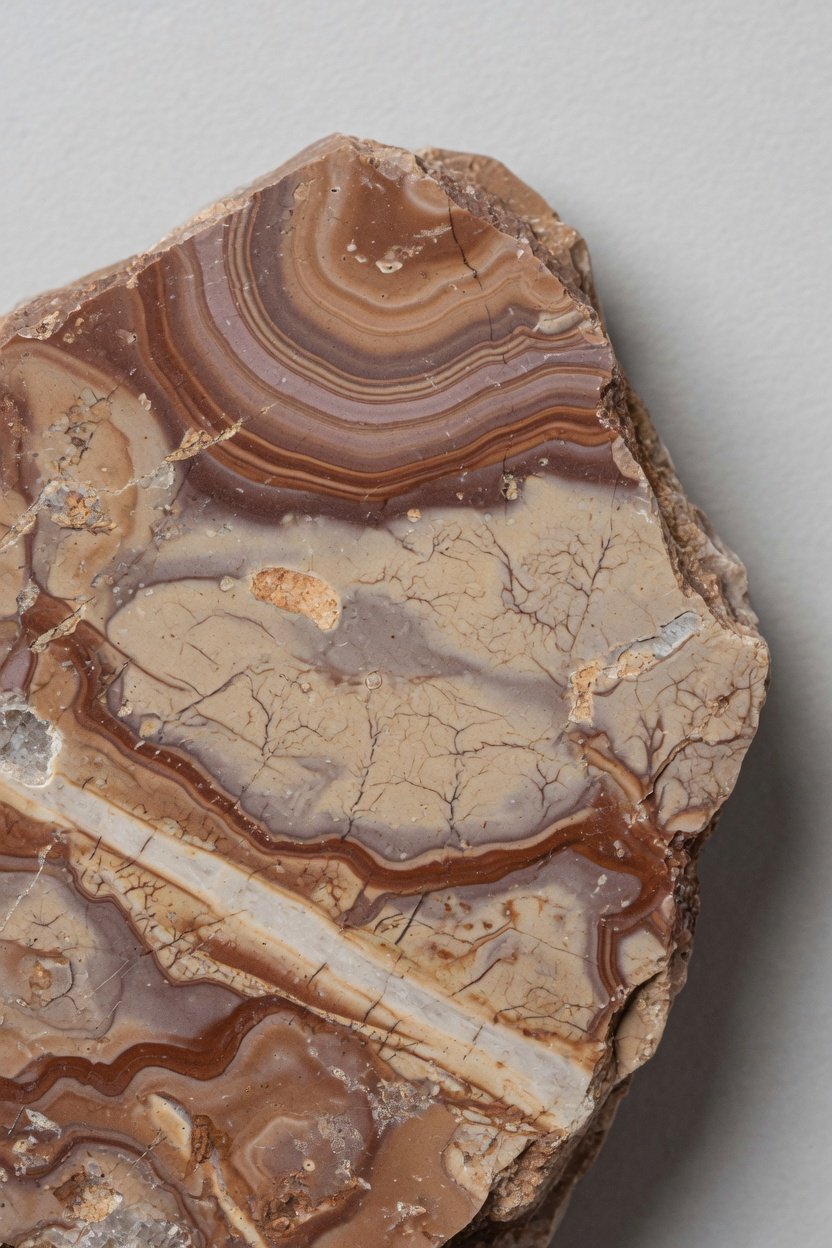
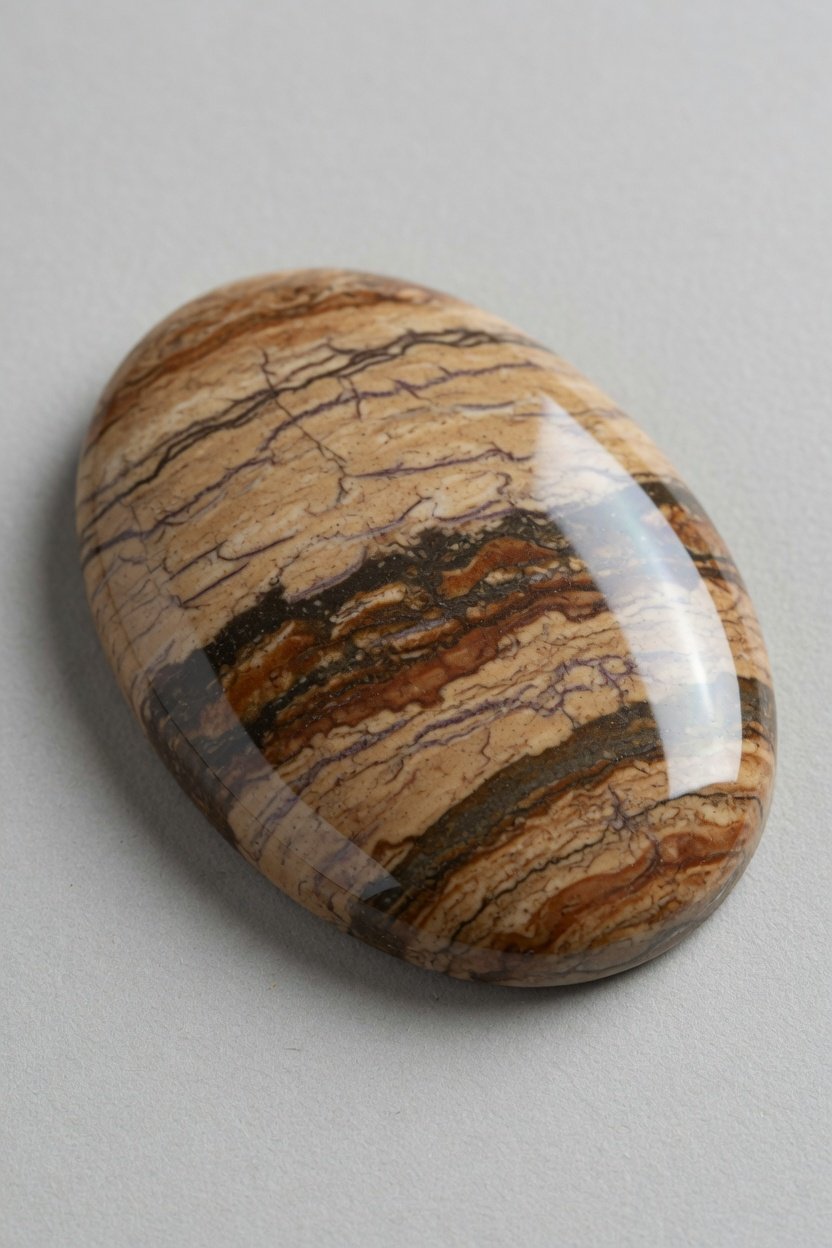
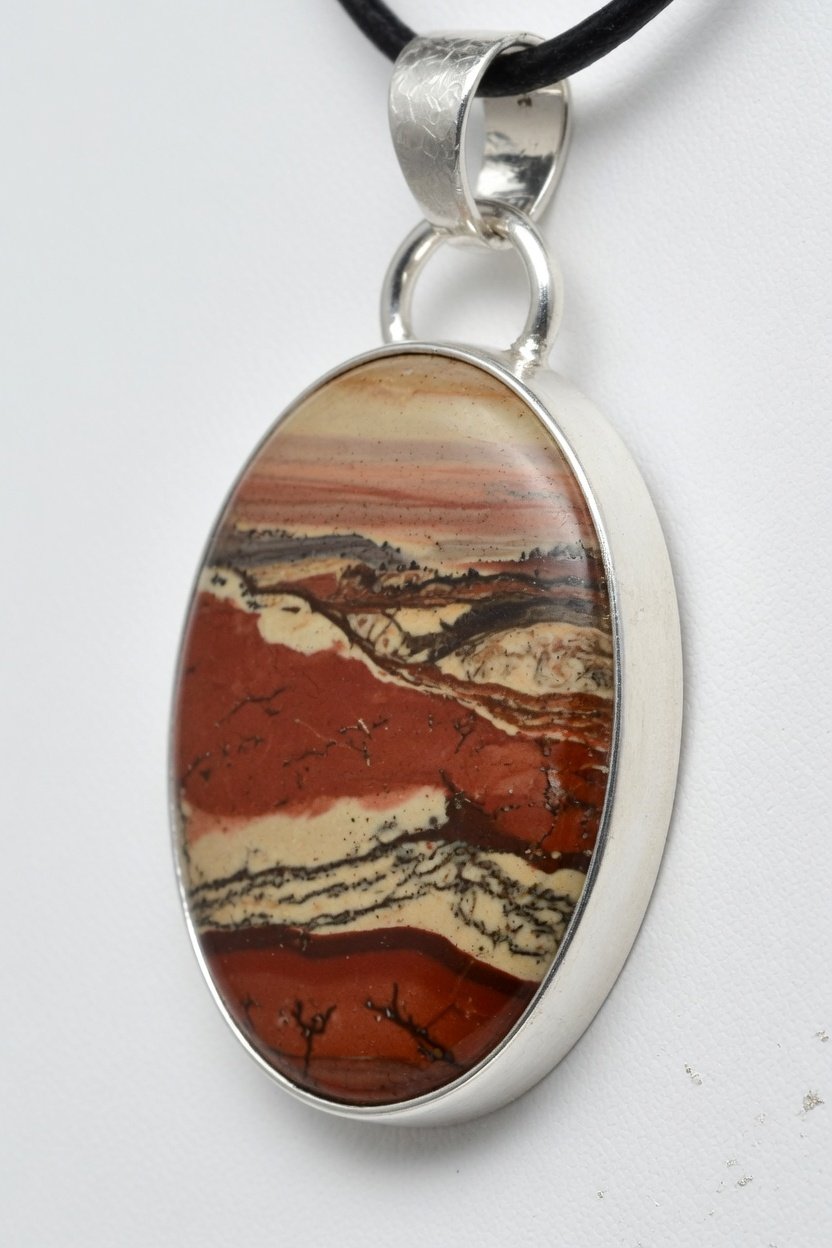
Picture Jasper forms when silica-rich waters slowly replace volcanic ash and sediment, trapping intricate mineral patterns that resemble miniature landscapes. These scenes of hills, rivers, and skies emerge only after careful cutting and polishing reveal the hidden artwork inside each nodule. Silversmiths prize the stone for its ability to turn a simple bezel into a window on an ancient world.
Physical Properties Picture Jasper is a microcrystalline quartz variety with a Mohs hardness of 6.5 to 7, making it durable enough for everyday wear yet soft enough to cut and polish without specialized diamond tools. Its specific gravity ranges from 2.55 to 2.65, and it displays an opaque body with a waxy to dull luster. The stone must be set only after all soldering and pickling are complete to avoid thermal shock or discoloration of the delicate iron-oxide banding.
Origin and Sourcing Most commercial Picture Jasper comes from the high desert regions of Oregon and Idaho, where ancient volcanic activity created the perfect conditions for its formation. Smaller quantities appear in parts of Washington and Nevada. Miners extract the nodules from shallow open-pit benches or hard-rock adits, then sort them by the clarity of their internal scenes before sending rough material to lapidaries.
History and Significance Native American artisans in the Pacific Northwest have long collected similar jaspers for ceremonial objects, valuing the stones as records of the earth’s memory. European settlers later named the material for its photographic quality, and by the mid-twentieth century it entered the American studio-jewelry movement. Today the stone continues to symbolize grounded creativity and connection to place.
In Jewelry and Silversmithing Picture Jasper is almost always cut as a cabochon to preserve its scenic patterns. The best practice is to set the finished cabochon only after every soldering operation is finished and the piece has cooled. Its moderate hardness allows secure bezel work, yet the iron-oxide layers can fade if overheated, so prolonged torch exposure is avoided. Finished pieces benefit from occasional wiping with a soft cloth; ultrasonic cleaners are safe provided the stone has no fractures.
Identifying Picture Jasper in the Field In the field the stone appears as rounded nodules or seams within rhyolitic tuff, showing a matte tan to chocolate-brown exterior that hides the interior picture. A quick scratch test with a steel point leaves no mark, and a drop of water on a broken surface temporarily darkens the patterns, revealing the scene beneath. Always confirm the stone after all soldering is finished and avoid prolonged heat.
Quick Facts
Common names: Picture Jasper, Scenic Jasper, Landscape Jasper
Chemical formula: SiO₂
Mohs hardness: 6.5–7
Specific gravity: 2.55–2.65
Color: Brown, tan, cream, beige with landscape-like patterns
Crystal system: Trigonal (microcrystalline)
Luster: Waxy to dull
Transparency: Opaque
Common cuts: Cabochon, freeform, tumbled
Common treatments: None
Best silver setting: Classic Silver Bezel Pendant
Birthstone month (if any): None
Main sources: USA (Oregon, Idaho)
Meaning & Intentions
GROUNDING
Picture Jasper anchors scattered thoughts by mirroring the steady rhythm of the land within its banded scenes. Wearers carry a small cabochon during meditation or place it on a work surface to maintain focus through long creative sessions. The stone’s earthy palette reinforces a sense of belonging to the present moment.
Chakra: Root — stability and physical presence INSIGHT
The stone’s miniature landscapes invite quiet observation, helping users notice overlooked details in daily life. A polished freeform kept on a desk encourages reflective pauses that surface fresh perspectives. Over time the patterns become personal metaphors for navigating change.
Chakra: Third Eye — clarity and inner vision PROTECTION
Picture Jasper forms a subtle energetic boundary that shields against external emotional noise. Many silversmiths keep a small tumbled piece near the bench to maintain steady concentration during intricate work. Its durable quartz structure physically reinforces this sense of safety.
Chakra: Root — security and endurance Affirmation: "I stand steady and see clearly." AT A GLANCE: Chakra: Root Element: Earth Energy: Receptive Zodiac: Capricorn Planet: Saturn Affirmation: "I stand steady and see clearly."
Related Stones
Explore more stones from the Gemstone Library: Onyx · Agate · Jasper