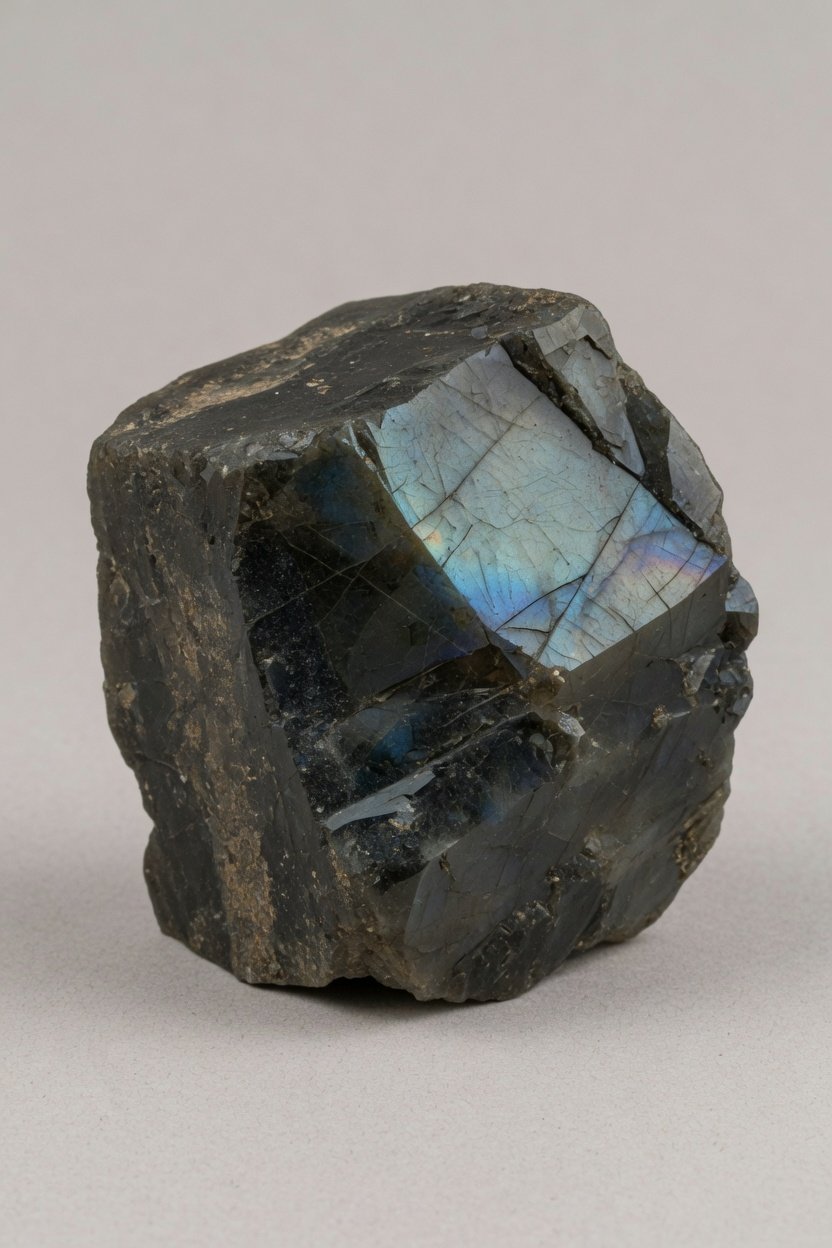
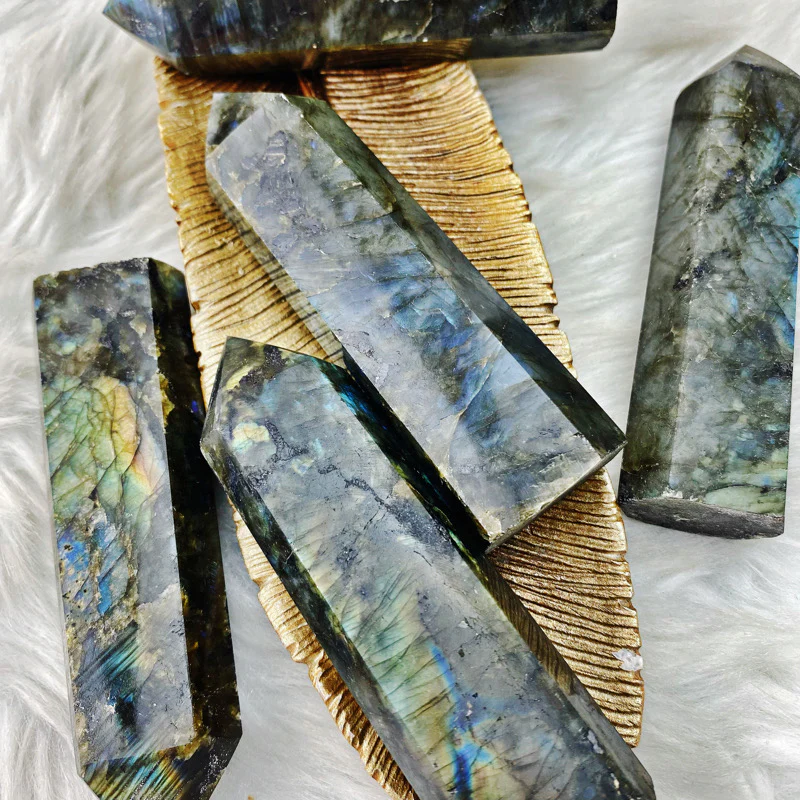
Labradorite is one of nature's most magical gemstones — a plain gray-black stone that suddenly bursts into flashing blue, green, gold, and violet when the light catches it just right. This astonishing optical effect is called labradorescence, named after the stone itself, and it is unlike anything else in the gem world. At rest, labradorite can look dull and unremarkable. Tilt it in the light, and it comes alive with the colors of the aurora borealis, seeming to glow from within. That dramatic transformation is exactly why this stone has captured imaginations since it was first discovered.
Physical Properties
Labradorite is a member of the feldspar family, ranking about 6 to 6.5 on the Mohs hardness scale. That makes it moderately hard — harder than glass but softer than quartz — and durable enough for jewelry with reasonable care. The catch is its cleavage: labradorite has two directions of perfect cleavage, meaning a sharp knock can cause it to split along a flat plane. That makes a protective setting important. The base color is usually smoky gray to nearly black, and it is the strength and spread of the color flash, not the body color, that determines a stone's value. It is almost always cut as a cabochon, oriented carefully to show the best flash.
What Makes Labradorite Special
The magic is in the labradorescence. The effect does not come from the surface — it happens inside the stone. Light enters, strikes microscopic internal layers formed as the mineral cooled, and reflects back as flashing color. Different internal surfaces throw back different colors, which is why a single stone can flash blue in one spot and gold in another as you turn it. The most prized stones show a broad spectrum and a bright, electric blue. A particularly vivid variety from Finland, called spectrolite, shows the full rainbow and is especially treasured.
Origin and Sourcing
Labradorite was first discovered around 1770 on the Labrador Peninsula in eastern Canada, which is how it got its name. Canada remains an important source of fine, vividly flashing stones. Today, however, Madagascar dominates the commercial market, supplying most of the labradorite used in jewelry worldwide. Finland produces the rare, full-spectrum spectrolite variety. Other deposits are found in Russia's Ural Mountains, Norway, Mexico, India, and the United States — including Oregon, where a transparent variety without the flash is faceted as Oregon sunstone. Labradorite forms in igneous rocks like basalt and gabbro, crystallizing slowly as molten rock cools deep underground.
History and Significance
For the Indigenous peoples of Labrador, this stone held the light of the heavens. An Inuit legend tells that the northern lights were once trapped inside the rocks along the Labrador coast, until a warrior struck them with his spear and freed most of the aurora into the sky — but some light remained caught in the stone forever, and that is the flash we see today. It is a perfect story for a gem that truly seems to hold the aurora within it. Labradorite was largely unknown to the wider world until the 18th century, making it a relative newcomer among ancient gems, but its dramatic beauty quickly earned it a devoted following that continues to grow.
In Jewelry and Silversmithing
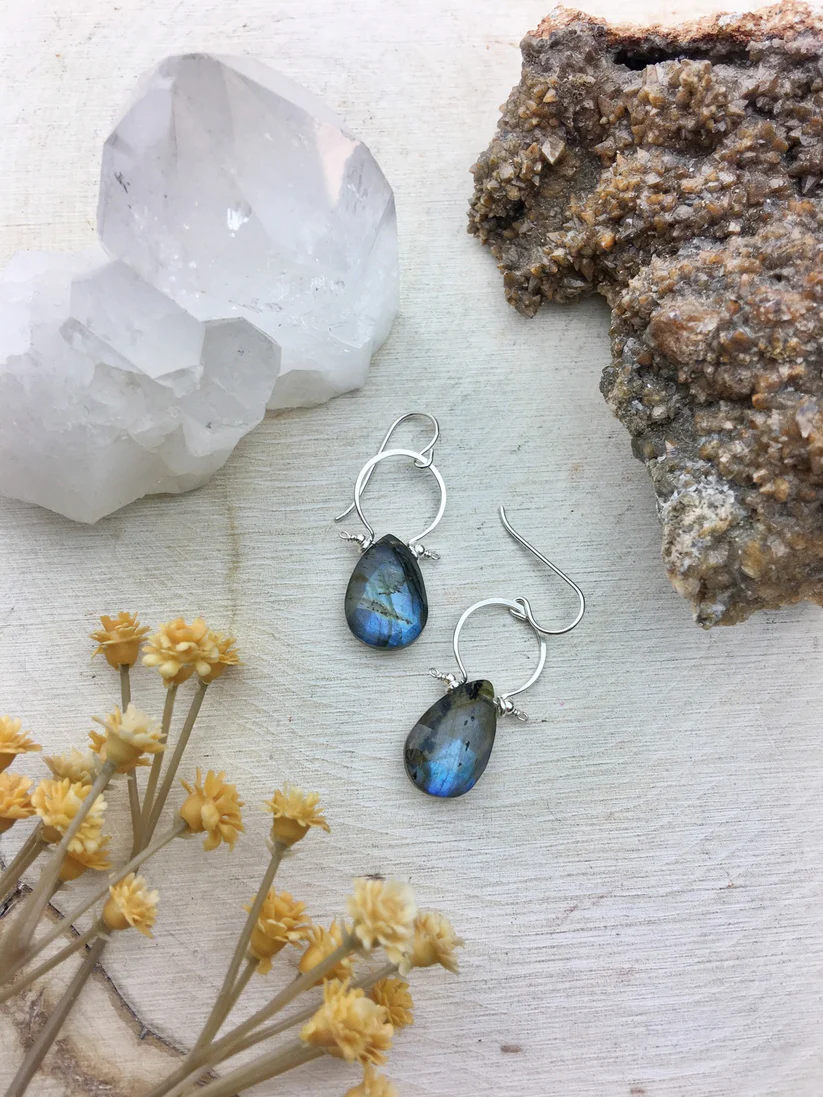
Labradorite is a favorite among silversmiths for its drama and its affordability. Because the flash is directional, orienting the cabochon correctly in its setting is everything — a well-set labradorite flashes brilliantly as the wearer moves. Its moderate hardness and perfect cleavage mean a protective bezel is the ideal setting, shielding the stone from knocks that could split it. The cool gray body with its electric flash pairs beautifully with both bright and oxidized silver. As always, set labradorite after all soldering is complete, and clean it gently with mild soap and water, avoiding harsh chemicals and ultrasonic cleaners.
Identifying Labradorite in the Field
Labradorite is found in coarse-grained igneous rocks such as anorthosite, gabbro, and basalt. In the field, a rough piece often looks like a dull, gray, glassy feldspar — until you turn it in sunlight and catch a sudden flash of blue or green from within. That schiller flash is the unmistakable identifier. It has a hardness around 6 to 6.5, so it scratches glass but is scratched by quartz, and it shows two directions of cleavage meeting at close to a right angle, often visible as flat reflective surfaces. Its specific gravity of about 2.7 is typical for feldspar. Look for it in large crystalline masses in old, deeply cooled igneous terrain, where freshly broken surfaces reveal the telltale play of color.
Quick Facts
Common names: Labradorite, Spectrolite (Finland variety)
Chemical formula: (Na,Ca)(Al,Si)₄O₈ — plagioclase feldspar
Mohs hardness: 6–6.5
Specific gravity: 2.65–2.75
Color: Gray to black body with blue, green, gold, violet flash
Crystal system: Triclinic
Luster: Vitreous; with labradorescent schiller flash
Transparency: Translucent to opaque
Common cuts: Almost always cabochon (oriented for best flash)
Common treatments: Usually untreated — a natural stone
Best silver setting: Bezel (protects against cleavage splitting)
Birthstone month: Not a traditional birthstone (modern: associated with winter)
Anniversary: Sometimes given for inner-transformation milestones
Main sources: Canada (Labrador), Madagascar, Finland, Russia
Meaning & Metaphysical Properties
Labradorite is known as the stone of magic and transformation. Just as it hides a hidden flash of color beneath a plain surface, it is said to awaken hidden potential and the magic within. People turn to labradorite during times of change and new beginnings, trusting it to illuminate the path forward and reveal gifts they did not know they had. It is a stone for those stepping into something new and wanting the courage to embrace it.
Chakra: Third Eye chakra (Ajna) — intuition, vision, awakening
Also associated with: Crown chakra — higher awareness
Labradorite has long been considered a powerful protective stone, said to form a shield around the aura and guard against negativity. It is especially linked to intuition and psychic insight — the deep inner knowing that guides us when logic runs out. Many keep labradorite close during meditation or spiritual work, or simply carry it through the day for a steady sense of being protected and tuned in to their own inner voice.
Chakra: Third Eye chakra (Ajna) — intuition and inner protection
With its aurora-like flash, labradorite is a stone of imagination and creative inspiration. It is said to lift the spirit, spark new ideas, and help dreamers and artists see possibility everywhere. Like the northern lights it resembles, labradorite invites a sense of wonder — a reminder that beauty and magic are often hidden just beneath an ordinary surface, waiting for the right light to reveal them.
Affirmation: "I carry hidden light within me, I trust my intuition, and I
welcome transformation with wonder."
At a Glance
Chakra: Third Eye, Crown
Element: Water, Air
Energy: Magical, protective, intuitive, transformative
Zodiac: Leo, Scorpio, Sagittarius
Planet: Uranus, Moon
Affirmation: I carry hidden light and I trust my intuition
Related Stones
Explore more stones from the Gemstone Library: LAPIS LAZULI · AMETHYST · OPAL