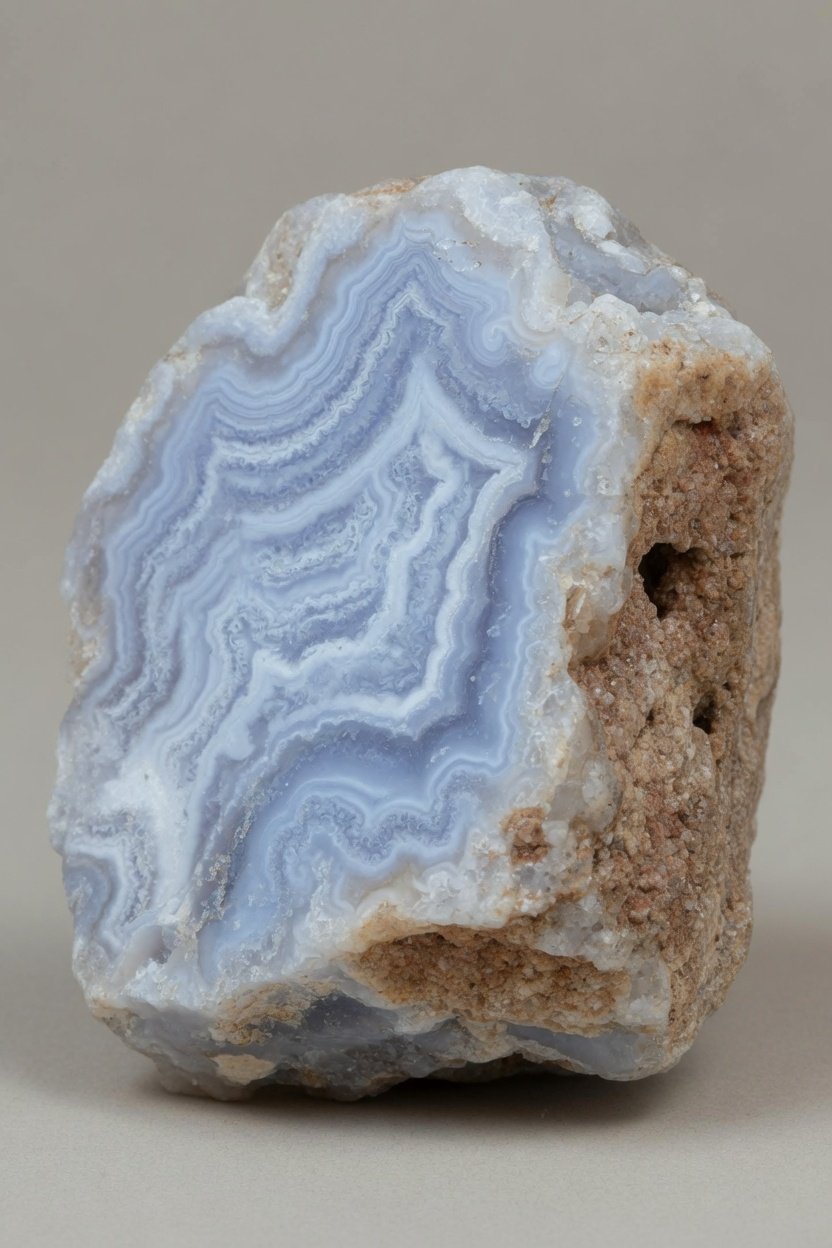
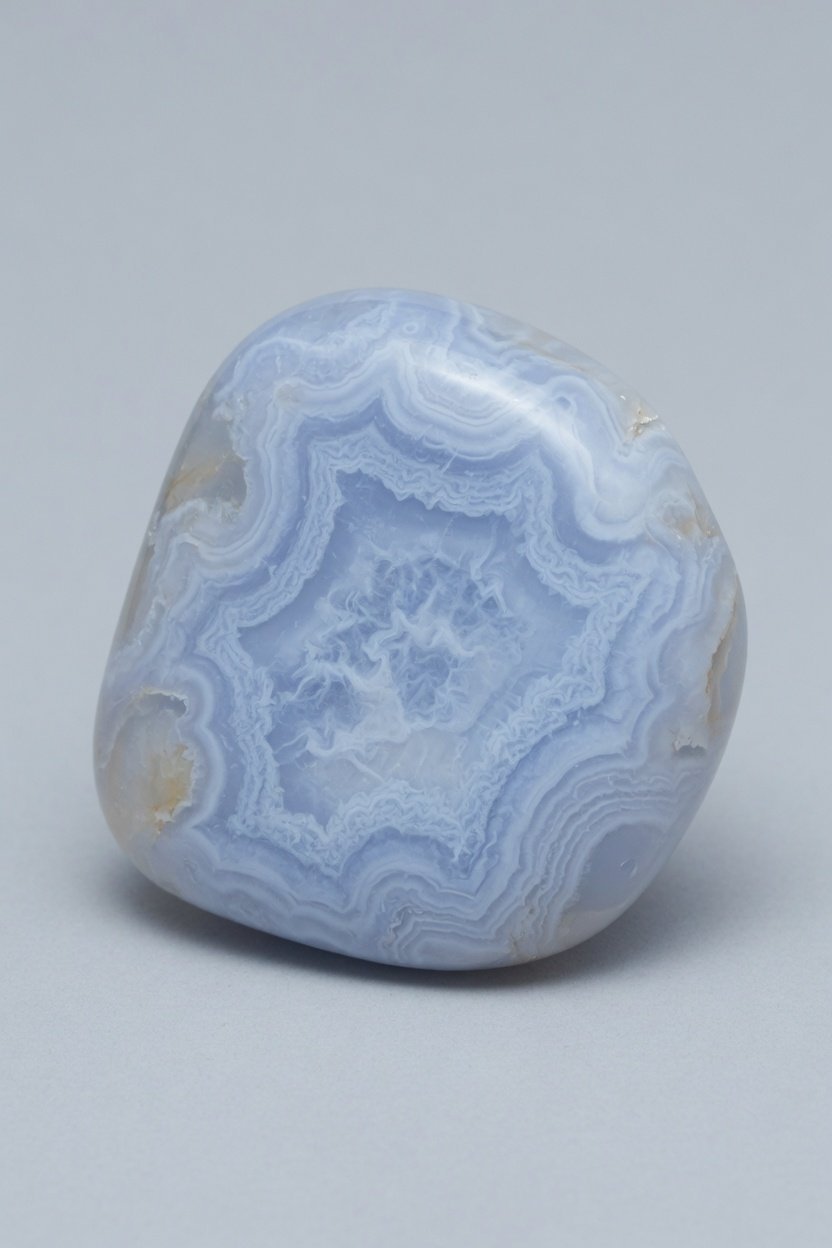
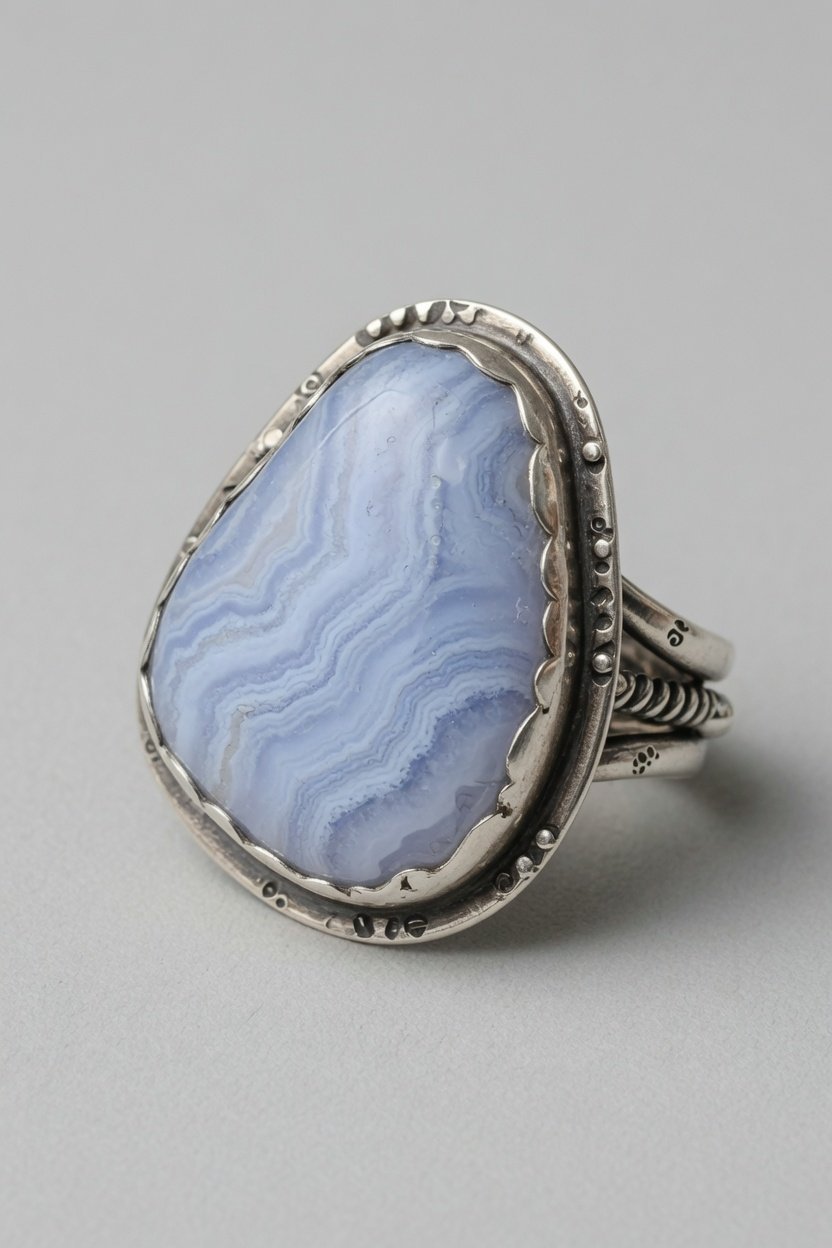
Agate forms in layered bands that capture the slow rhythm of mineral-rich waters seeping through ancient volcanic cavities, creating a stone that feels both timeless and alive. Its concentric patterns invite silversmiths to frame natural history inside metal, turning raw earth into wearable art that rewards careful observation.
Physical Properties Agate is a banded variety of chalcedony, itself a microcrystalline form of quartz. Its chemical makeup is silicon dioxide, yet the visible structure arises from successive deposits of silica gel that harden into parallel or concentric stripes. Hardness ranges from 6.5 to 7 on the Mohs scale, and specific gravity sits between 2.58 and 2.64. Colors shift through milky white, soft gray, muted blue, warm brown, and occasional flashes of pink or green depending on trace minerals. The stone is typically translucent to opaque with a vitreous to waxy luster once polished. In silversmithing the finished cabochon must be set only after all soldering is complete; heat from the torch can fracture the delicate banding or cloud the surface. Avoid ultrasonic cleaners and sudden temperature changes that may cause internal stress cracks.
Origin and Sourcing Most commercial agate today comes from the volcanic plateaus of southern Brazil and northern Uruguay, where gas bubbles in basalt filled with silica solutions millions of years ago. Miners extract nodules from open-pit operations, then saw them to reveal the hidden banding. Smaller quantities reach the market from India, Mexico, and the United States, yet Brazilian material remains the benchmark for consistent size and color variety. Ethical sourcing favors mines that reclaim overburden and limit water use during cutting.
History and Significance Civilizations across the Mediterranean and Near East prized agate for seals and amulets as early as 3000 BCE. Roman soldiers carried banded stones into battle believing the layers would steady nerves and protect against fever. During the Renaissance, Italian lapidaries carved intricate cameos that exploited the natural color zones. Victorian silversmiths mounted polished slices in mourning jewelry, valuing the stone’s quiet permanence. Today the same layered structure speaks to contemporary makers who seek materials that record geological time rather than imitate it.
In Jewelry and Silversmithing Agate’s even hardness and lack of cleavage make it forgiving for cabochon cutting, yet its beauty lies in the bands that must be oriented to catch light across the dome. Silversmiths most often choose a classic silver bezel that fully encloses the girdle, protecting the edges while allowing the stone’s color play to dominate. The bezel is formed and soldered to the mounting first; only after the piece has cooled and been pickled does the setter gently press the metal over the stone. Care cautions include removing agate jewelry before household chores involving strong acids or abrasives and storing pieces separately to prevent surface scratches from harder gems.
Identifying Agate in the Field Look for rounded nodules weathering out of basalt flows; broken surfaces reveal concentric banding absent in jasper or plain chalcedony. A quick hardness test with a steel file will leave no mark, while the translucency at the edges distinguishes agate from opaque chert. Always note that true agate shows smooth, continuous stripes rather than the patchy coloration of picture jasper.
Quick Facts
Common names: Agate, Banded Agate
Chemical formula: SiO2
Mohs hardness: 6.5-7
Specific gravity: 2.58-2.64
Color: White, gray, blue, brown, pink bands
Crystal system: Trigonal
Luster: Vitreous to waxy
Transparency: Translucent to opaque
Common cuts: Cabochon, beads, slices
Common treatments: Dyeing, heat treatment
Best silver setting: Classic Silver Bezel Pendant
Birthstone month (if any): None
Main sources: Brazil, Uruguay, India
Meaning & Intentions
GROUNDING
Agate’s steady horizontal bands mirror the layered earth beneath our feet, helping wearers remain anchored during change. Silversmiths set the polished slice in a low bezel so the stone rests close to the skin, its weight serving as a tactile reminder to breathe and return to the present moment. The natural stripes are believed to absorb scattered energy and redistribute it evenly through the body.
Chakra: Root — stability and connection to physical reality CLARITY
The translucent layers of agate act like windows into deeper seeing, encouraging honest self-examination without judgment. When cut as a pendant the stone hangs near the heart, its banded pattern drawing the gaze inward during meditation. Makers often leave a thin edge of matrix visible so the contrast between rough and polished surfaces highlights the journey from confusion to insight.
Chakra: Third Eye — perception and inner vision STABILITY
Agate’s concentric rings suggest enduring structure, supporting those who need to rebuild routines after disruption. A cabochon set after all soldering cools becomes a permanent fixture whose cool touch on the wrist or chest reinforces commitment to long-term goals. The stone’s density provides a physical counterweight to emotional turbulence.
Chakra: Root — endurance and calm persistence Affirmation: "I move forward one steady layer at a time." AT A GLANCE: Chakra: Root Element: Earth Energy: Receptive Zodiac: Gemini Planet: Mercury Affirmation: "I move forward one steady layer at a time."
Video Transcript
Along Brazilian basalt cliffs this banded stone forms in quiet volcanic pockets. Set the finished cabochon only after every joint has cooled to protect the bands. Learn to bezel-set agate in our weekend workshops and carry its steady layers yourself.
Related Stones
Explore more stones from the Gemstone Library: Moss Agate · Onyx · Bloodstone