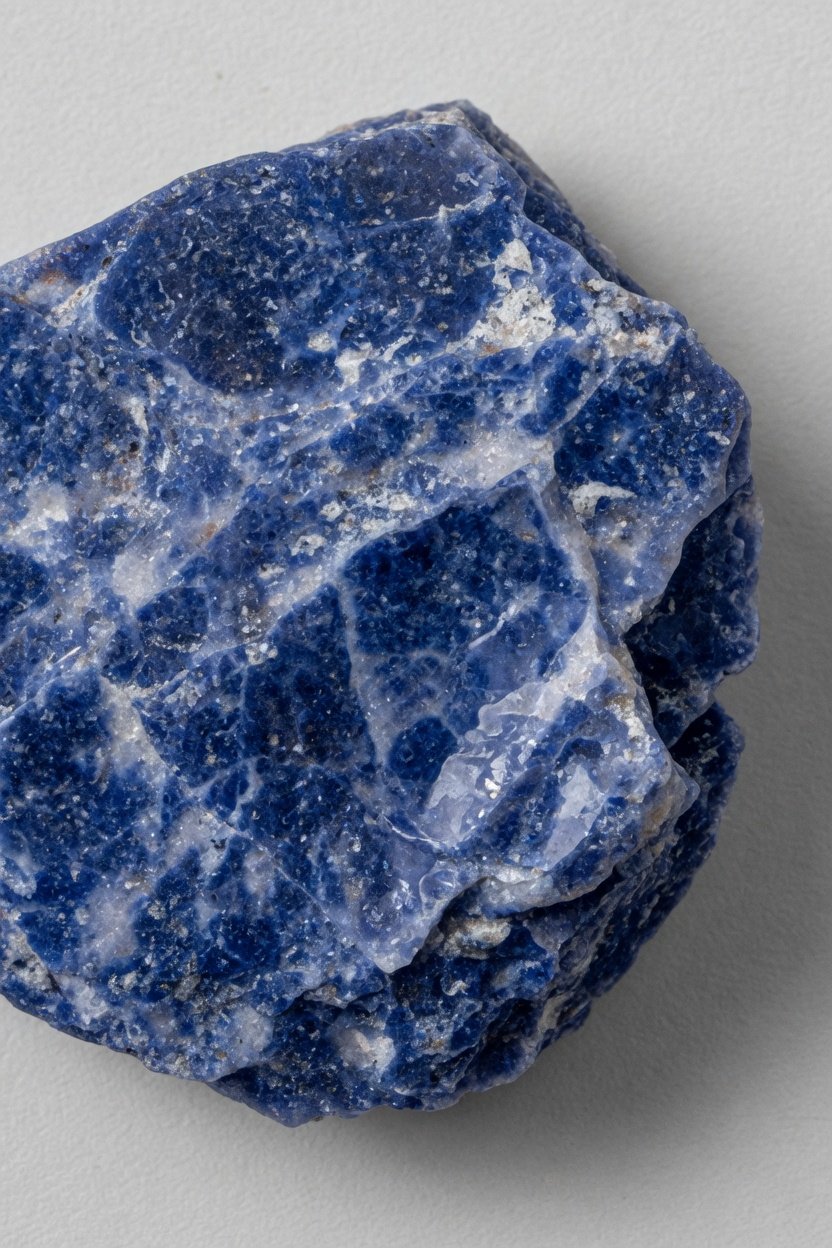
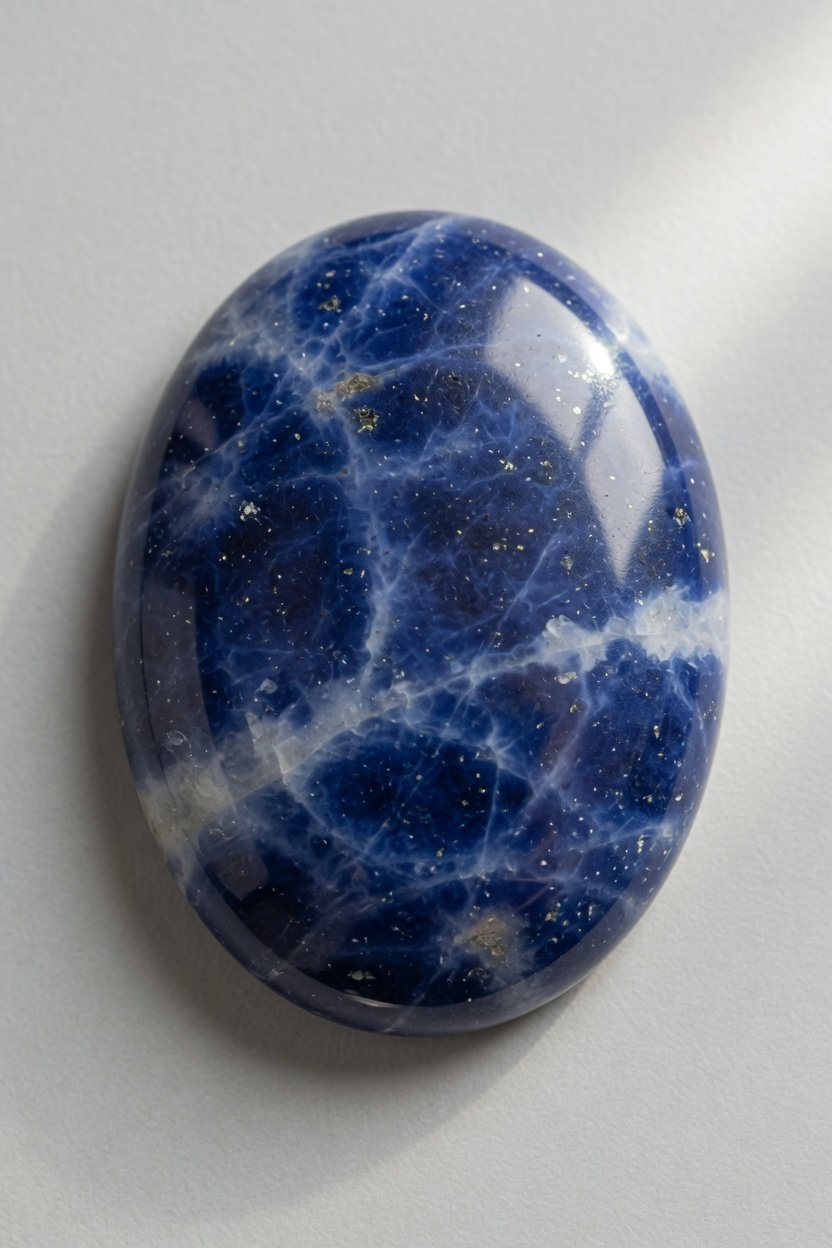
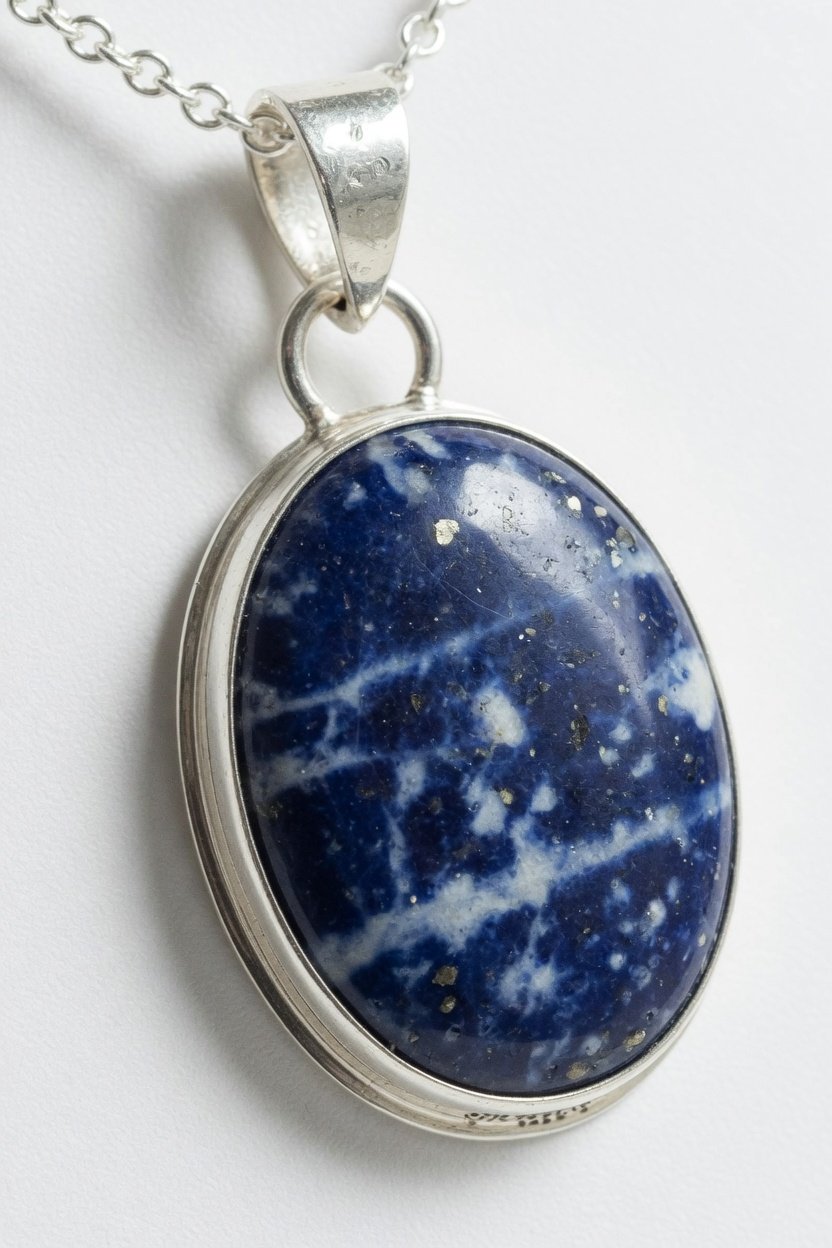
Sodalite emerges from the earth in striking blocks of intense blue that immediately catch the eye, often threaded with stark white veins that give it a distinctive marbled appearance. This sodium-rich feldspathoid has long been prized by lapidaries for its ability to take a fine polish while remaining workable with hand tools. Its rich color and relative affordability make it a favorite in both historic and contemporary silver jewelry.
Physical Properties Sodalite registers 5.5 to 6 on the Mohs scale, placing it between apatite and orthoclase feldspar in hardness and requiring careful handling during cutting and polishing. Its specific gravity hovers between 2.2 and 2.3, giving cabochons a substantial yet not overly heavy feel when set. The stone is typically opaque with a vitreous to slightly greasy luster that deepens after polishing. Because heat from soldering can cause fracturing or discoloration, the stone must always be set after all soldering and pickling steps are complete. Avoid prolonged exposure to acids or harsh detergents that may dull its surface over time.
Origin and Sourcing Primary deposits occur in nepheline syenite intrusions, with notable sources in Ontario, Canada; Bahia, Brazil; the Kola Peninsula of Russia; and minor occurrences in Namibia and the United States. Material is extracted through hard-rock mining methods that follow narrow veins within larger igneous bodies. Canadian material from the Princess Sodalite Mine remains especially valued for its deep, uniform blue tone and minimal white veining.
History and Significance First described in 1811 from specimens collected in Greenland, sodalite gained popularity in the late nineteenth century after large deposits were opened in Canada. It was used extensively in Russian and European decorative arts during the Art Nouveau period. Indigenous communities in northern Canada incorporated the stone into ceremonial objects long before European contact, associating its color with clear winter skies and truthful speech.
In Jewelry and Silversmithing Silversmiths most often cut sodalite into smooth cabochons or beads that highlight the contrast between blue groundmass and white calcite veins. The stone pairs beautifully with sterling silver in bezel settings that protect its edges while allowing light to play across the polished surface. Because the material is relatively soft and heat-sensitive, every piece must be set only after soldering, polishing, and final cleaning of the silver are finished. Gentle care with a soft cloth and avoidance of ultrasonic cleaners will preserve both color and polish for generations.
Identifying Sodalite in the Field In outcrop, sodalite appears as massive, granular pods or veins within coarse-grained nepheline syenite. Fresh surfaces show a deep royal blue that may fade slightly on weathered faces. The presence of associated white calcite or black amphibole grains helps distinguish it from similar-looking lazurite or dyed howlite. A simple hardness test with a steel point will confirm its position below quartz while a lack of effervescence in dilute acid rules out calcite-rich marbles.
Quick Facts
Common names: Sodalite
Chemical formula: Na₈(Al₆Si₆O₂₄)Cl₂
Mohs hardness: 5.5–6
Specific gravity: 2.2–2.3
Color: Royal blue to indigo with white veining
Crystal system: Cubic
Luster: Vitreous to greasy
Transparency: Opaque to translucent
Common cuts: Cabochons, beads, tumbled stones
Common treatments: None
Best silver setting: Classic Silver Bezel Pendant
Birthstone month (if any): None
Main sources: Canada, Brazil, Russia, Namibia
Meaning & Intentions
TRUTHFUL SPEECH
Sodalite supports clear and honest communication by calming the mind and reducing the impulse to self-censor. Wearers often keep a small polished piece near the throat during difficult conversations or place it on a desk to encourage straightforward dialogue in meetings. Its steady blue color acts as a visual reminder to speak from integrity rather than fear.
Chakra: Throat — clear expression and authentic voice INNER VISION
The stone’s deep indigo tones are traditionally linked to enhanced intuition and the ability to perceive patterns beneath surface appearances. Practitioners place tumbled sodalite on the forehead during meditation or carry it when seeking insight into complex decisions. Over time the mineral is believed to strengthen trust in one’s own inner guidance.
Chakra: Third Eye — perception and inner knowing EMOTIONAL PROTECTION
Sodalite is used as a protective talisman that absorbs chaotic emotional energy and prevents it from overwhelming the wearer. Many keep a piece in a pocket or desk drawer during stressful periods to maintain equilibrium. Its dense structure is thought to create a subtle energetic boundary around the user.
Chakra: Throat — calm boundaries and steady presence "Affirmation: I speak my truth with clarity and calm." AT A GLANCE: Chakra: Throat Element: Water Energy: Receptive Zodiac: Sagittarius Planet: Moon Affirmation: I speak my truth with clarity and calm.
Related Stones
Explore more stones from the Gemstone Library: Amazonite · Rhodochrosite · Jasper