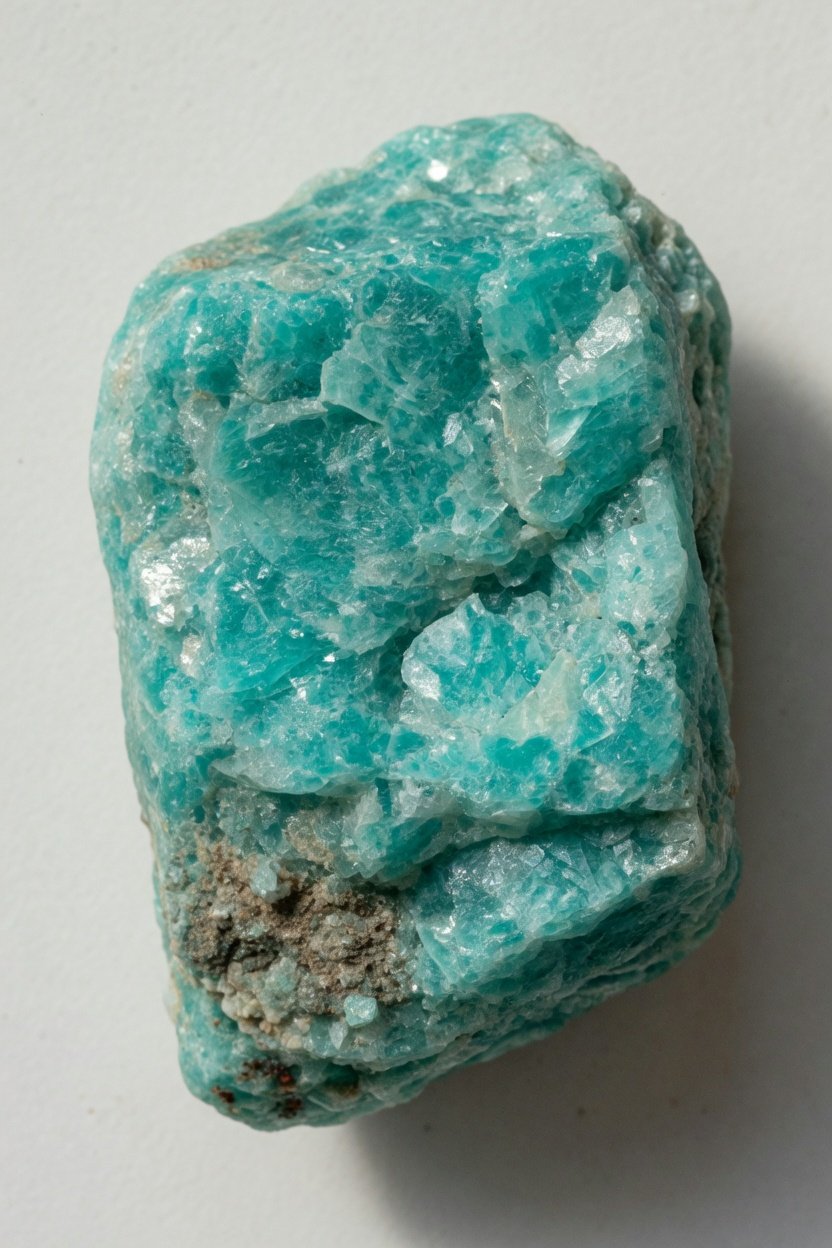
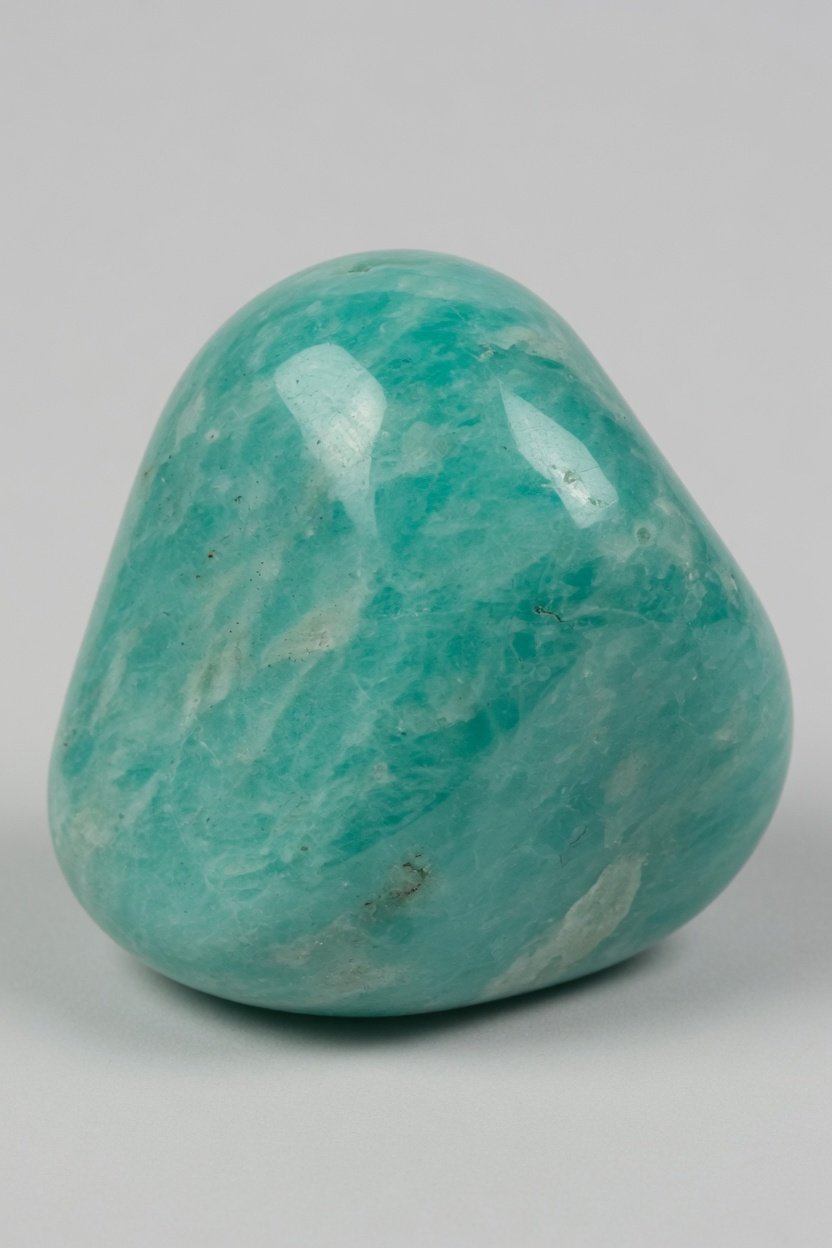
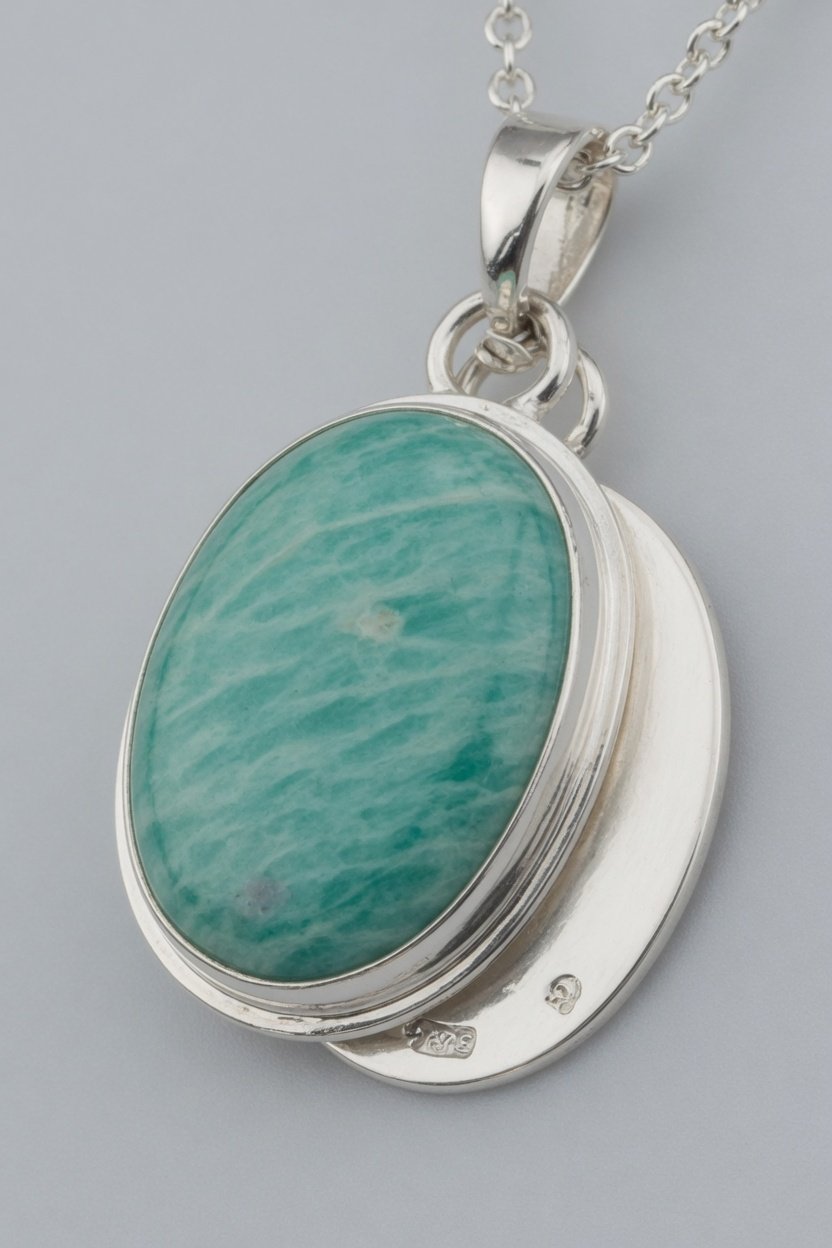
Amazonite draws the eye with its cool blue-green tones that shift between pale aqua and deeper turquoise, often threaded with soft white veining that catches light like frozen river ice. This variety of microcline feldspar feels at once ancient and fresh, offering silversmiths a stone that balances bold color with subtle patterning. Its presence in finished work immediately signals calm strength without ever shouting.
Physical Properties Amazonite registers 6 to 6.5 on the Mohs scale, making it durable enough for daily wear yet soft enough to cut and polish with standard lapidary tools. Specific gravity sits between 2.56 and 2.58, giving pieces a satisfying weight that feels substantial in silver settings. The stone displays a vitreous to slightly pearly luster and ranges from translucent to opaque, with the finest material showing even color across the entire cabochon face. Care cautions include avoiding prolonged ultrasonic cleaning and harsh chemicals that can dull the surface; gentle soap and water suffice. Always set the stone after all soldering is complete to prevent heat damage that can whiten or fracture the feldspar.
Origin and Sourcing Primary sources lie in Russia’s Ilmensky Mountains, Brazil’s Minas Gerais pegmatites, and Colorado’s Pikes Peak region in the United States, with additional material from Madagascar and Ethiopia. Extraction occurs through hard-rock mining of granitic pegmatites where amazonite crystals form alongside smoky quartz and albite. Miners follow narrow adits into the rock, using headlamps and careful blasting to free large blocks that are later trimmed for transport. Responsible sourcing now emphasizes reclamation of these mountain sites once extraction ends.
History and Significance Ancient Amazonian peoples reportedly valued the stone for adornment, though most documented material traveled trade routes from Russia into Europe by the eighteenth century. Russian carvers produced elaborate boxes and snuff bottles that showcased the stone’s distinctive color, while Native American artisans in the American Southwest incorporated it into silver jewelry during the early twentieth century. The name itself stems from a mistaken belief that the stone originated along the Amazon River, yet the misnomer has endured in every lapidary text since.
In Jewelry and Silversmithing Silversmiths favor amazonite for cabochons because its color harmonizes beautifully with oxidized or patinated silver. The recommended approach remains a classic bezel that fully supports the stone’s edges while allowing maximum light to play across the polished surface. Always set the stone after all soldering is complete and pickle the piece separately to avoid chemical interaction. Its modest hardness permits gentle engraving or subtle texturing around the bezel without risk of chipping. Finished pieces benefit from occasional re-polishing with a soft cloth to maintain the stone’s quiet glow.
Identifying Amazonite in the Field In the field, amazonite appears as blocky crystals or irregular masses within coarse-grained pegmatite, displaying the characteristic blue-green hue that distinguishes it from other feldspars. Fresh surfaces show the same white veining seen in polished stones, while weathered pieces may carry a thin chalky coating that masks color until rinsed. Hardness testing with a steel point leaves a faint scratch, and the stone lacks the strong pleochroism of tourmaline or the uniform banding of chrysoprase. Matrix often contains smoky quartz or muscovite, providing reliable visual context for confirmation.
Quick Facts
Common names: Amazonite, Amazon Stone
Chemical formula: KAlSi3O8
Mohs hardness: 6–6.5
Specific gravity: 2.56–2.58
Color: Blue-green to turquoise-green with white streaks
Crystal system: Triclinic
Luster: Vitreous to pearly
Transparency: Translucent to opaque
Common cuts: Cabochon, freeform, tumbled
Common treatments: None typical
Best silver setting: Classic Silver Bezel Pendant
Birthstone month (if any): None
Main sources: Russia, Brazil, United States (Colorado)
Meaning & Intentions
TRUTH SPEAKING
Amazonite supports clear and honest expression by quieting inner doubt so words emerge with steady confidence. Wearers often keep a small polished piece near the throat during difficult conversations, allowing the stone’s cool energy to steady the voice and encourage authentic sharing without aggression or evasion.
Chakra: Throat — communication and self-expression CALM INSIGHT
The stone’s tranquil color helps quiet mental static, making space for patient observation and gentle understanding of complex situations. Practitioners place amazonite on the desk or hold it during meditation to maintain composure while examining emotions or decisions from a balanced perspective.
Chakra: Heart — emotional balance and compassion PROTECTIVE BOUNDARIES
Amazonite creates an energetic buffer that absorbs stray tension and discourages emotional overreach from others. Many keep a tumbled piece in a pocket or workspace to maintain personal space while remaining open and receptive to genuine connection.
Chakra: Root — grounding and security Affirmation: "I speak my truth with calm clarity and steady heart." AT A GLANCE: Chakra: Throat Element: Water Energy: Receptive Zodiac: Virgo Planet: Uranus Affirmation: "I speak my truth with calm clarity and steady heart."
Related Stones
Explore more stones from the Gemstone Library: Jade · Aventurine · Agate