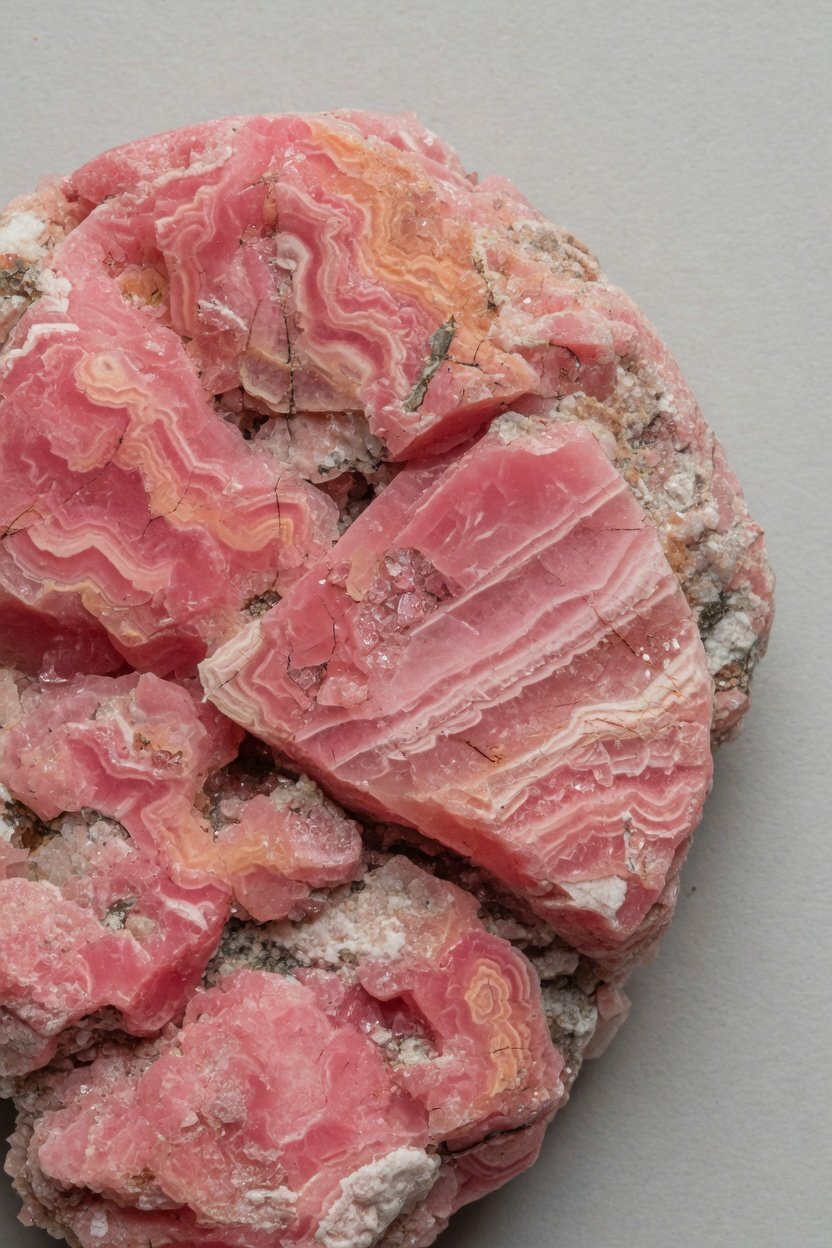
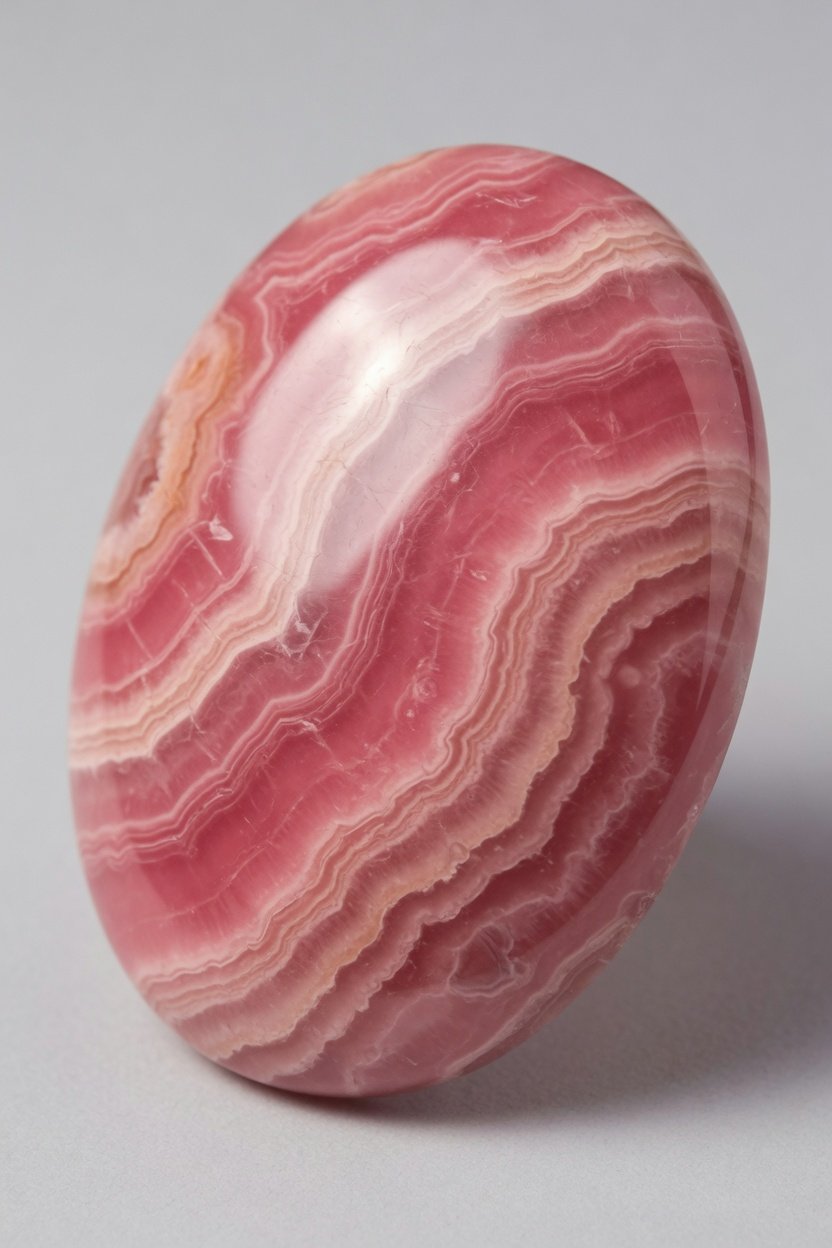
Rhodochrosite draws the eye with its distinctive raspberry-pink swirls and creamy white bands that ripple across the surface like frozen mineral rivers. The stone’s soft translucence and banded patterns make it instantly recognizable even before it reaches the bench. Silversmiths prize it for its warm glow against silver, yet its delicacy demands careful handling throughout every stage of fabrication.
Physical Properties Rhodochrosite is manganese carbonate with the formula MnCO₃. It registers 3.5–4 on the Mohs scale, rendering it too soft for everyday rings without protection. Specific gravity ranges from 3.5 to 3.7. The material shows vitreous to pearly luster and occurs in transparent to translucent form. Its perfect cleavage in three directions makes it prone to fracture under pressure or heat. Because of this fragility, the stone is always set after all soldering and polishing are complete; applying heat near the gem risks cracking or discoloration. Avoid ultrasonic cleaners and harsh chemicals; wipe with a soft damp cloth only.
Origin and Sourcing Primary deposits lie in Argentina’s Capillitas and Catamarca regions, Colorado’s Sweet Home Mine, and smaller occurrences in Peru and South Africa. Most commercial rhodochrosite is recovered from hard-rock veins using conventional underground mining methods. Miners follow narrow manganese-rich seams, extracting ore that is later sorted by hand for the best banded material. The Argentine deposits produce the classic vivid pink with sharp white banding, while Colorado specimens often display deeper red tones and occasional clear crystals.
History and Significance Inca peoples of the Andes collected the stone and called it “Inca Rose,” believing it carried the blood of their ancestors. Specimens reached European collections in the nineteenth century, where mineralogists formally described the species. During the twentieth century the Sweet Home Mine yielded spectacular transparent crystals that elevated rhodochrosite from curiosity to collector favorite. Its banded patterns have long symbolized emotional balance and compassion in various lapidary traditions.
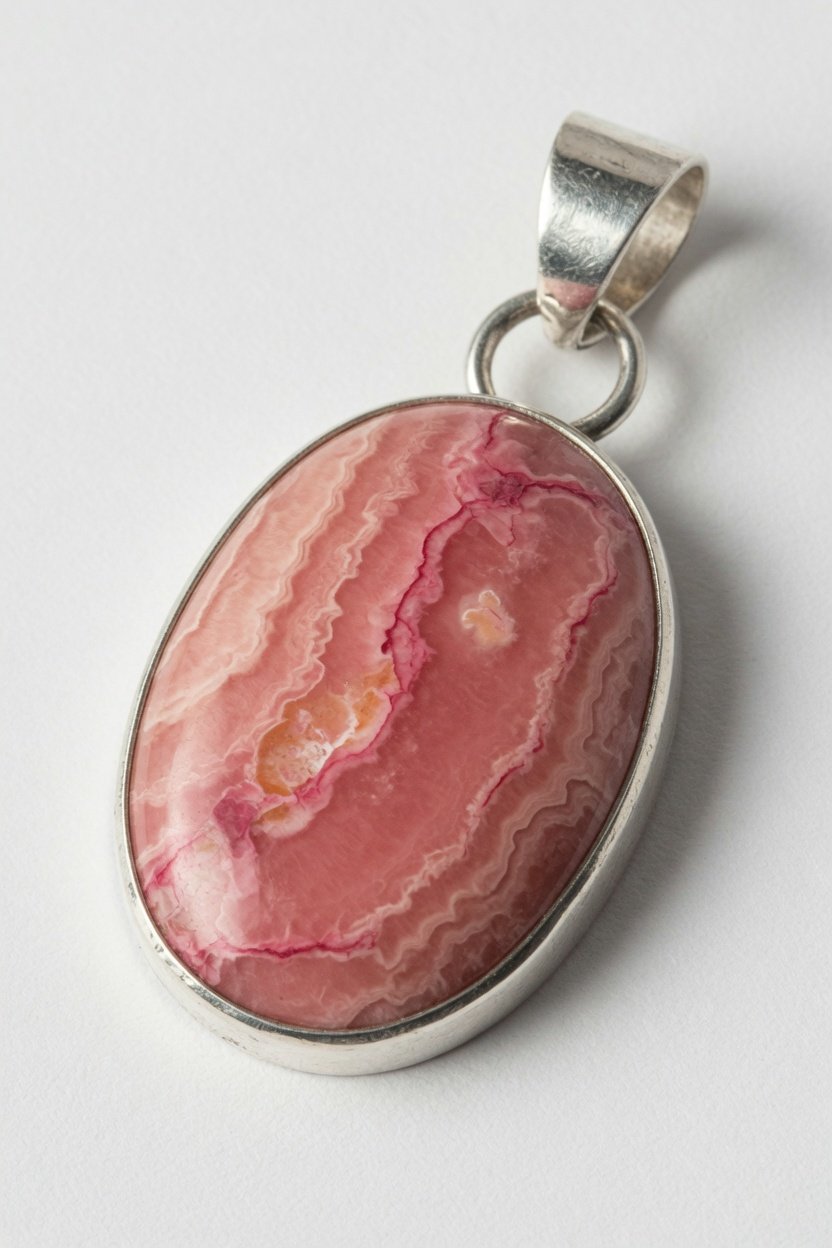
In Jewelry and Silversmithing Because of its low hardness, rhodochrosite is almost always cut as cabochons and set in protective bezels. Silversmiths complete all soldering, filing, and tumbling before introducing the stone. Classic closed or half-bezel settings in sterling silver provide the necessary rim of metal to shield the edges. The finished piece should be removed before household chores or sports; sudden temperature changes can cause the carbonate to craze. With proper care the stone retains its saturated color for generations.
Identifying Rhodochrosite in the Field Look for medium-pink matrix laced with curving white or pale-pink bands that follow rhombohedral growth patterns. The material feels noticeably lighter than surrounding country rock and may show a faint effervescence with dilute acid. Fresh surfaces display a glassy luster that dulls quickly when weathered. Always confirm hardness with a scratch test on an inconspicuous corner; anything below 5 on the Mohs scale rules out harder pink minerals such as rhodonite.
Quick Facts
Common names: Inca Rose, Raspberry Spar
Chemical formula: MnCO₃
Mohs hardness: 3.5–4
Specific gravity: 3.5–3.7
Color: Pink to red with white banding
Crystal system: Trigonal
Luster: Vitreous to pearly
Transparency: Transparent to translucent
Common cuts: Cabochon
Common treatments: None
Best silver setting: Classic Silver Bezel Pendant
Birthstone month (if any): None
Main sources: Argentina, United States (Colorado), Peru
Meaning & Intentions
EMOTIONAL HEALING
Rhodochrosite supports release of old emotional patterns by encouraging gentle self-compassion during reflective practices. Silversmiths set the banded cabochon in a protective silver bezel so the wearer can carry the stone close to the heart without fear of damage. The pink-and-white layers visually mirror the integration of past and present feelings.
Chakra: Heart — center of compassion and forgiveness INNER CLARITY
The stone’s alternating bands act as a visual metaphor for discerning layers of thought and feeling. When used in meditation the translucent pink zones invite focused attention on what lies beneath surface emotions. A simple pendant keeps the stone near the throat and heart for daily reminders of balanced perspective.
Chakra: Heart — bridge between emotion and expression PROTECTIVE GROUNDING
Rhodochrosite’s manganese content offers a subtle anchoring effect that steadies fluctuating moods. Crafted into a pendant or brooch, the stone becomes a tactile talisman that reminds the wearer to return to present-moment stability. Its softness necessitates bezel protection, reinforcing the intention of safeguarded boundaries.
Chakra: Heart — foundation for secure emotional boundaries Affirmation: "I welcome healing with an open and steady heart." AT A GLANCE: Chakra: Heart Element: Water Energy: Receptive Zodiac: Leo Planet: Venus Affirmation: "I welcome healing with an open and steady heart."
Related Stones
Explore more stones from the Gemstone Library: Aventurine · Amazonite · Agate