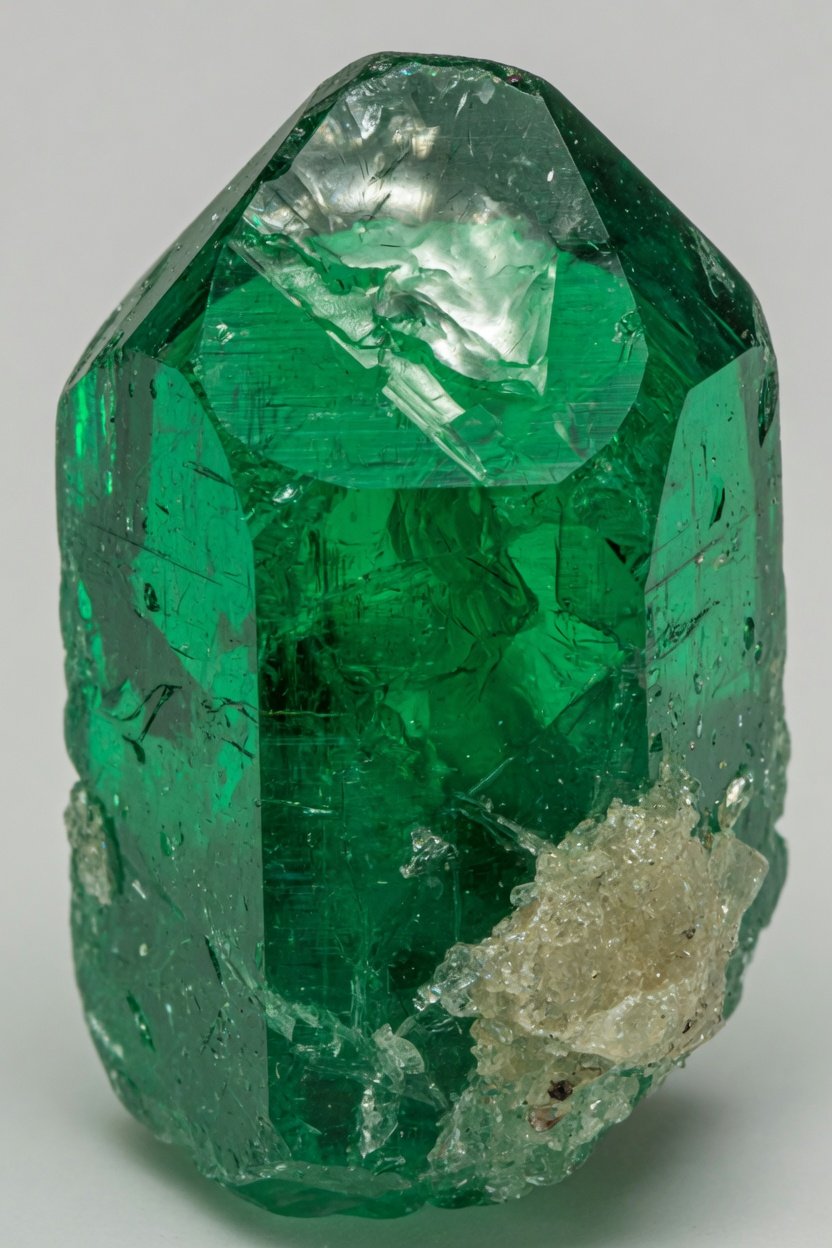
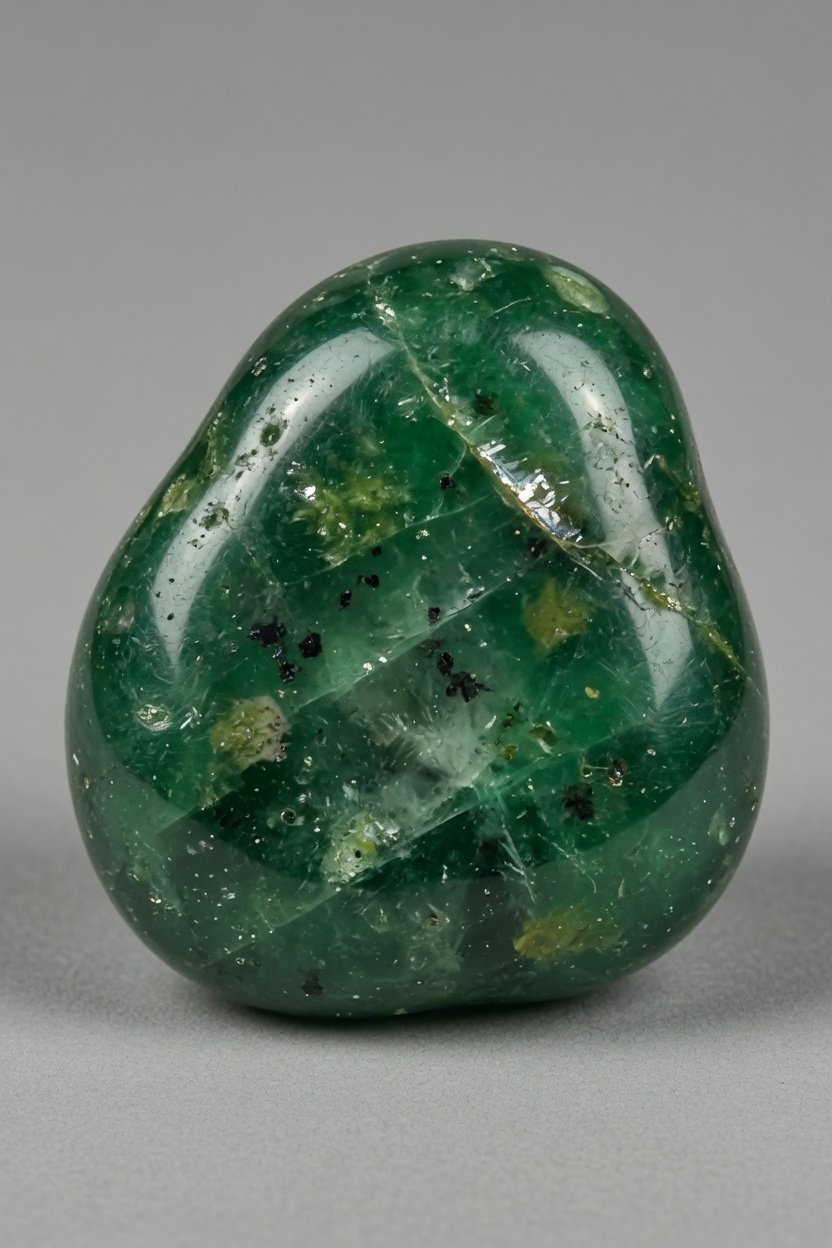
Emerald captures the eye with its saturated green that seems to hold the depth of ancient forests and the clarity of spring water. Formed under intense pressure deep within the earth, this variety of beryl carries chromium and vanadium that produce its unmistakable hue, often interrupted by natural inclusions known as jardin. These internal features give each stone a unique fingerprint while demanding careful handling from the moment it reaches the silversmith’s bench.
Physical Properties Emerald registers 7.5 to 8 on the Mohs scale yet remains brittle because of its numerous inclusions and three-directional cleavage. Its specific gravity sits between 2.67 and 2.78, producing a relatively light feel for its size. The crystal system is hexagonal, and the stone exhibits a vitreous luster that can appear slightly oily when heavily included. Transparency ranges from transparent to translucent, with the finest material showing strong saturation without being overly dark. Because emerald contains structural water, prolonged heat can cause fracturing or color change; therefore the stone must be set only after all soldering and polishing steps are complete. Avoid ultrasonic or steam cleaners, as the fractures can propagate under vibration or sudden temperature shifts.
Origin and Sourcing Major deposits occur in Colombia’s Muzo and Chivor mines, Brazil’s Itabira and Nova Era districts, Zambia’s Kafubu area, and Zimbabwe’s Sandawana belt. Colombian material typically forms in veins within black shale, while African stones often appear in talc-tremolite schists. Trace-element chemistry differs by locality, allowing gemologists to assign origin through spectroscopy. Rough is usually extracted through hard-rock tunneling rather than alluvial methods, yielding crystals that range from heavily fractured to remarkably clean.
History and Significance Egyptian pharaohs mined emerald as early as 1500 BCE in the Sikait-Zabara region, and Cleopatra’s mines supplied stones for Roman jewelry. Mughal emperors of India carved large emeralds with intricate floral motifs, many of which survive in museum collections today. In European heraldry the stone symbolized rebirth and foresight, while Andean cultures associated its green with agricultural fertility. These layered meanings continue to influence modern designers who choose emerald for pieces meant to convey renewal or protection.
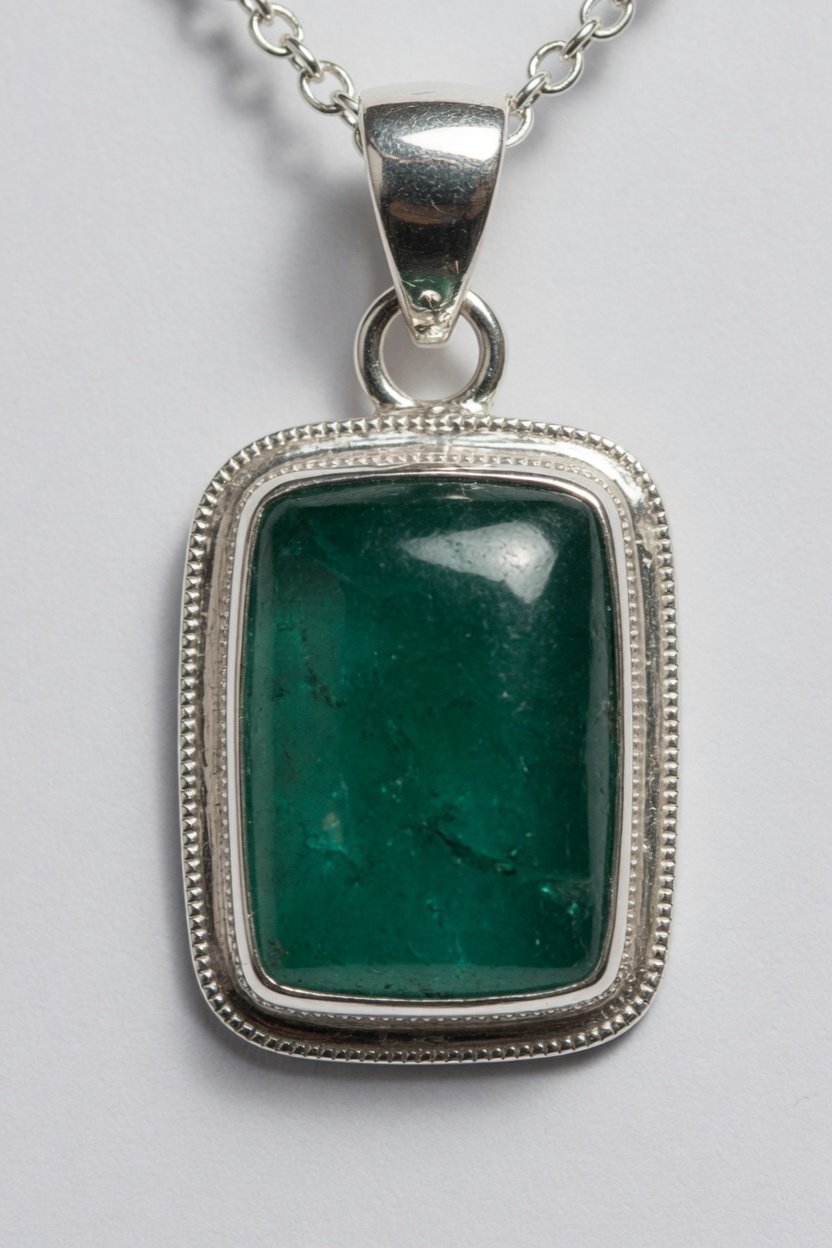
In Jewelry and Silversmithing Because of its inclusions and brittleness, emerald is almost always set after soldering is finished and the piece has cooled completely. Classic Silver Bezel Pendant settings provide full perimeter support without stressing the stone. Bezel walls are burnished gently to avoid point pressure, and a thin layer of epoxy is sometimes used behind the stone for added stability. Care instructions given to clients emphasize removal during heavy work or sports and periodic inspection of the bezel to ensure the stone remains secure.
Identifying Emerald in the Field A field test begins with color: a rich, slightly bluish green that does not shift dramatically under different lighting. Magnification reveals the characteristic jardin of mineral inclusions and fractures, often accompanied by hexagonal growth zoning. Refractive index measured with a refractometer falls between 1.565 and 1.602, and birefringence is low at 0.005–0.009. A Chelsea filter produces a red reaction in chromium-rich Colombian stones, while Zambian material may appear green. These combined observations distinguish emerald from green tourmaline or jadeite.
Quick Facts
Common names: Emerald
Chemical formula: Be₃Al₂Si₆O₁₈ with chromium and/or vanadium
Mohs hardness: 7.5–8 (brittle)
Specific gravity: 2.67–2.78
Color: Vivid green to bluish green
Crystal system: Hexagonal
Luster: Vitreous to slightly oily
Transparency: Transparent to translucent
Common cuts: Emerald cut, oval, cushion, cabochon
Common treatments: Oil or resin fracture filling
Best silver setting: Classic Silver Bezel Pendant
Birthstone month: May
Main sources: Colombia, Brazil, Zambia, Zimbabwe
Meaning & Intentions
RENEWAL
Emerald supports renewal by anchoring the wearer to cycles of growth and restoration. Silversmiths set the stone in pendants worn close to the heart so its steady green color can serve as a daily reminder to release old patterns and invite fresh energy into daily routines.
Chakra: Heart — center of compassion and emotional balance CLARITY
Emerald sharpens inner vision, helping the wearer discern truth beneath surface appearances. When placed in a pendant that rests over the heart, the stone’s inclusions act as a visual metaphor for seeing through complexity toward authentic understanding.
Chakra: Heart — center of compassion and emotional balance PROTECTION
Emerald creates a protective field that shields the heart from emotional depletion. Crafted into a silver bezel pendant, the stone’s natural fractures are framed rather than hidden, turning potential weakness into a symbol of resilient boundaries.
Chakra: Heart — center of compassion and emotional balance Affirmation: "I grow steadily, seeing clearly and protecting what matters." AT A GLANCE: Chakra: Heart Element: Water Energy: Receptive Zodiac: Taurus Planet: Venus Affirmation: "I grow steadily, seeing clearly and protecting what matters."
Related Stones
Explore more stones from the Gemstone Library: Rhodonite · Aventurine · Chrysoprase