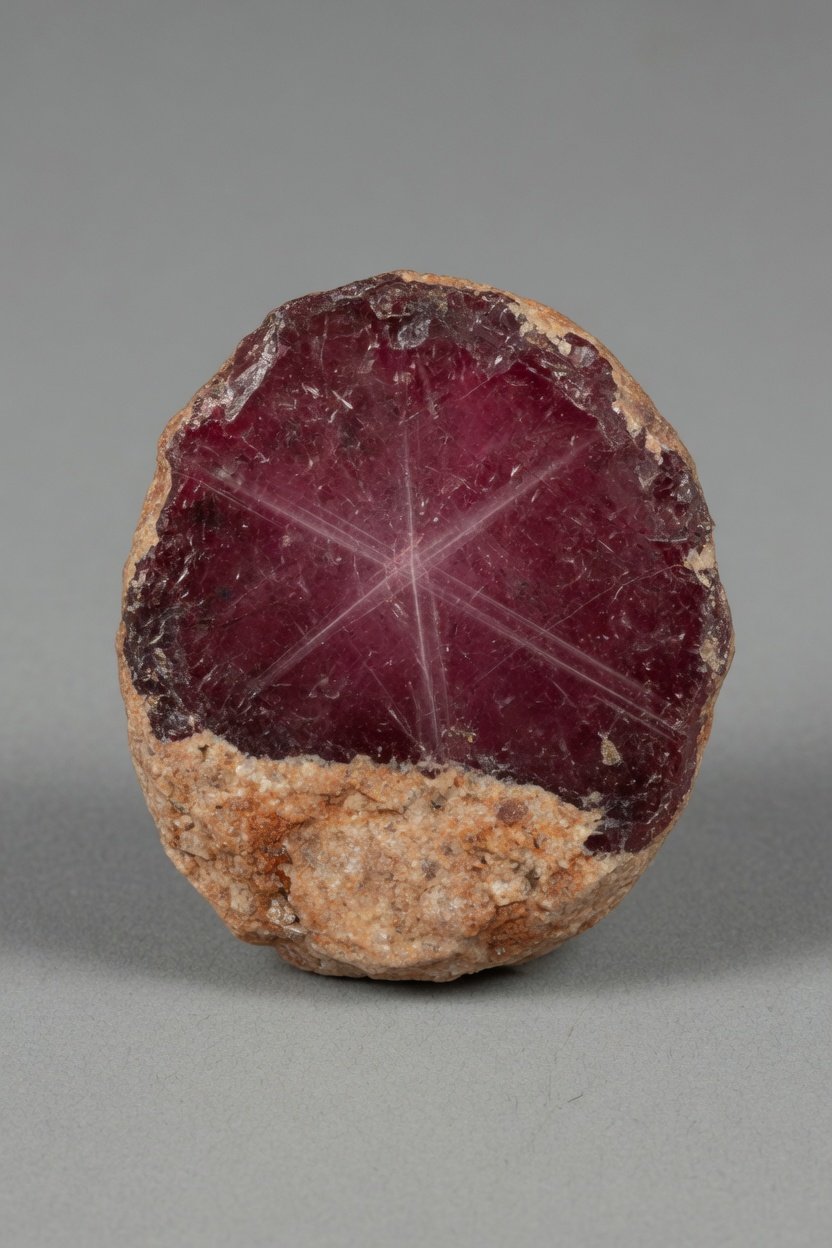
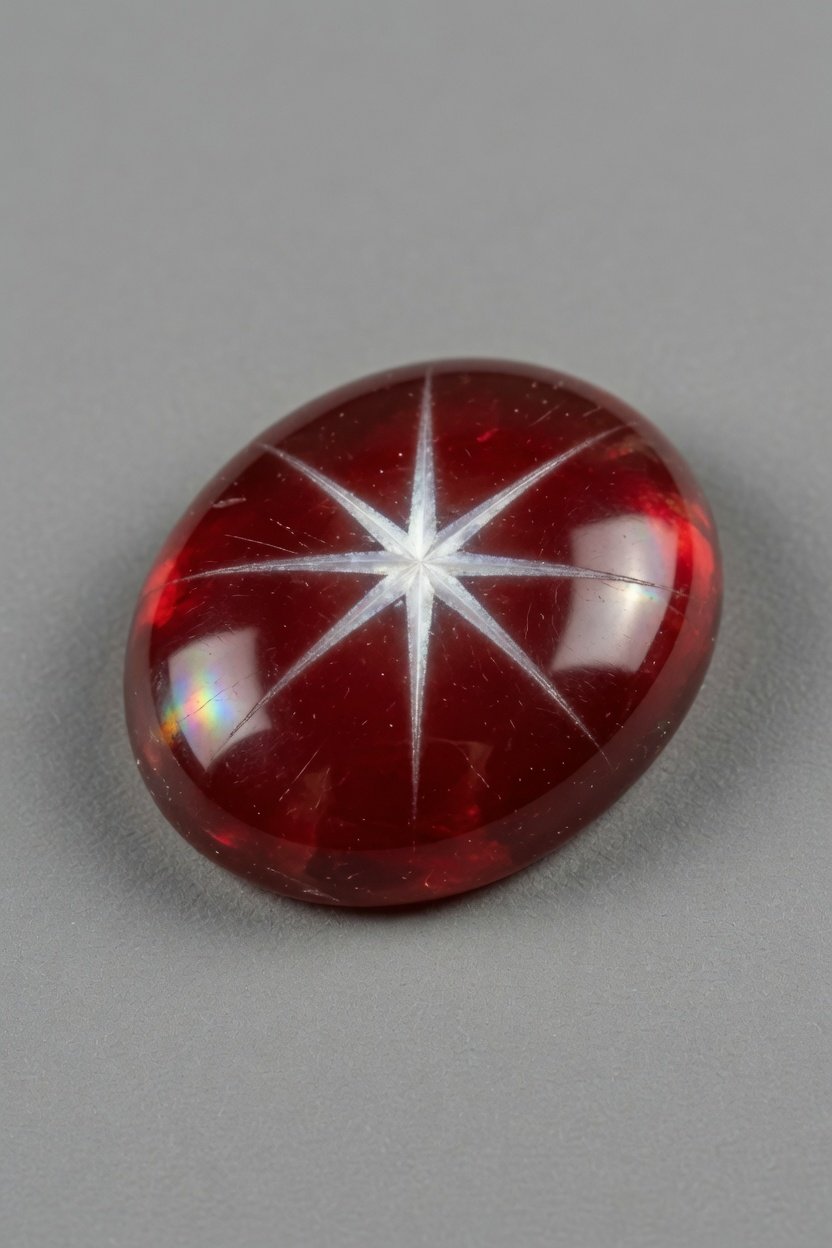
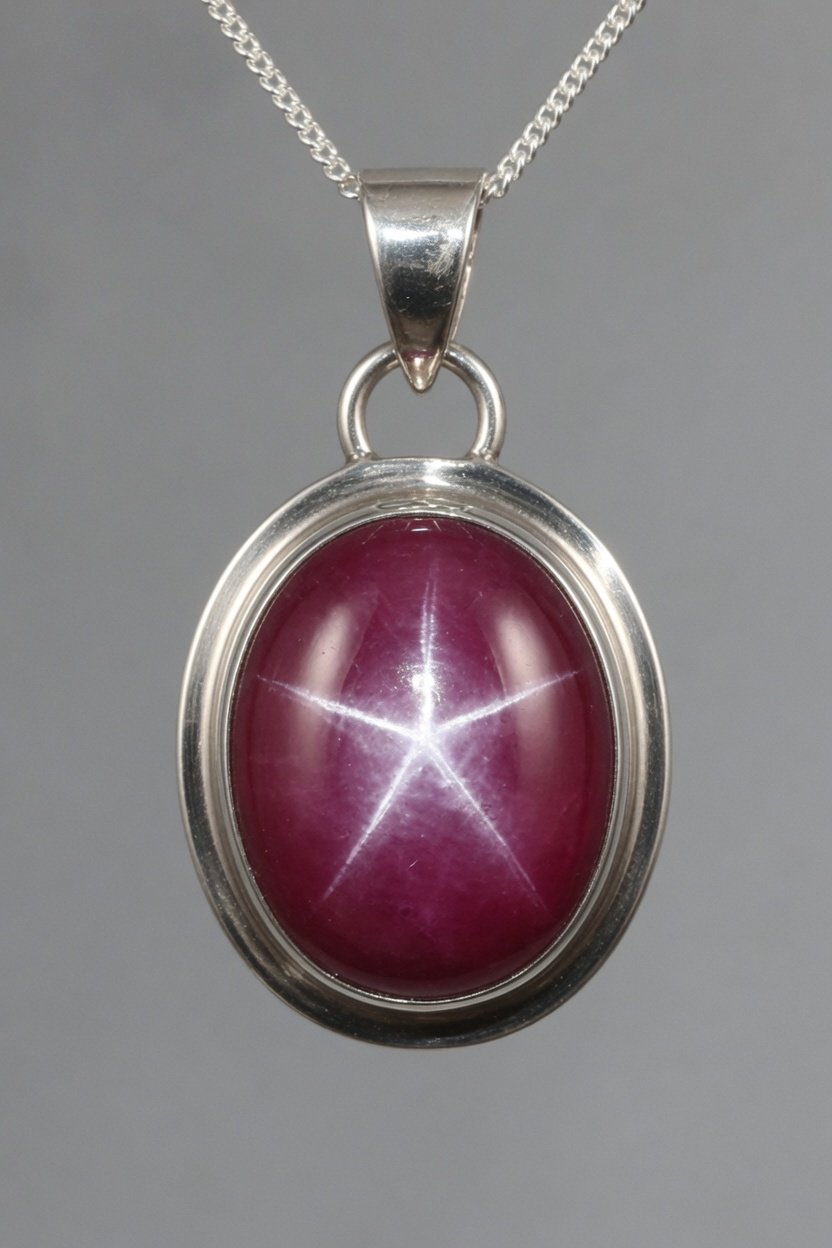
Star Ruby captures light in a rare six-rayed star that glides across its surface when moved under a single source, revealing a deep crimson body that seems to pulse with inner fire. This optical phenomenon arises from aligned rutile needles within the corundum crystal, turning an already durable gem into a living display of celestial geometry prized by collectors and artisans alike. The stone’s intense color and asterism together create an unmistakable presence that has drawn silversmiths for centuries.
Physical Properties Star Ruby registers 9 on the Mohs scale, second only to diamond, and exhibits a specific gravity near 4.00. Its hexagonal crystal system produces a vitreous luster that ranges from translucent to semi-opaque, with the signature asterism appearing only when the stone is cut as a cabochon oriented perpendicular to the c-axis. Trace iron and chromium create the saturated red hue, while the intersecting rutile silk responsible for the star must remain intact; any disruption destroys the effect. Because the material is heat-sensitive due to internal strain along cleavage planes, the stone must be set after all soldering is complete. Avoid ultrasonic and steam cleaners; warm soapy water and a soft brush are safest.
Origin and Sourcing Primary deposits lie in the Mogok Stone Tract of Myanmar, where marble-hosted corundum yields the finest stars. Additional sources include the alluvial gravels of Sri Lanka, the Karnataka region of India, and limited occurrences in Madagascar. Miners extract the rough through hard-rock tunneling or careful washing of river sediments, always searching for pieces that show even silk distribution under strong light. Rough is graded on the strength and centering of the future star before export.
History and Significance Ancient Burmese royalty reserved star rubies for the highest nobility, believing the star represented the divine eye watching over the kingdom. Medieval texts from the region describe the gem as a protector in battle and a guide for rulers. European lapidaries later adopted the stone during colonial trade, incorporating it into signet rings and ceremonial pieces that survive in museum collections today.
In Jewelry and Silversmithing Silversmiths favor low, protective bezels that allow light to graze the dome while shielding the girdle. The cabochon must be seated only after all heat work is finished to prevent cracking along rutile planes. Star orientation is critical: the artisan rotates the stone under a pinpoint lamp until the rays intersect perfectly at center before final setting. Daily wear demands caution around impacts that could dislodge silk alignment; periodic inspection under magnification ensures the star remains crisp.
Identifying Star Ruby in the Field In rough form the stone appears as a dull reddish lump with a sugary surface; breaking a small window reveals the internal silk as fine, straight, intersecting lines. A strong single light source held above the specimen will project a ghostly star across the polished test face. Color zoning is common, with deeper red cores surrounded by lighter rims. Hardness testing leaves no scratch from topaz, and the absence of visible cleavage distinguishes it from garnet or spinel imitations.
Quick Facts
Common names: Star Ruby, Asteriated Ruby
Chemical formula: Al₂O₃
Mohs hardness: 9
Specific gravity: 4.00
Color: Deep red with white six-rayed star
Crystal system: Hexagonal (trigonal)
Luster: Vitreous
Transparency: Translucent to semi-opaque
Common cuts: Cabochon
Common treatments: Heat treatment to improve color and silk visibility
Best silver setting: Classic Silver Bezel Pendant
Birthstone month (if any): July
Main sources: Myanmar, Sri Lanka, India, Madagascar
Meaning & Intentions
PROTECTION
Star Ruby forms an energetic boundary that absorbs scattered intentions and returns them to their source, allowing the wearer to move through uncertain spaces with steady focus. Artisans set the cabochon low in silver so the star remains visible yet guarded, reinforcing the stone’s role as a quiet sentinel during travel or confrontation.
Chakra: Root — grounding and physical security CLARITY
The gliding star sharpens perception, helping users notice patterns in daily events and separate signal from noise. When worn during decision-making, the gem’s steady rays encourage precise observation without emotional distortion.
Chakra: Third Eye — insight and focused awareness BOUNDARIES
Star Ruby seals personal space by reflecting external pressure back outward, supporting those who need firmer limits in relationships or work. The silver bezel acts as a literal frame that mirrors this internal containment.
Chakra: Solar Plexus — personal power and self-definition Affirmation: "My center holds steady under any light." AT A GLANCE: Chakra: Root, Third Eye, Solar Plexus Element: Fire Energy: Protective, clarifying, stabilizing Zodiac: Aries, Leo, Scorpio Planet: Mars Affirmation: "My center holds steady under any light."
Related Stones
Explore more stones from the Gemstone Library: Ruby · Tiger's Eye · Bloodstone