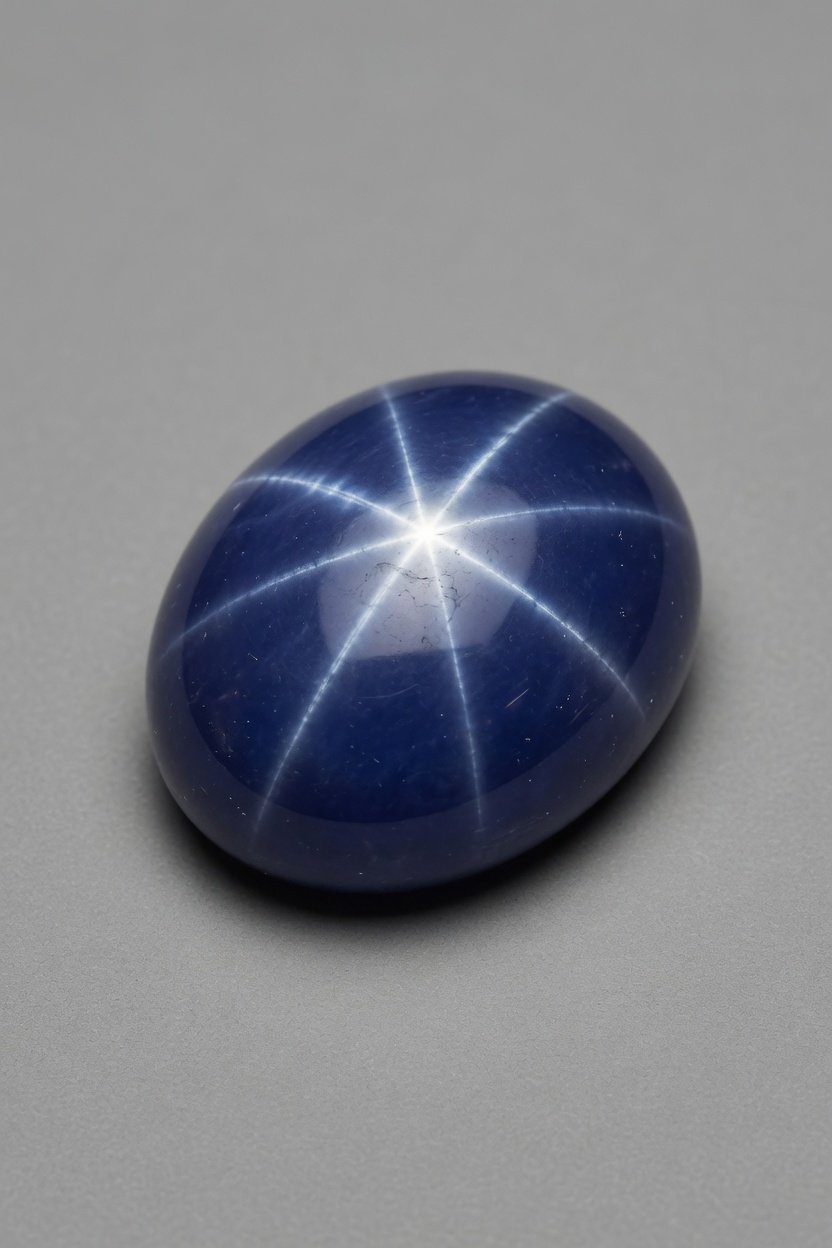
Star Sapphire forms deep within the earth yet reveals its celestial secret only when light strikes its surface at the precise angle. The stone’s signature six-rayed star floats across a velvety dome, shifting gently as the piece moves, as though the night sky itself has been captured in corundum. This optical phenomenon draws silversmiths and collectors alike into its quiet gravitational pull.
Physical Properties Star Sapphire is a variety of corundum whose aluminum-oxide crystals contain aligned rutile needles that produce asterism. It registers 9 on the Mohs scale, second only to diamond, and displays a specific gravity near 4.0. The stone is typically translucent to semi-opaque, with a vitreous to silky luster that softens reflected light into the characteristic star. Because the rutile inclusions are heat-sensitive above certain thresholds, the finished cabochon must be set only after all soldering and torch work are complete; prolonged high heat can blur or erase the star. Daily care requires avoiding ultrasonic cleaners and storing the piece away from harder gems that could scratch the polished dome.
Origin and Sourcing Primary deposits occur in alluvial gravels and metamorphic rocks across Sri Lanka, Myanmar, Madagascar, and parts of Australia. Miners recover the rough by screening river sediments or carefully extracting it from weathered host rock. Color zoning and star orientation vary by locality, with Sri Lankan material often showing the sharpest rays against a cornflower ground. Trace elements such as iron and titanium determine both body color and the density of the rutile silk responsible for the star.
History and Significance Ancient traders carried star sapphires along the Silk Road, where the stones were prized as talismans of safe passage. In medieval Europe they were set into crowns and reliquaries to symbolize divine guidance. By the nineteenth century, the discovery of large, gem-quality crystals in Ceylon renewed interest among European lapidaries, who perfected the cabochon cut that best displays the asterism. Today the stone continues to evoke both celestial wonder and grounded protection.
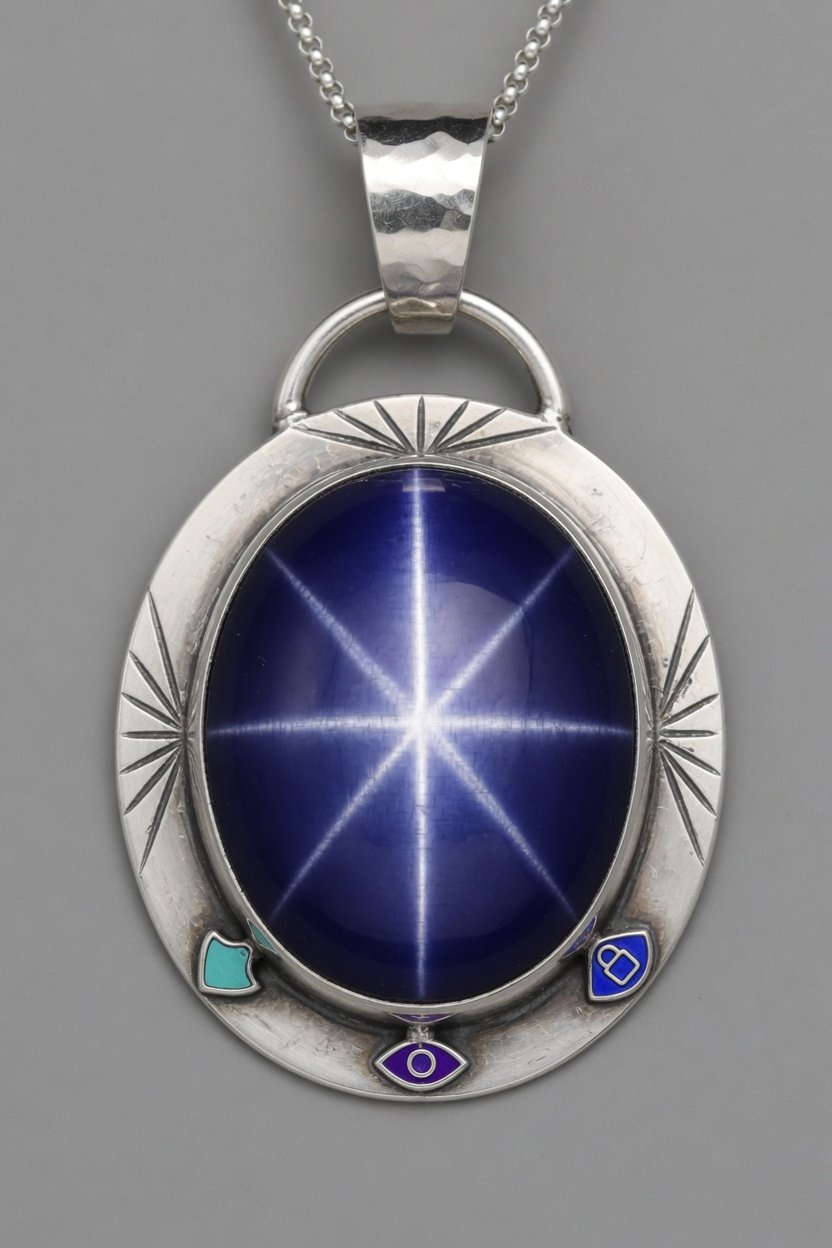
In Jewelry and Silversmithing Silversmiths favor low, protective bezels that cradle the dome without interrupting the star’s movement. The metal should be finished and cooled before the stone is seated, preventing any thermal shock to the rutile needles. Because the star is directional, the cabochon must be oriented so the rays align with the wearer’s natural line of sight when the piece rests on the body. This attention to orientation transforms a simple ring or pendant into a living optical instrument.
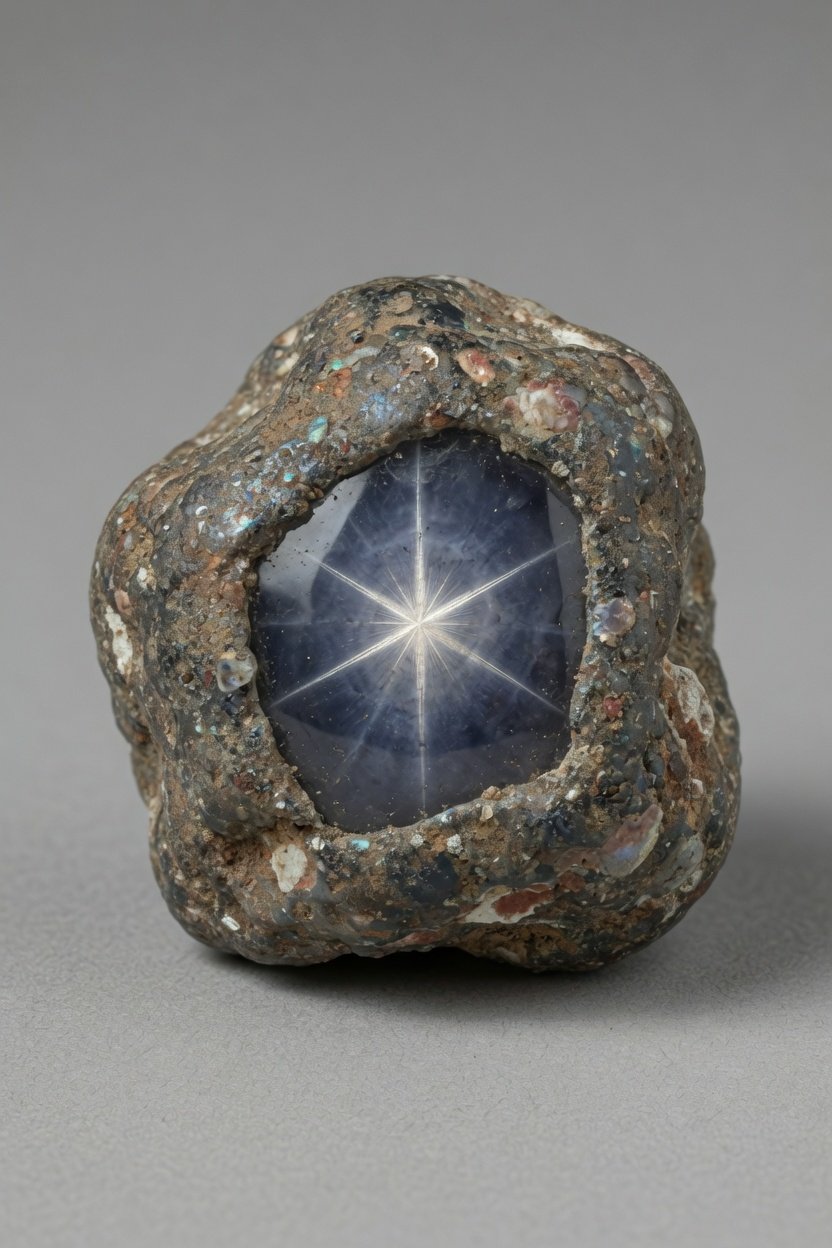
Identifying Star Sapphire in the Field In rough form the stone appears as a blue-gray lump with a slightly greasy feel; only after a window is polished does the star emerge. A true star remains sharp under a single overhead light source and moves smoothly across the surface when the stone is rotated. Synthetic or doublet imitations often show a star that stays fixed or dissolves into multiple faint rays. Natural specimens may also display hexagonal growth lines visible under magnification, confirming their corundum identity.
Quick Facts
Common names: Star Sapphire, Asteriated Sapphire
Chemical formula: Al₂O₃
Mohs hardness: 9
Specific gravity: 3.99–4.00
Color: Blue, pink, black, or gray with white six-rayed star
Crystal system: Trigonal
Luster: Vitreous to silky
Transparency: Translucent to opaque
Common cuts: Cabochon
Common treatments: Heat treatment to improve color and silk
Best silver setting: Classic Silver Bezel Pendant
Birthstone month (if any): September
Main sources: Sri Lanka, Myanmar, Madagascar, Australia
Meaning & Intentions
GUIDANCE
Star Sapphire channels focused intention, helping the wearer perceive clear direction amid uncertainty. The stone’s star acts as an inner compass, steadying thought and revealing the next right step when decisions feel clouded. Silversmiths set the cabochon so the rays point outward, symbolically extending that clarity into daily life.
Chakra: Third Eye — intuition and inner vision PERCEPTION
The asterism sharpens awareness of subtle patterns and hidden information. Wearers report an increased ability to notice synchronicities and read situations with greater accuracy. In jewelry the moving star serves as a gentle daily reminder to stay present and observant.
Chakra: Crown — expanded awareness PROTECTION
Star Sapphire forms an energetic boundary that deflects negativity while preserving personal sovereignty. Its hardness mirrors an unyielding shield, and the star’s light is said to illuminate safe passage through challenging circumstances. The stone is traditionally carried or worn during travel and major life transitions.
Chakra: Root — stability and grounding Affirmation: "I follow the light that moves within me." AT A GLANCE: Chakra: Third Eye Element: Air Energy: Receptive Zodiac: Virgo Planet: Saturn Affirmation: "I follow the light that moves within me."
Related Stones
Explore more stones from the Gemstone Library: Benitoite · Sillimanite · Phenakite