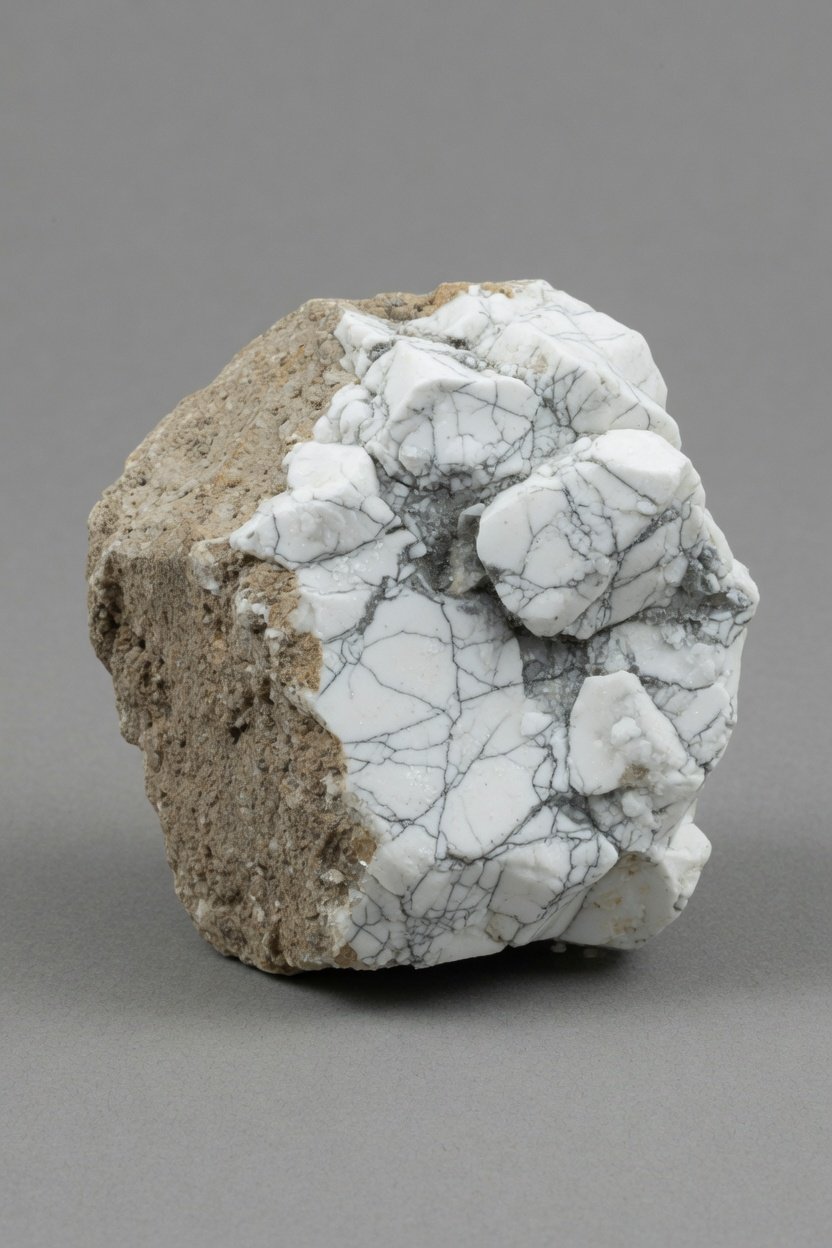
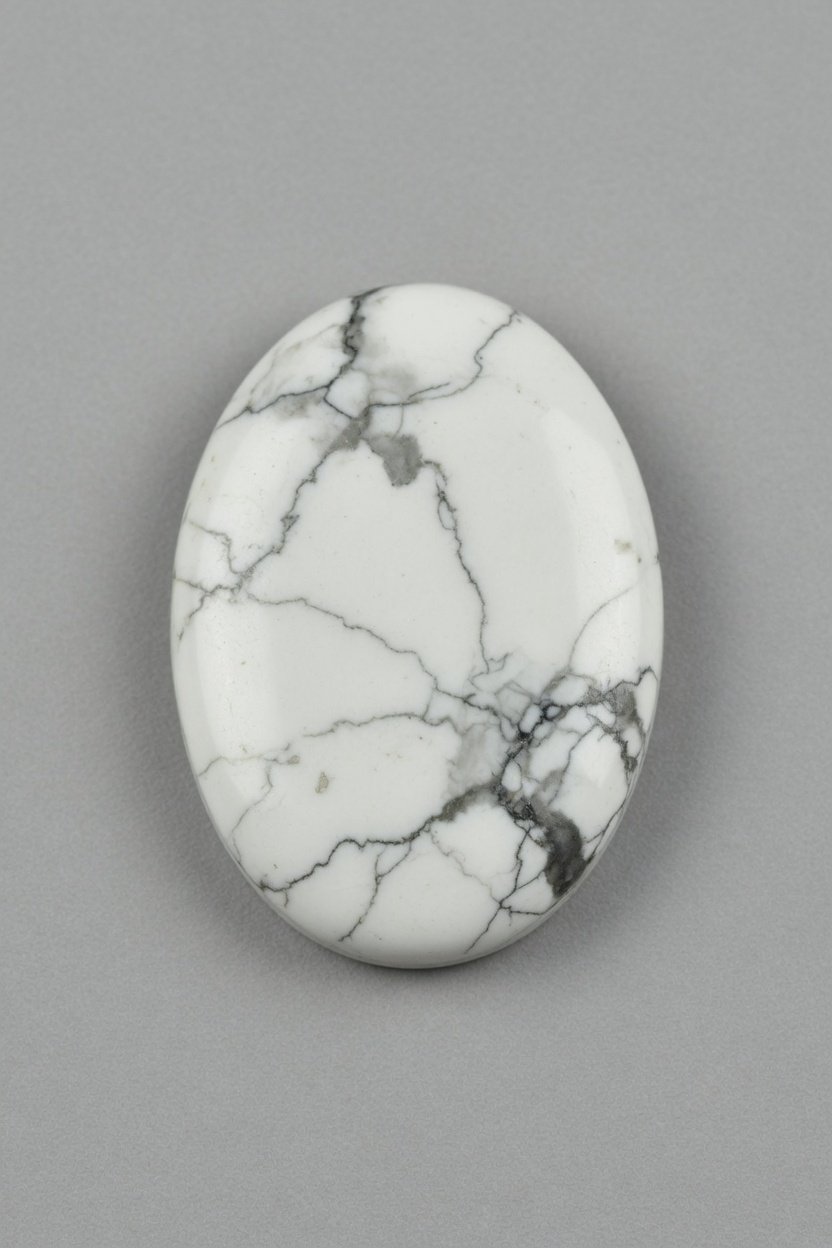
Howlite emerges from the earth as a quiet marvel of white stone laced with delicate black veins, its soft surface inviting touch while hinting at deeper layers of calm beneath the surface. This calcium borosilicate mineral forms in nodular masses that jewelers prize for their ability to take a gentle polish, revealing patterns reminiscent of marble or snow-dusted landscapes. Its understated presence makes it a favorite in silversmithing studios where restraint meets artistry.
Physical Properties Howlite registers 3.5 on the Mohs scale, rendering it softer than most common jewelry stones and requiring careful handling throughout fabrication. Its specific gravity hovers between 2.45 and 2.58, giving pieces a lightweight feel once set. The stone is opaque with a dull to earthy luster and displays characteristic white ground color interrupted by fine black manganese oxide veining. Because of its moderate hardness and water content, the stone must always be set after all soldering is complete; heat from the torch can cause cracking or discoloration. Daily care cautions include avoiding ultrasonic cleaners, prolonged water exposure, and abrasive polishes that could dull the surface or widen natural fissures.
Origin and Sourcing Howlite occurs primarily in evaporite deposits within Nova Scotia, California, and parts of Mexico. Miners extract the nodules from sedimentary layers using open-pit methods that expose the white masses amid gray host rock. Canadian sources near Windsor yield dense, high-quality material prized for its clean veining, while California deposits often produce larger nodules suitable for statement cabochons. Ethical sourcing emphasizes small-scale operations that reclaim disturbed ground and limit heavy equipment use.
History and Significance Discovered in 1868 by Canadian geologist Henry How, howlite quickly entered mineral collections for its distinctive appearance. Indigenous artisans in North America incorporated similar white stones into ceremonial objects long before formal naming, valuing the material for its soothing visual rhythm. Victorian lapidaries later adopted howlite for mourning jewelry, where its pale tone symbolized quiet remembrance. Over time the stone’s lore expanded to include themes of memory and measured reflection.
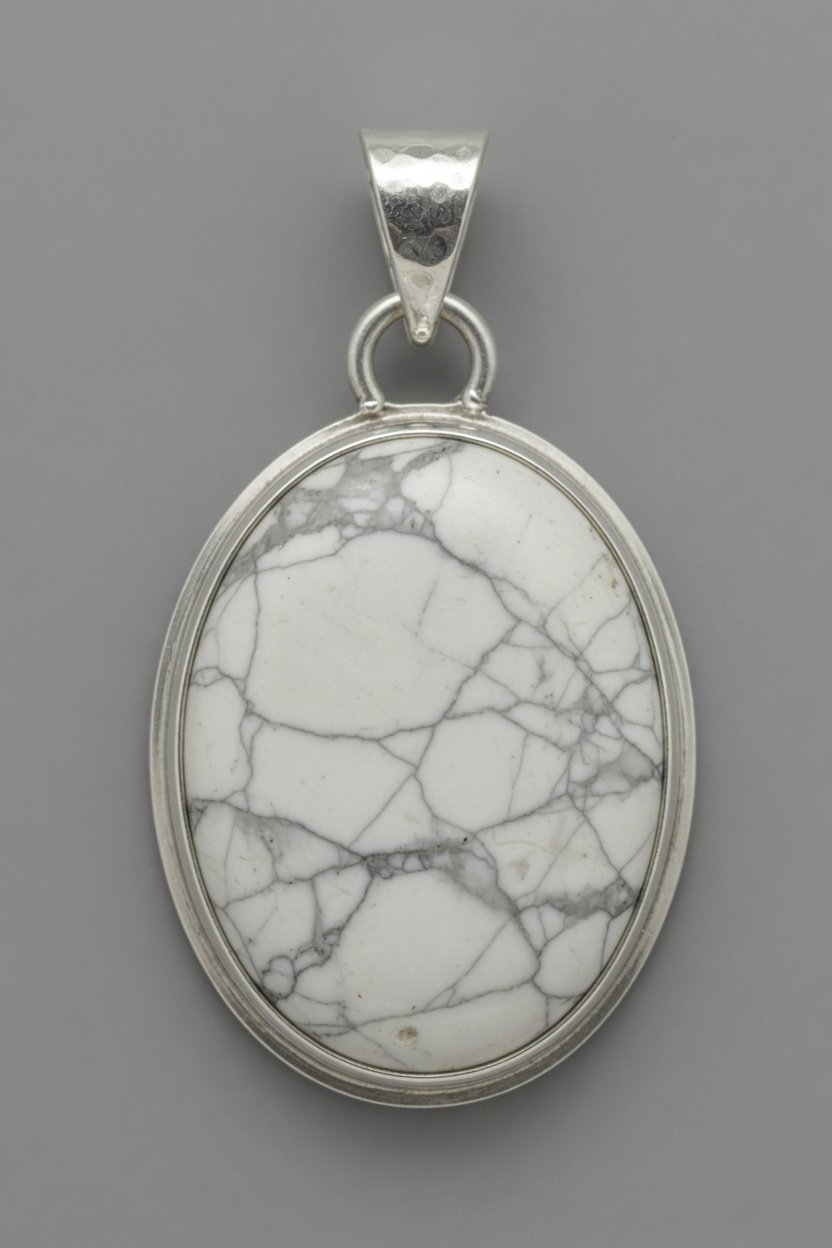
In Jewelry and Silversmithing Silversmiths favor howlite for cabochon work because its opaque body accepts a smooth dome without the need for faceting equipment. The stone’s veining provides natural contrast against sterling silver, especially when set in bezels that protect the soft edges. After soldering, the cooled piece receives the cabochon so no thermal shock occurs. Designers often orient veins to follow the curve of a pendant or ring, creating movement that echoes flowing water. Care instructions given to clients emphasize storing pieces separately to prevent scratching and wiping with a soft cloth rather than immersing in liquids.
Identifying Howlite in the Field Field identification begins with the white color and fine black dendritic veining that resembles frost on glass. The stone feels slightly warm to the touch compared with denser minerals and can be scratched with a copper penny. Broken surfaces reveal a porcelain-like texture rather than conchoidal fracture. When doubt remains, a small drop of water darkens the surface temporarily, a reaction tied to its slight porosity.
Quick Facts
Common names: Howlite, white turquoise (misnomer), cauliflower stone
Chemical formula: Ca₂B₅SiO₉(OH)₅
Mohs hardness: 3.5
Specific gravity: 2.45–2.58
Color: White with black veining
Crystal system: Monoclinic
Luster: Dull to earthy
Transparency: Opaque
Common cuts: Cabochon
Common treatments: Dyed blue to imitate turquoise
Best silver setting: Bezel
Birthstone month (if any): None
Main sources: Canada (Nova Scotia), USA (California), Mexico
Meaning & Intentions
CALM FOCUS
Howlite supports steady concentration during long silversmithing sessions by encouraging measured breathing and release of scattered thoughts. Artisans keep a small polished piece on the bench to touch between steps, letting its cool surface anchor attention back to the present task. The stone’s veining acts as a visual reminder that complexity can still rest within order.
Chakra: Root — grounding and physical steadiness CLEAR PERCEPTION
Howlite sharpens observational skills when studying stone patterns or metal textures, helping makers notice subtle details before committing to cuts or settings. Practitioners place the stone near design sketches so its quiet energy invites patient examination rather than hurried decisions. Over time the habit builds confidence in trusting one’s eye.
Chakra: Third Eye — insight and pattern recognition BOUNDARY SETTING
Howlite assists in maintaining personal limits during collaborative studio work by reinforcing calm resolve without confrontation. Wearers carry a small tumbled piece in a pocket as a tactile cue to pause before overcommitting time or energy. The stone’s structure models strength through gentle consistency rather than rigidity.
Chakra: Throat — honest communication and limits Affirmation: "I move through my work with steady clarity and protected energy." AT A GLANCE: Chakra: Root, Third Eye, Throat Element: Earth Energy: Receptive Zodiac: Gemini, Virgo Planet: Moon Affirmation: "I move through my work with steady clarity and protected energy."
Related Stones
Explore more stones from the Gemstone Library: Chrysoberyl · Agate · Boulder Opal