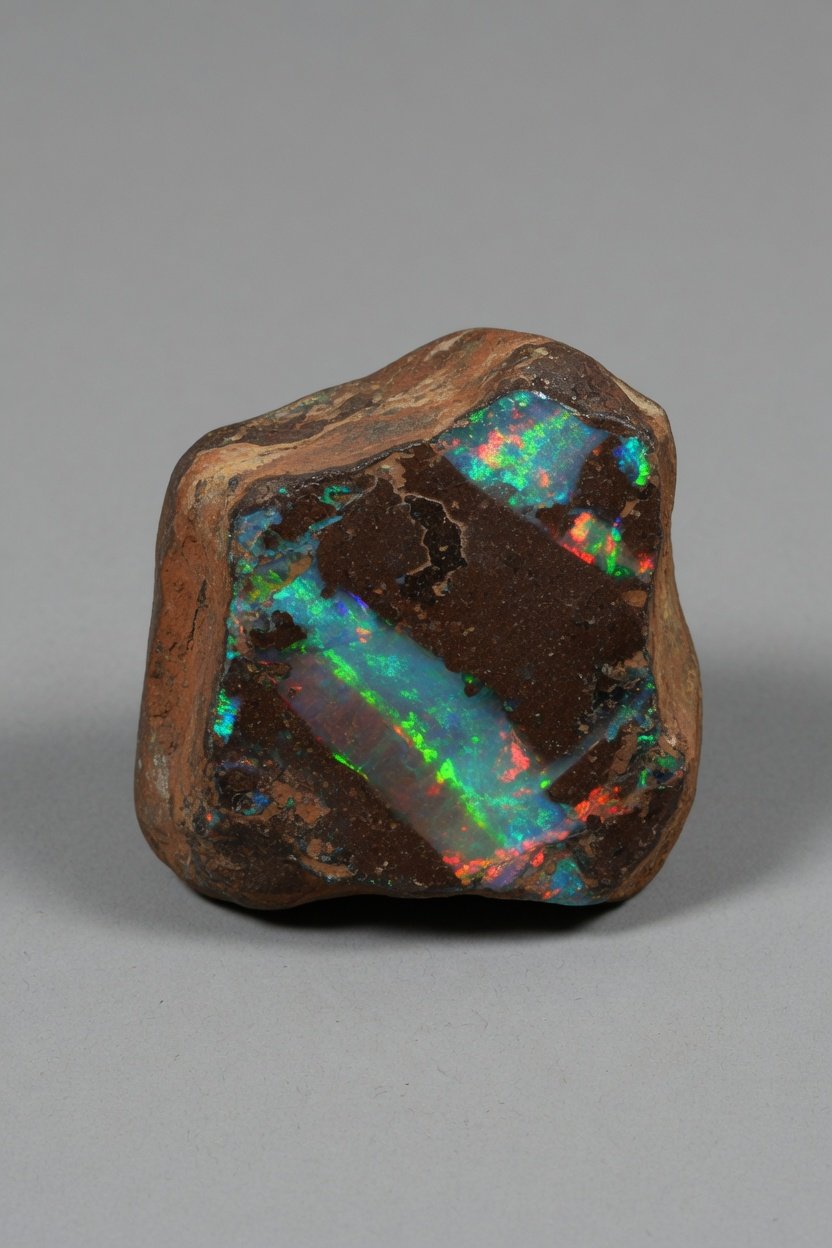
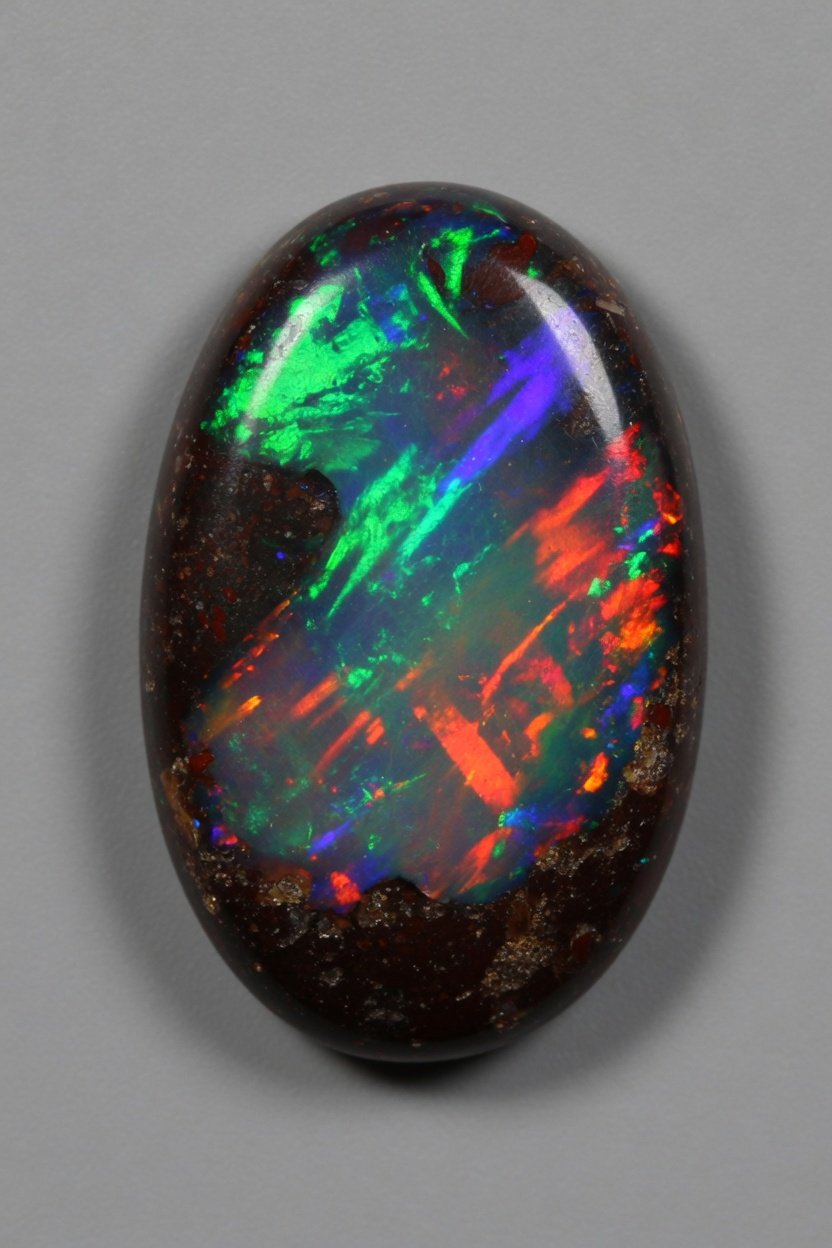
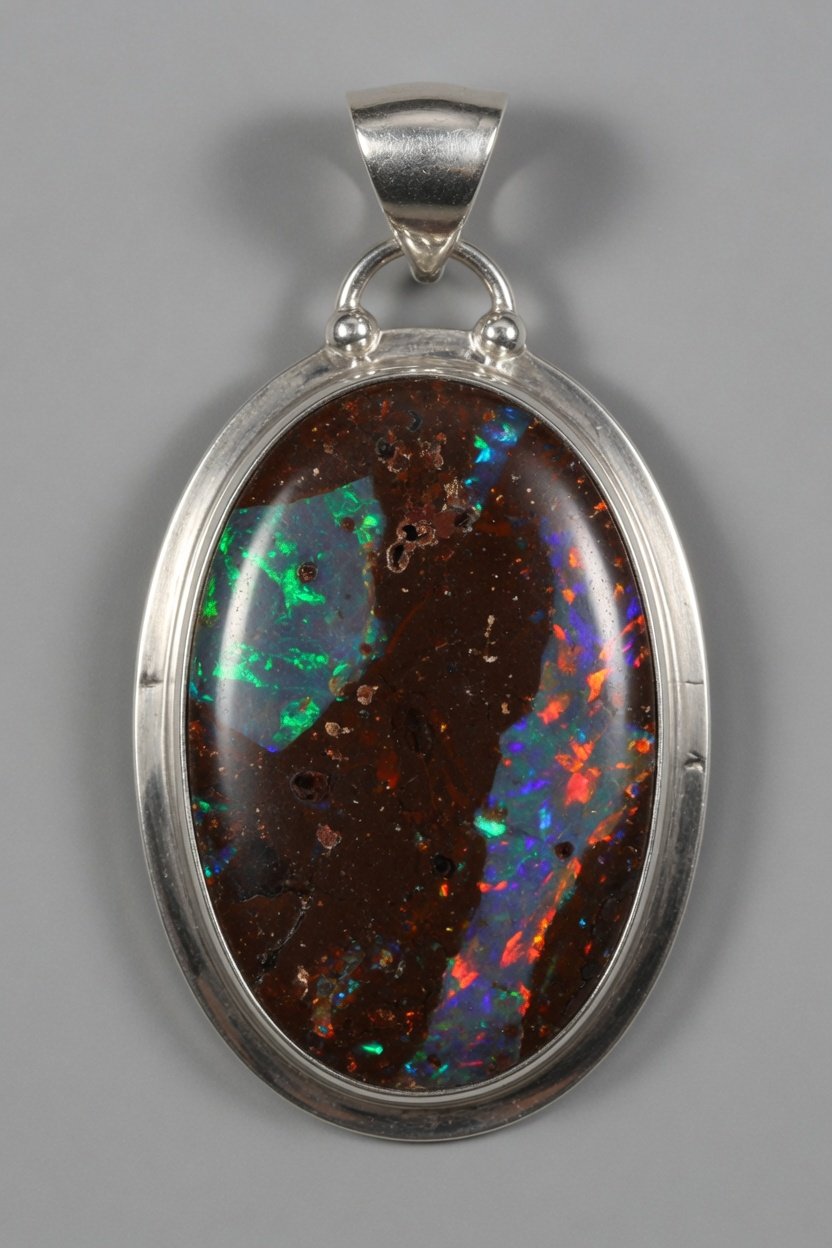
Boulder Opal emerges from the ancient ironstone landscapes of Australia as a stone that conceals vivid flashes of spectral color within its rugged matrix. Formed over millions of years, this variety of precious opal reveals its inner fire only when the matrix is carefully shaped and polished, offering silversmiths a material that balances earthy strength with ethereal brilliance. Its unique structure makes it a favorite for those who seek both durability and visual drama in handcrafted jewelry.
Physical Properties Boulder Opal consists of hydrated silica deposited within cracks and cavities of ironstone, resulting in a hardness ranging from 5.5 to 6.5 on the Mohs scale and a specific gravity between 1.9 and 2.3. The stone displays a vitreous to waxy luster with play-of-color that shifts through greens, blues, reds, and oranges against a dark brown or black matrix. Because the opal layer is intimately bonded to the host rock, the material exhibits greater toughness than seam opal, reducing the risk of cracking during setting. Silversmiths always set Boulder Opal after all soldering operations are complete to avoid heat damage to its water content, and they recommend avoiding prolonged exposure to ultrasonic cleaners or sudden temperature changes that could cause crazing.
Origin and Sourcing The primary deposits lie in Queensland, Australia, particularly around the towns of Quilpie, Winton, and Yowah, where ironstone boulders weathered from Cretaceous sediments contain precious opal veins. Miners extract the material through hard-rock tunneling and selective blasting, preserving the natural matrix that gives each piece its distinctive character. Australian Boulder Opal accounts for the majority of commercial supply, with smaller occurrences reported in other regions but rarely matching the intensity of color or matrix integration found in the Queensland fields.
History and Significance Indigenous Australians have long recognized the stone’s presence in the landscape, incorporating similar opals into cultural stories that speak of rainbows trapped in the earth. European prospectors began systematic mining in the late nineteenth century, and Boulder Opal gained international attention at world expositions for its ability to display broad flashes of color within a wearable, durable form. The stone’s significance grew among silversmiths who valued its resistance to chipping compared with thinner opal seams, allowing larger, more sculptural designs.
In Jewelry and Silversmithing Silversmiths favor Boulder Opal for cabochon cuts that highlight the contrast between the dark matrix and vivid color bars. The material accepts a high polish that enhances its play-of-color without the fragility that often accompanies purer opal. After soldering, the stone is set in bezels or prongs that protect the edges while allowing light to reach the color zones. Care cautions include storing pieces away from direct sunlight for extended periods and cleaning only with a soft cloth and mild soap to preserve both the polish and the integrity of the silica layers.
Identifying Boulder Opal in the Field In the field, Boulder Opal appears as rounded ironstone nodules or boulders with a dark, iron-rich exterior that may show thin veins or patches of iridescence when broken or wetted. The matrix is typically brown to black and dense, distinguishing it from the lighter host rocks of other opal varieties. Genuine material shows color that remains visible even in direct sunlight, unlike glass imitations that lose fire under strong illumination. Prospectors test suspected pieces by noting the seamless transition between opal and ironstone, confirming the stone formed in situ rather than being assembled.
Quick Facts
Common names: Boulder Opal
Chemical formula: SiO₂·nH₂O (hydrated silica in ironstone matrix)
Mohs hardness: 5.5–6.5
Specific gravity: 1.9–2.3
Color: Dark brown/black matrix with play-of-color flashes in green, blue, red, orange
Crystal system: Amorphous
Luster: Vitreous to waxy
Transparency: Opaque to translucent in thin color bars
Common cuts: Cabochon
Common treatments: None (occasional stabilization)
Best silver setting: Classic Silver Bezel Pendant
Birthstone month (if any): October
Main sources: Queensland, Australia
Meaning & Intentions
GROUNDING
Boulder Opal anchors scattered energy by combining the stabilizing weight of ironstone with flashes of color that remind the wearer of earth’s hidden vitality. Silversmiths set the stone in protective bezels so the matrix remains in direct contact with the skin, allowing its steady presence to support daily resilience and calm during creative work.
Chakra: Root — fosters security and connection to physical reality INSIGHT
The stone’s shifting colors within dark matrix encourage clear perception of subtle patterns in life and relationships. When worn as a pendant near the heart or throat, Boulder Opal is believed to open pathways for intuitive understanding while the ironstone prevents the insight from becoming overwhelming.
Chakra: Third Eye — supports focused awareness and pattern recognition PROTECTION
Boulder Opal’s tough matrix shields the more delicate opal layers, mirroring an energetic boundary that guards against negativity. Artisans choose sturdy silver settings that encase the edges, letting the stone serve as a talisman for personal boundaries during travel or challenging projects.
Chakra: Solar Plexus — reinforces inner strength and self-trust Affirmation: "I stand steady while color and possibility move through me." AT A GLANCE: Chakra: Root, Third Eye, Solar Plexus Element: Earth Energy: Receptive Zodiac: Scorpio, Virgo Planet: Saturn Affirmation: "I stand steady while color and possibility move through me."
Related Stones
Explore more stones from the Gemstone Library: Agate · Moss Agate · Picture Jasper