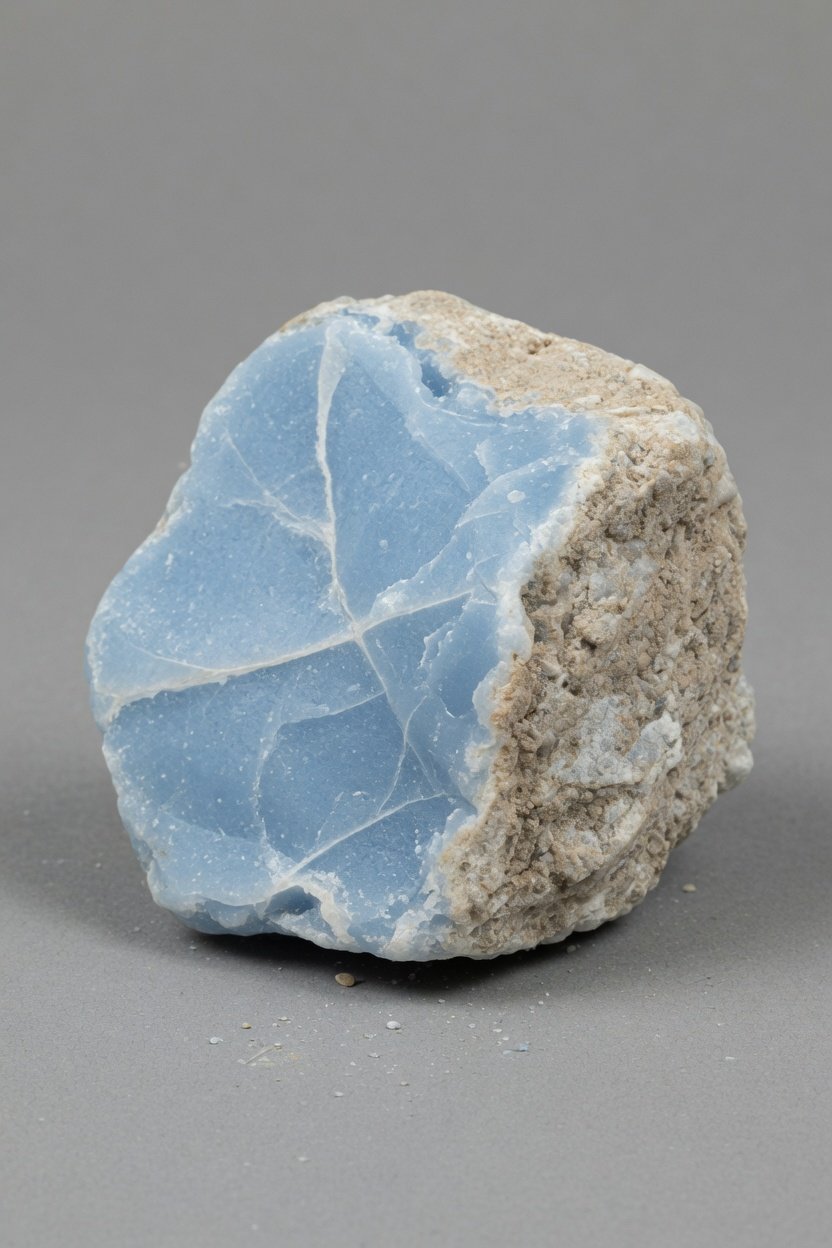
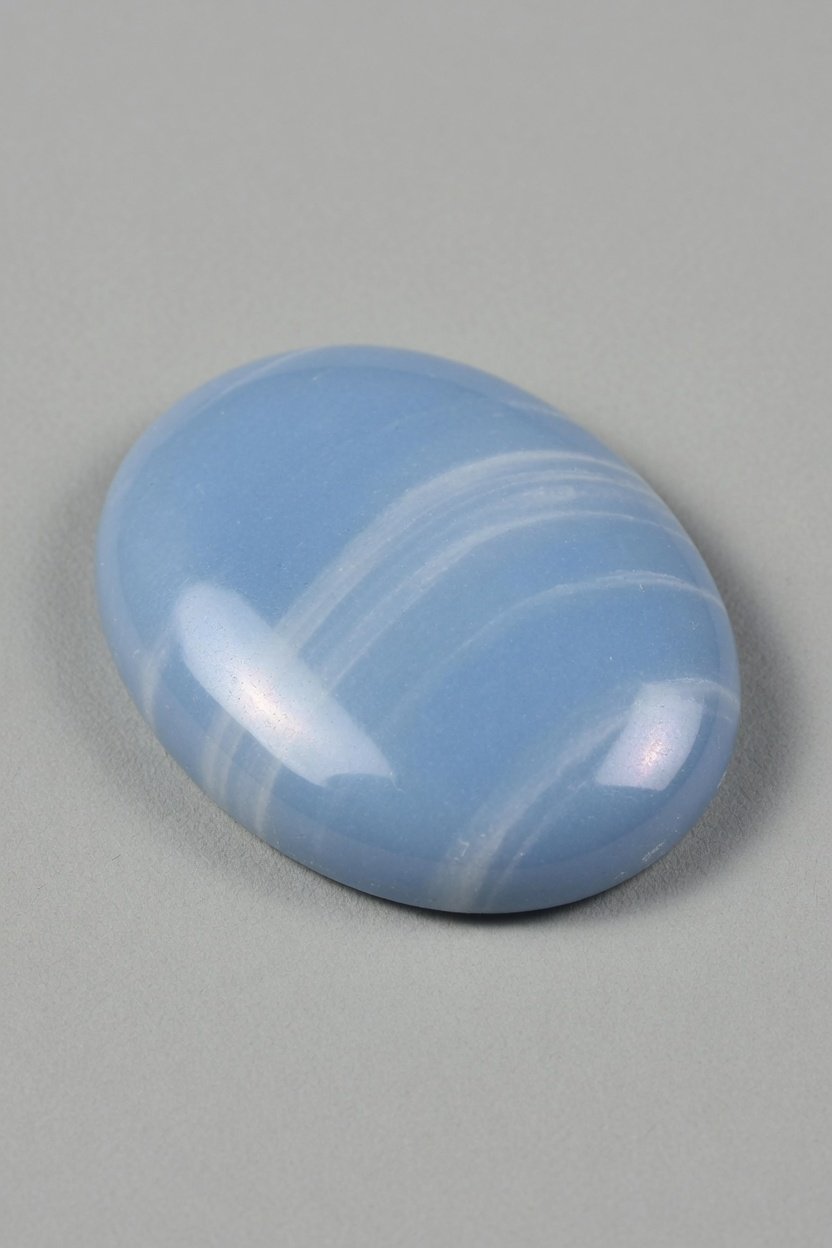
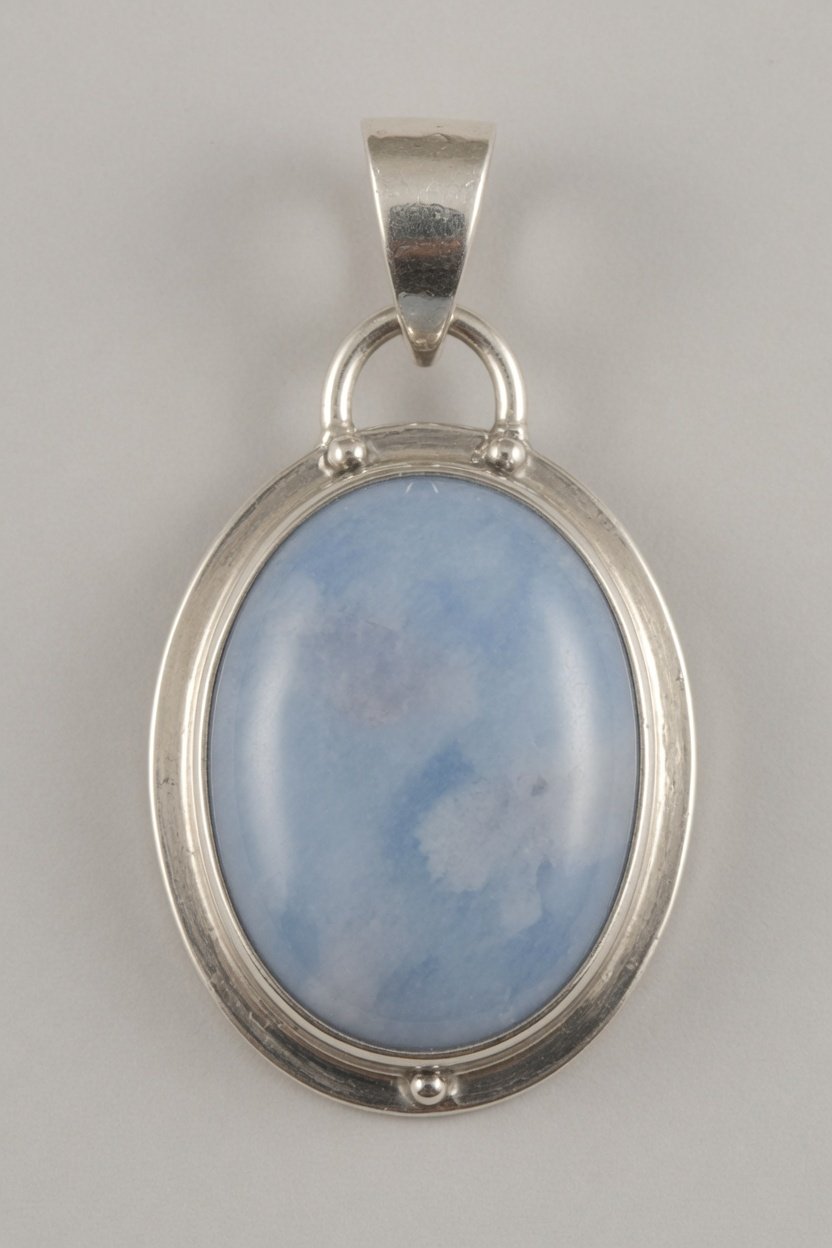
Angelite emerges from the earth as a tranquil blue stone whose soft, sky-like tones immediately evoke calm and quiet reflection. Formed deep within ancient sedimentary layers, this variety of anhydrite carries a subtle translucence that seems to hold light rather than reflect it. Silversmiths prize it for its ability to anchor contemplative jewelry pieces that feel both grounded and ethereal.
Physical Properties Angelite is calcium sulfate in the form of anhydrite, registering 3 to 3.5 on the Mohs scale and therefore requiring gentle handling throughout every stage of jewelry construction. Its specific gravity hovers near 2.9, and its crystal system is triclinic, producing a fibrous or massive habit that rarely yields transparent crystals. The stone displays a pearly to vitreous luster when polished, yet remains opaque to translucent, with characteristic white veining or faint banding running through its celestial blue body. Because of its modest hardness and perfect cleavage in one direction, the stone must be set only after all soldering and heat work is complete; exposure to torch temperatures can cause cracking or dehydration. Daily care calls for soft cloths and avoidance of ultrasonic or steam cleaners that could exploit cleavage planes.
Origin and Sourcing The finest commercial Angelite is extracted from deposits in the Peruvian Andes, where miners work narrow veins in hard-rock formations using hand tools and small-scale blasting. Additional material reaches the market from Mexico and limited occurrences in Canada and Austria, though Peruvian stock dominates the trade for its consistent color depth. Extraction remains largely artisanal, preserving the stone’s integrity while supporting local communities that have long regarded the mineral as a gift from the mountains.
History and Significance Angelite received its modern trade name in the late twentieth century, yet the underlying anhydrite mineral has been known since antiquity in evaporite basins. In Andean cultures the blue stone was sometimes carried as a talisman for clear speech and peaceful negotiation during long trading journeys across high plateaus. Contemporary metaphysical practitioners continue this thread, associating the mineral with serene communication and connection to higher guidance.
In Jewelry and Silversmithing Because of its softness, Angelite is almost always cut as cabochons or smooth freeforms that emphasize its color and gentle pattern rather than attempting facets. Silversmiths set the finished cabochons only after every solder joint has cooled, typically choosing protective bezels that shield the vulnerable edges. The resulting pieces—pendants, rings, and earrings—reward owners who treat them with care, avoiding knocks that could fracture the cleavage planes. A simple weekly wipe with a damp cloth followed by thorough drying keeps the stone’s pearly surface luminous without risking chemical cleaners.
Identifying Angelite in the Field In rough form Angelite appears as compact blue masses with a slightly waxy feel and occasional white calcite veining. A quick hardness test with a copper coin will leave a mark, distinguishing it from harder blue minerals such as lazulite. Its specific gravity feels lighter than turquoise, and broken surfaces show the tell-tale fibrous texture and perfect cleavage that confirm its anhydrite identity.
Quick Facts
Common names: Angelite, Blue Anhydrite
Chemical formula: CaSO₄
Mohs hardness: 3–3.5
Specific gravity: 2.9–3.0
Color: Pale to deep sky blue with white veining
Crystal system: Triclinic
Luster: Vitreous to pearly
Transparency: Opaque to translucent
Common cuts: Cabochon, smooth freeform
Common treatments: None
Best silver setting: Classic Silver Bezel
Birthstone month (if any): None
Main sources: Peru, Mexico
Meaning & Intentions
PEACE
Angelite’s tranquil blue color is traditionally used to quiet racing thoughts and create an inner sanctuary during stressful periods. Wearers often keep a small cabochon in a pocket or wear it as a pendant so the stone’s cool surface can serve as a tactile reminder to pause and breathe. The mineral’s gentle energy is believed to dissolve tension in both personal meditation and group settings where harmony is desired.
Chakra: Throat – supports calm expression CLARITY
By encouraging honest yet compassionate dialogue, Angelite helps users perceive situations without emotional distortion. Silversmiths sometimes incorporate the stone into pieces intended for counselors or teachers who must communicate difficult truths with kindness. Regular handling is said to sharpen intuitive awareness while maintaining a grounded perspective.
Chakra: Third Eye – enhances intuitive sight PROTECTION
The stone’s shielding quality is invoked to maintain healthy energetic boundaries during travel or crowded events. Many practitioners carry Angelite in a small pouch or set within a bezel pendant so the cool blue surface acts as a portable ward against overwhelming external influences. Its anhydrite composition is thought to absorb stray emotional static and release it harmlessly.
Chakra: Crown – anchors higher connection Affirmation: "I move through each day wrapped in calm clarity." AT A GLANCE: Chakra: Throat, Third Eye, Crown Element: Air Energy: Receptive Zodiac: Aquarius Planet: Neptune Affirmation: "I move through each day wrapped in calm clarity."
Related Stones
Explore more stones from the Gemstone Library: Larimar · Paraiba Tourmaline · Aquamarine