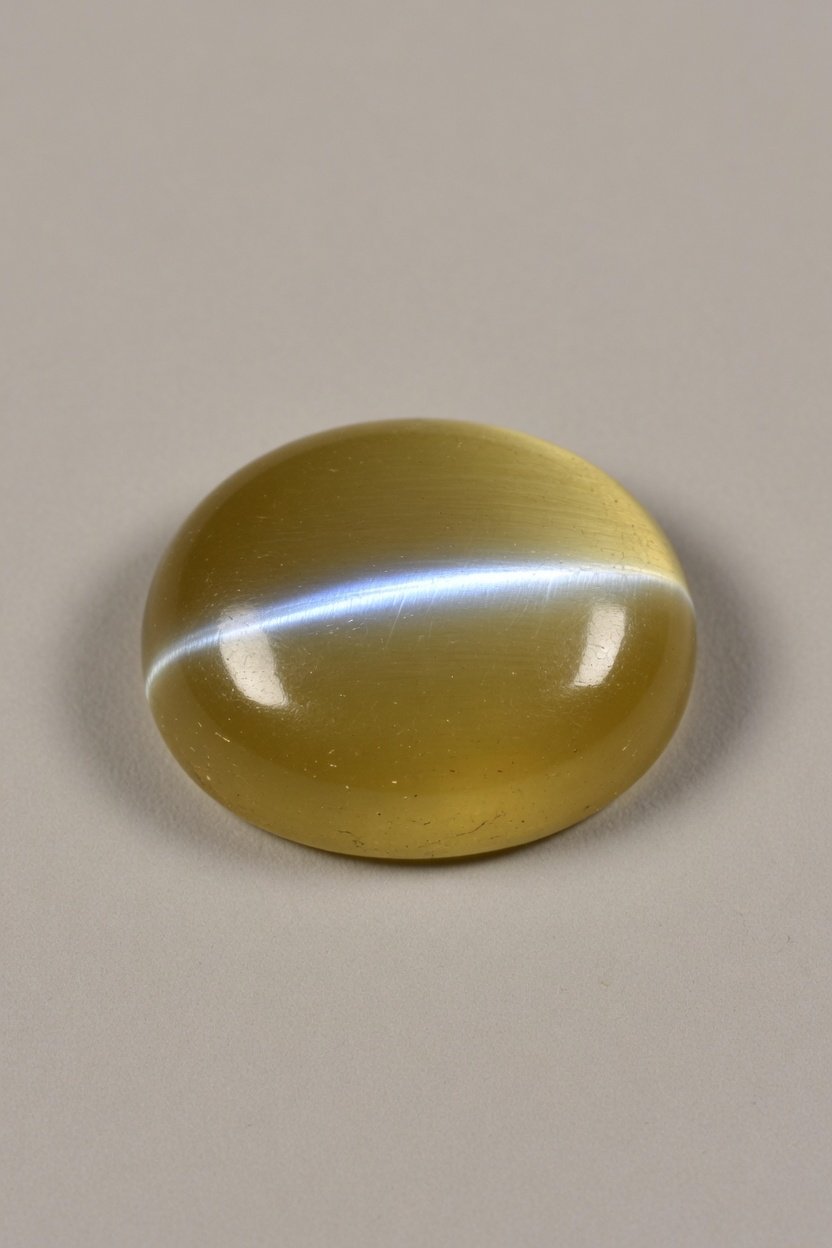
Cat's Eye Chrysoberyl (Cymophane) draws the eye with its silky, banded glow that shifts like a living thread of light across a polished dome. This rare chatoyant variety of chrysoberyl forms under intense pressure deep in the earth, trapping fine needle-like inclusions that create its signature optical effect. Jewelers prize it for the way that single bright band moves with the slightest tilt of the stone.
Physical Properties Cat's Eye Chrysoberyl (Cymophane) registers 8.5 on the Mohs scale, making it one of the hardest gemstones suitable for everyday wear. Its specific gravity falls between 3.68 and 3.78, and it belongs to the orthorhombic crystal system. The stone typically appears translucent to semi-transparent with a vitreous to silky luster that intensifies the cat's eye band when properly oriented. Colors range from honey gold and greenish yellow to brown and gray, though the finest examples display a sharp, silvery-white eye against a rich golden background. Always set Cat's Eye Chrysoberyl (Cymophane) after all soldering is complete to avoid heat damage to the delicate fibrous inclusions responsible for its chatoyancy; clean with mild soap and water only, avoiding ultrasonic cleaners that can fracture the stone along internal planes.
Origin and Sourcing Primary sources include alluvial deposits in Sri Lanka, Brazil, India, and Madagascar, where erosion has freed the crystals from their host pegmatites and metamorphic rocks. Miners recover the rough through careful hand-sifting of river gravels or limited hard-rock extraction, preserving the fragile chatoyant zones. Material from Sri Lanka often shows the sharpest eyes, while Brazilian stones frequently display deeper green tones.
History and Significance Ancient traders along the Indian Ocean routes valued Cat's Eye Chrysoberyl (Cymophane) for its protective reputation, carrying it as talismans against misfortune. European lapidaries in the 18th century began cutting it as cabochons to maximize the moving light band, establishing its place in Victorian mourning and signet jewelry. The stone's name "cymophane" derives from Greek words meaning "wave" and "appear," referencing the undulating light effect.
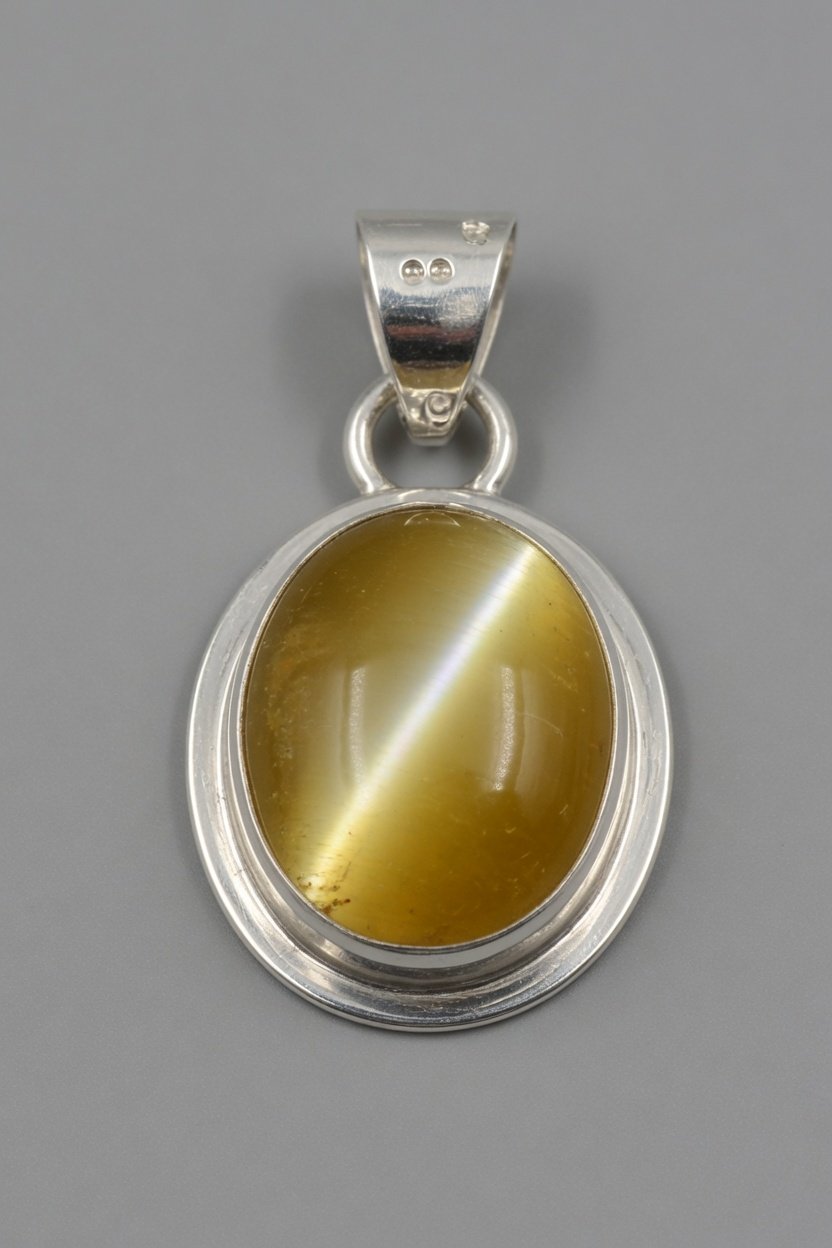
In Jewelry and Silversmithing Silversmiths favor bezel settings that fully surround the cabochon, protecting the vulnerable edges while allowing the cat's eye to remain fully visible. The high hardness permits crisp polishing, yet the fibrous inclusions demand slow, cool cutting to prevent overheating that could blur the optical band. Always set Cat's Eye Chrysoberyl (Cymophane) after soldering to preserve the chatoyancy; store away from other gems to avoid scratches on its fine surface.
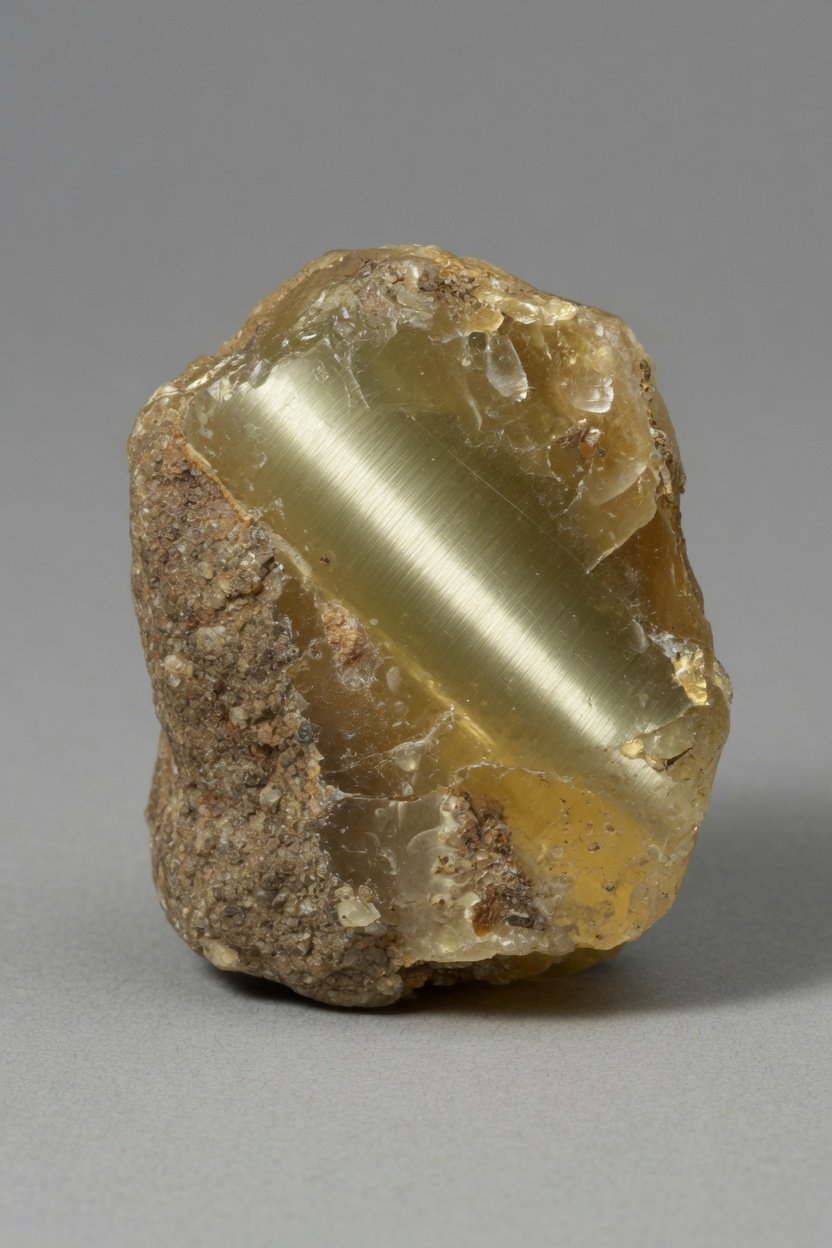
Identifying Cat's Eye Chrysoberyl (Cymophane) in the Field In rough form the stone shows a dull, waxy exterior with occasional glassy patches; a strong light source held at an angle reveals the internal silk that produces the eye once cut. Hardness testing with a steel file leaves no mark, distinguishing it from softer look-alikes such as quartz cat's eye. True Cat's Eye Chrysoberyl (Cymophane) also displays distinct pleochroism, shifting between yellow and green when viewed from different directions.
Quick Facts
Common names: Cat's Eye, Cymophane, Chrysoberyl Cat's Eye
Chemical formula: BeAl₂O₄
Mohs hardness: 8.5
Specific gravity: 3.68–3.78
Color: Golden yellow to greenish brown with white chatoyant band
Crystal system: Orthorhombic
Luster: Vitreous to silky
Transparency: Translucent to semi-transparent
Common cuts: Cabochon
Common treatments: None
Best silver setting: Classic Silver Bezel
Birthstone month (if any): None
Main sources: Sri Lanka, Brazil, India, Madagascar
Meaning & Intentions
PROTECTION
Cat's Eye Chrysoberyl (Cymophane) is carried to create a steady energetic boundary that deflects negativity and supports clear decision-making during uncertain times. The moving band of light is said to act as a living shield, helping the wearer stay grounded while remaining alert to opportunities. Silversmiths often set the stone low in a protective bezel so the eye remains centered and the symbolic defense stays intact.
Chakra: Root for stability and security CLARITY
Worn during meditation or focused work, Cat's Eye Chrysoberyl (Cymophane) sharpens perception and reveals hidden patterns in complex situations. The stone's chatoyant band is believed to mirror the mind's ability to cut through distraction, bringing single-pointed awareness. Jewelers orient the eye vertically in pendants so the line of light points upward, reinforcing mental focus.
Chakra: Third Eye for insight and intuition SECURITY
Cat's Eye Chrysoberyl (Cymophane) is valued for reinforcing a sense of inner and outer safety, especially when traveling or navigating change. Its durable hardness and distinctive optical effect combine to symbolize lasting stability and guarded resources. The stone is frequently placed in lockets or signet rings so the protective eye rests close to the body.
Chakra: Solar Plexus for confidence and self-assurance Affirmation: "I move forward with clear vision and steady protection." AT A GLANCE: Chakra: Root, Third Eye, Solar Plexus Element: Earth Energy: Protective, clarifying, grounding Zodiac: Leo, Capricorn Planet: Saturn Affirmation: "I move forward with clear vision and steady protection."
Related Stones
Explore more stones from the Gemstone Library: Pyrite · Star Ruby · Andalusite