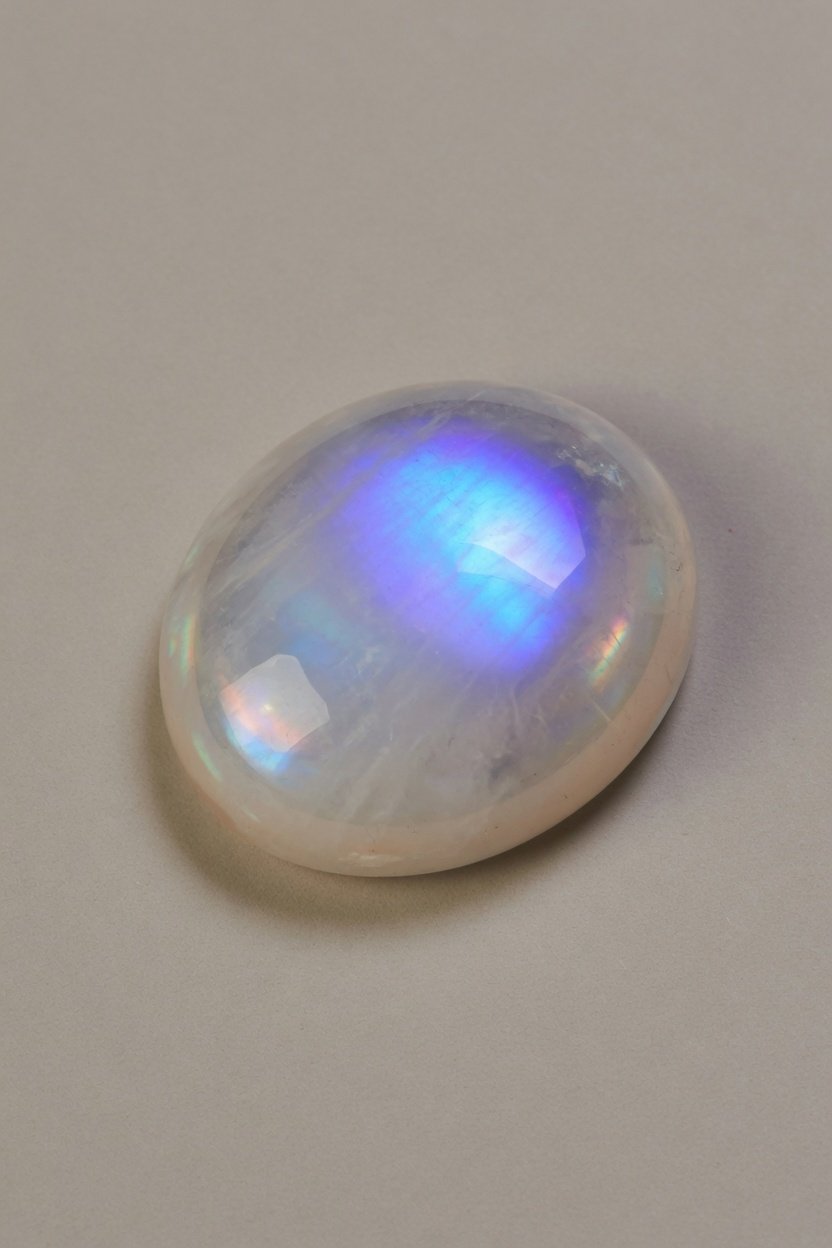
Rainbow Moonstone draws the eye with its soft milky glow that suddenly flares into vivid flashes of blue, violet, and gold when light strikes at the right angle. This play of color arises from thin layers of feldspar that scatter light in a way that feels almost alive under the jeweler’s bench lamp. Silversmiths prize the stone for the way its gentle radiance contrasts with the cool strength of sterling silver.
Physical Properties Rainbow Moonstone is a variety of labradorite feldspar whose adularescence creates shifting spectral colors across a translucent white to cream body. It registers 6 to 6.5 on the Mohs scale, making it softer than many transparent gems yet still workable with careful technique. Its specific gravity hovers around 2.7, and the stone shows perfect cleavage in two directions that demands gentle handling during setting. Because the material contains water and is sensitive to thermal shock, every piece must be set only after all soldering and pickling steps are complete; direct flame or ultrasonic cleaning can cause cracking or loss of color flash.
Origin and Sourcing Primary commercial deposits lie in the pegmatites of southern India, with additional material coming from Madagascar and Sri Lanka. Miners extract the rough from narrow veins using hand tools and controlled blasting, then sort blocks by the intensity of their color play before sending them to cutters. Indian material often shows stronger blue flashes, while Madagascar pieces frequently display warmer pink and gold tones. Ethical sourcing programs now track parcels from mine to market so silversmith schools can teach students the full provenance story.
History and Significance Ancient traders carried moonstone along the silk routes, where it was believed to capture moonlight and protect travelers at night. In India the stone was set into temple jewelry and royal regalia; Victorian jewelers later revived it for romantic lockets and engagement rings. Today the gem continues to symbolize new beginnings and emotional balance, qualities that resonate with contemporary makers who pair its luminous surface with oxidized silver to heighten the contrast.
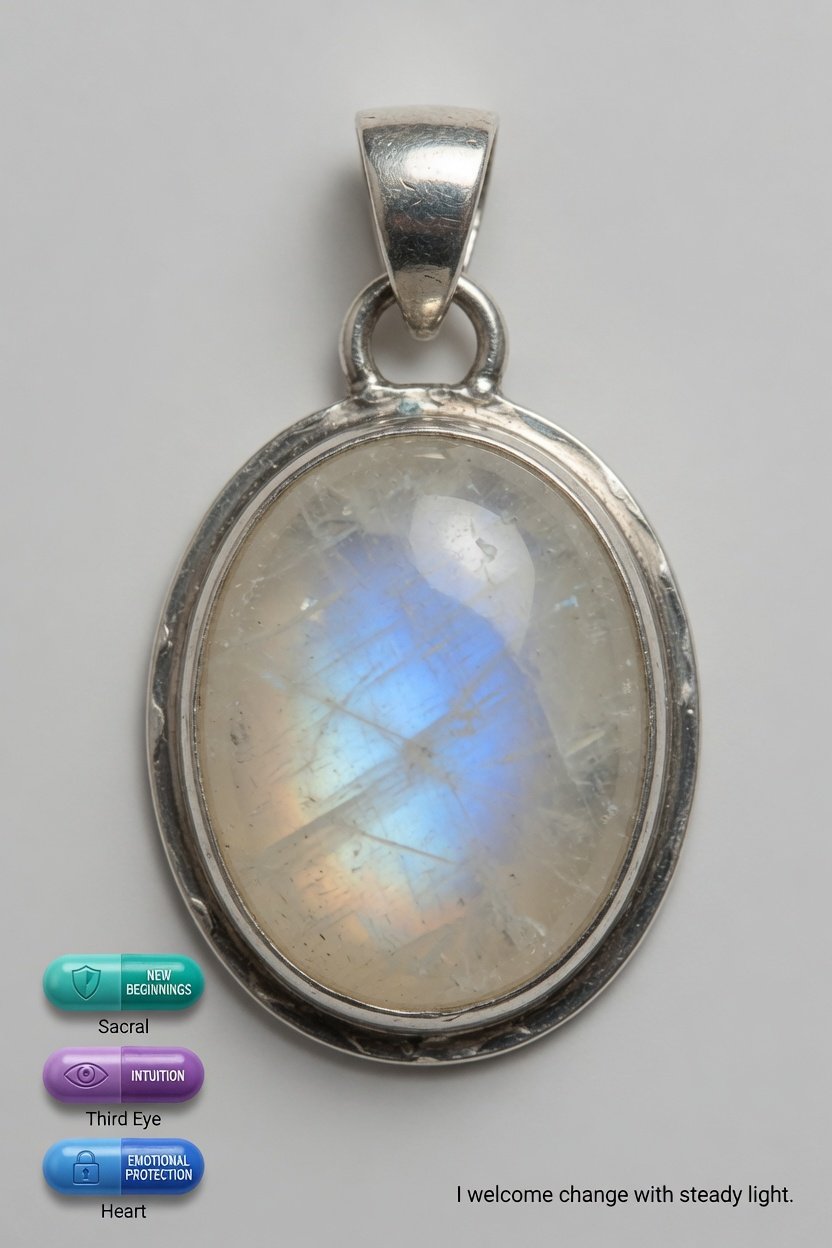
In Jewelry and Silversmithing The stone is almost always cut as a cabochon to preserve its adularescence; faceting would destroy the floating color. After fabrication, the piece is allowed to cool completely before the cabochon is seated in a bezel or prong setting. Care instructions emphasize avoiding prolonged sunlight, sudden temperature changes, and harsh chemicals that could dull the surface or open cleavage planes. A simple wipe with a soft cloth restores the luster between wearings.
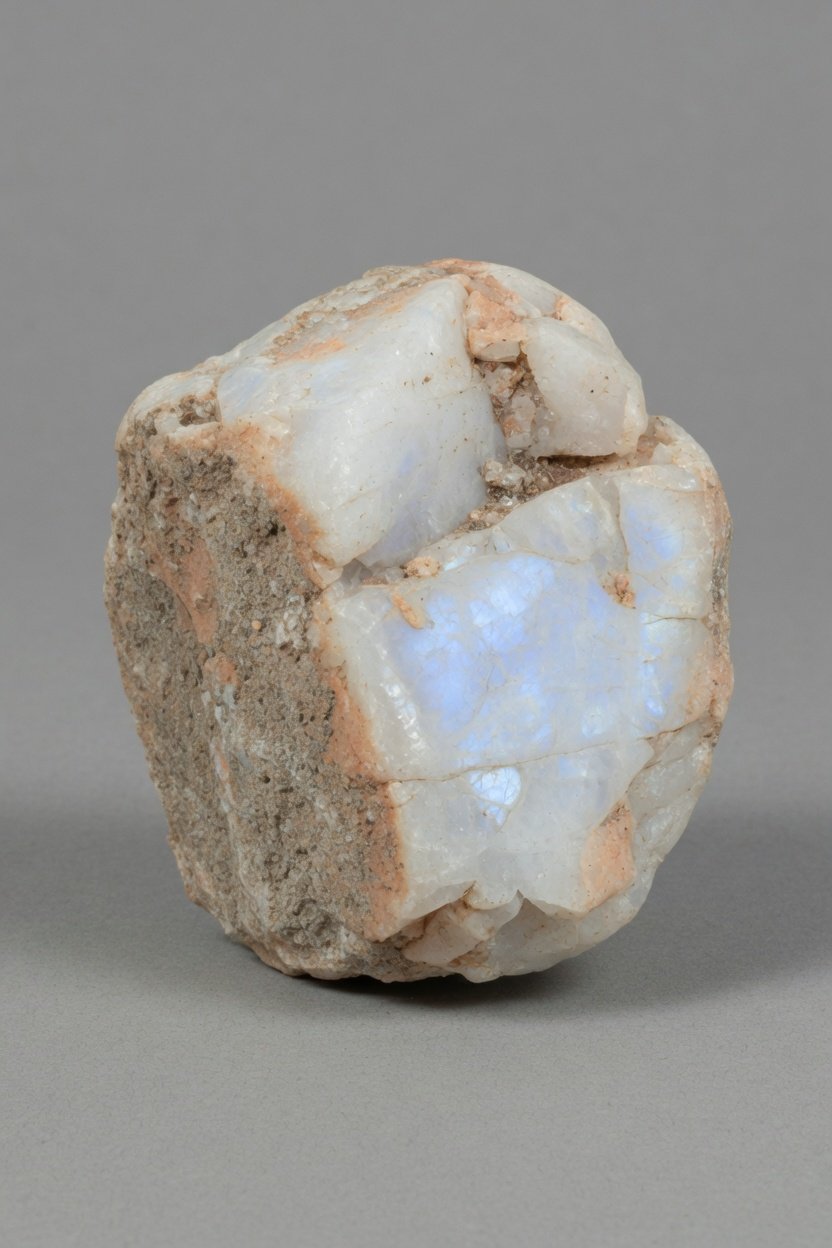
Identifying Rainbow Moonstone in the Field In rough form the stone appears as blocky feldspar crystals with a pearly sheen on fresh breaks. A quick test is to wet the surface; true adularescence will flash color even under diffuse light, whereas similar-looking quartz or calcite will remain static. Cleavage faces are smooth and step-like, and the material feels slightly cooler to the touch than glass imitations.
Quick Facts
Common names: Rainbow Moonstone, Spectrolite (trade overlap)
Chemical formula: (Na,Ca)AlSi₃O₈
Mohs hardness: 6–6.5
Specific gravity: 2.65–2.75
Color: Milky white to cream with blue, violet, pink, gold flashes
Crystal system: Triclinic
Luster: Vitreous to pearly
Transparency: Translucent
Common cuts: Cabochon
Common treatments: None (occasional waxing)
Best silver setting: Bezel
Birthstone month (if any): June (alternative)
Main sources: India, Madagascar, Sri Lanka
Meaning & Intentions
NEW BEGINNINGS
Rainbow Moonstone is carried or worn to mark fresh chapters, its shifting colors mirroring the way possibilities open when one steps into the unknown. Silversmiths set the stone after all heat work so the gentle glow remains undamaged and ready to accompany the wearer through change.
Chakra: Sacral — creativity and emotional flow INTUITION
The stone’s flashes are said to heighten inner sight, helping the wearer notice subtle patterns in daily life. When placed in a pendant or ring the cabochon is oriented so the strongest blue flash sits at the top, directing attention inward during quiet moments.
Chakra: Third Eye — insight and perception EMOTIONAL PROTECTION
Wearers use Rainbow Moonstone to create a soft energetic boundary that absorbs tension before it settles in the body. Because the stone is set only after soldering, its internal layers stay intact and continue to offer steady, quiet support.
Chakra: Heart — compassion and calm Affirmation: "I welcome change with steady light." AT A GLANCE: Chakra: Sacral, Third Eye, Heart Element: Water Energy: Receptive Zodiac: Cancer, Libra Planet: Moon Affirmation: "I welcome change with steady light."
Related Stones
Explore more stones from the Gemstone Library: Cat's Eye Moonstone · Kunzite · Chalcedony