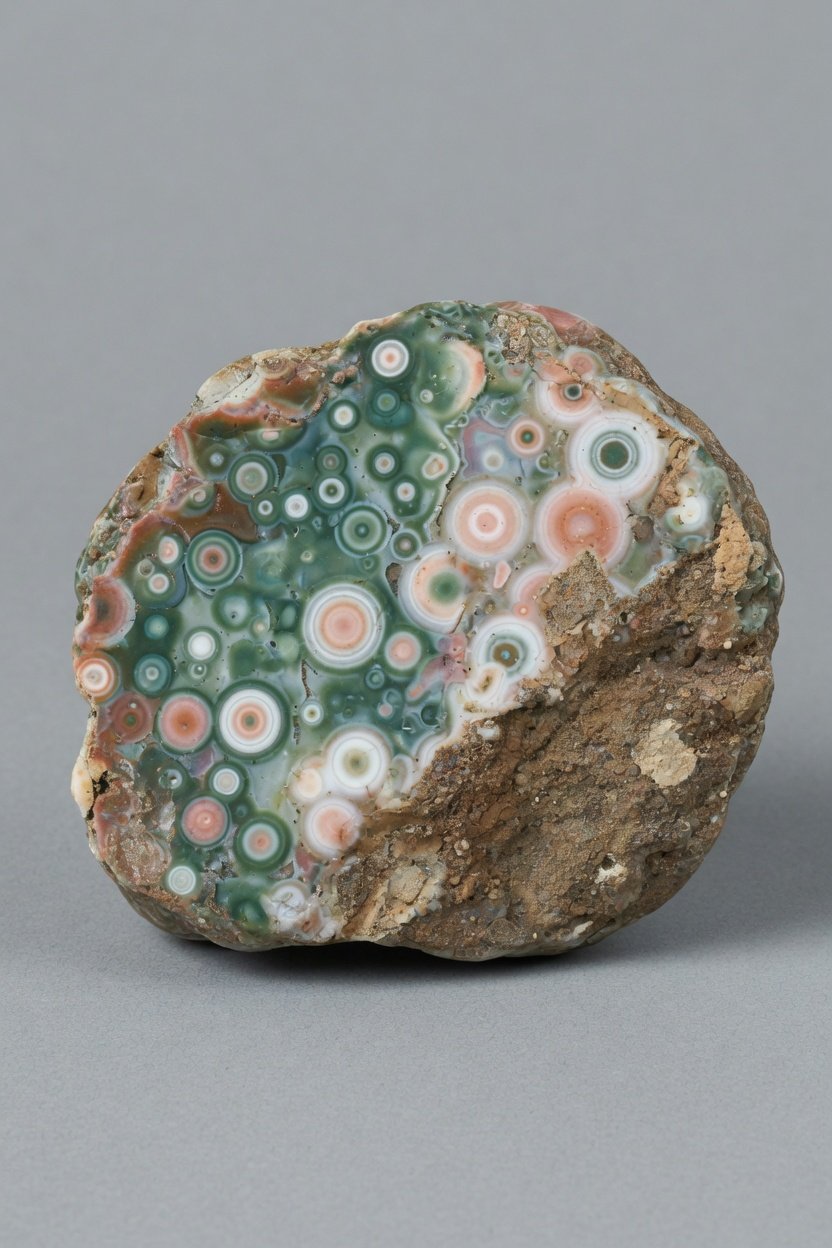
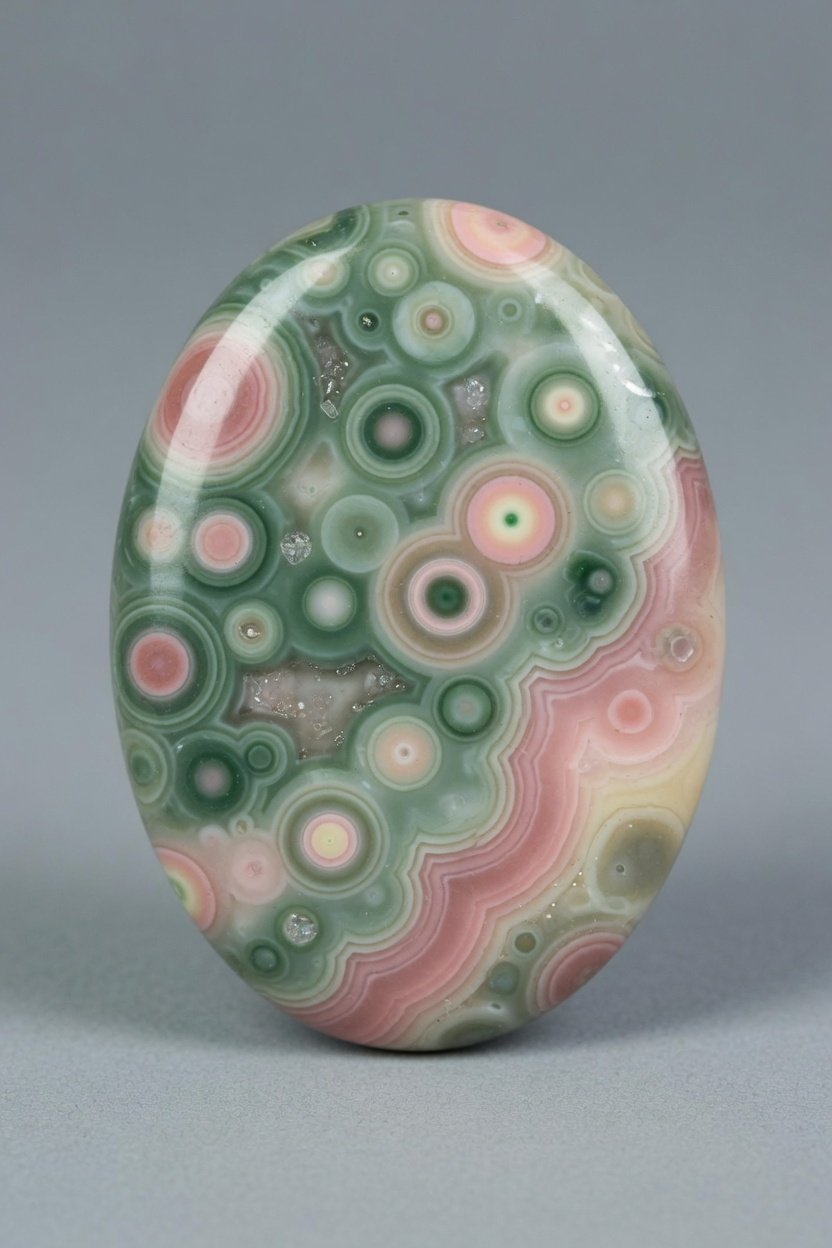
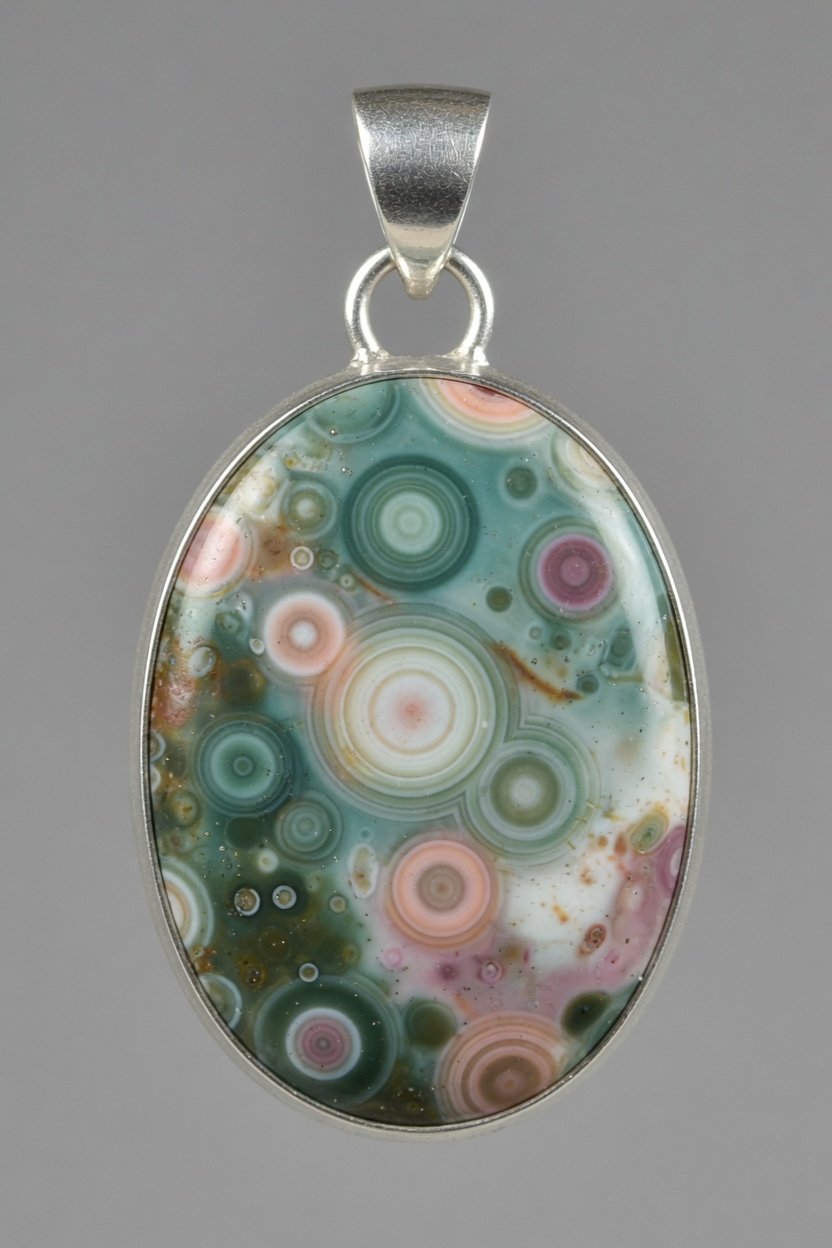
Ocean Jasper emerges from the rugged coasts of Madagascar like hidden tide pools frozen in stone, its swirling orbs and banded colors capturing the sea’s shifting moods in solid form. This chalcedony-rich jasper rewards silversmiths who understand its optical subtleties and structural needs. The patterns reward careful orientation during cutting and setting.
Physical Properties Ocean Jasper registers 6.5–7 on the Mohs scale and shows a specific gravity between 2.58 and 2.91. Its cryptocrystalline quartz composition produces a waxy to vitreous luster and remains fully opaque, with concentric orbs and layered banding in greens, creams, pinks, and occasional soft blues. The stone contains no significant cleavage, yet its fine grain can fracture under sharp impact. Set the finished piece only after all soldering and torch work are complete; avoid prolonged ultrasonic cleaning and store away from harder gems that could scratch the polished surface.
Origin and Sourcing All commercial Ocean Jasper originates from a handful of deposits along Madagascar’s northwest coast near Marovato and the Analalava region. Miners extract the material from volcanic rhyolite host rock using hand tools and small open cuts rather than large mechanized operations. Material is sorted on-site for orb density and color contrast before export as rough or preformed cabochons. Ethical sourcing remains critical because the deposits lie in remote areas with limited oversight.
History and Significance Local communities have collected the stone for generations, though modern recognition began in the late 1990s when lapidary dealer Paul Obenich introduced it to international markets. Its orbicular patterns evoked the ocean for Western buyers, giving the material its trade name. In Madagascar the stone carries quiet associations with coastal protection and continuity between land and sea.
In Jewelry and Silversmithing Ocean Jasper’s opacity and bold patterns suit cabochon cuts that preserve the orbs without facet interference. Silversmiths typically choose low-profile bezels or simple prong frames that protect the edges while allowing the pattern to dominate. Always set the stone after all soldering and pickling steps to prevent thermal shock or chemical discoloration. A light beeswax or commercial stone polish restores luster after years of wear; avoid harsh abrasives.
Identifying Ocean Jasper in the Field Look for rounded, grape-like orbs within a fine-grained matrix that may show faint banding or druzy pockets. Freshly broken surfaces reveal a dull conchoidal fracture rather than the sugary texture of coarser jaspers. True Ocean Jasper displays at least three distinct color zones arranged in concentric rings; uniform green material without orbs is more likely common jasper from other localities.
Quick Facts
Common names: Ocean Jasper, Orbicular Jasper
Chemical formula: SiO₂
Mohs hardness: 6.5–7
Specific gravity: 2.58–2.91
Color: Multicolored orbs and bands in green, pink, cream, brown, occasional blue
Crystal system: Trigonal
Luster: Waxy to vitreous
Transparency: Opaque
Common cuts: Cabochon
Common treatments: None
Best silver setting: Bezel
Birthstone month (if any): None
Main sources: Madagascar
Meaning & Intentions
GROUNDING
Ocean Jasper anchors scattered attention by mirroring the steady rhythm of tides within its concentric patterns. Wearers carry a small polished piece during demanding days to maintain composure when external pressures rise. The stone’s visual layers remind the user that stability grows from repeated, patient cycles rather than sudden effort.
Chakra: Root — stability and physical presence PERCEPTION
The orbicular markings train the eye to notice repeating structures in nature and daily life. Placing a cabochon on a workspace encourages deliberate observation before action. Over time the stone becomes a tactile cue that sharpens pattern recognition and reduces reactive decisions.
Chakra: Third Eye — insight and clear seeing BOUNDARIES
Ocean Jasper’s dense structure and closed patterns symbolize containment of personal energy. A pendant worn near the throat helps maintain conversational limits without aggression. The material’s toughness supports consistent self-definition while remaining open to measured exchange.
Chakra: Throat — measured expression Affirmation: "I move with the steady rhythm of the sea." AT A GLANCE: Chakra: Root, Third Eye, Throat Element: Water Energy: Receptive Zodiac: Cancer, Pisces Planet: Moon Affirmation: "I move with the steady rhythm of the sea."
Related Stones
Explore more stones from the Gemstone Library: Cat's Eye Moonstone · Mahogany Obsidian · Picture Jasper