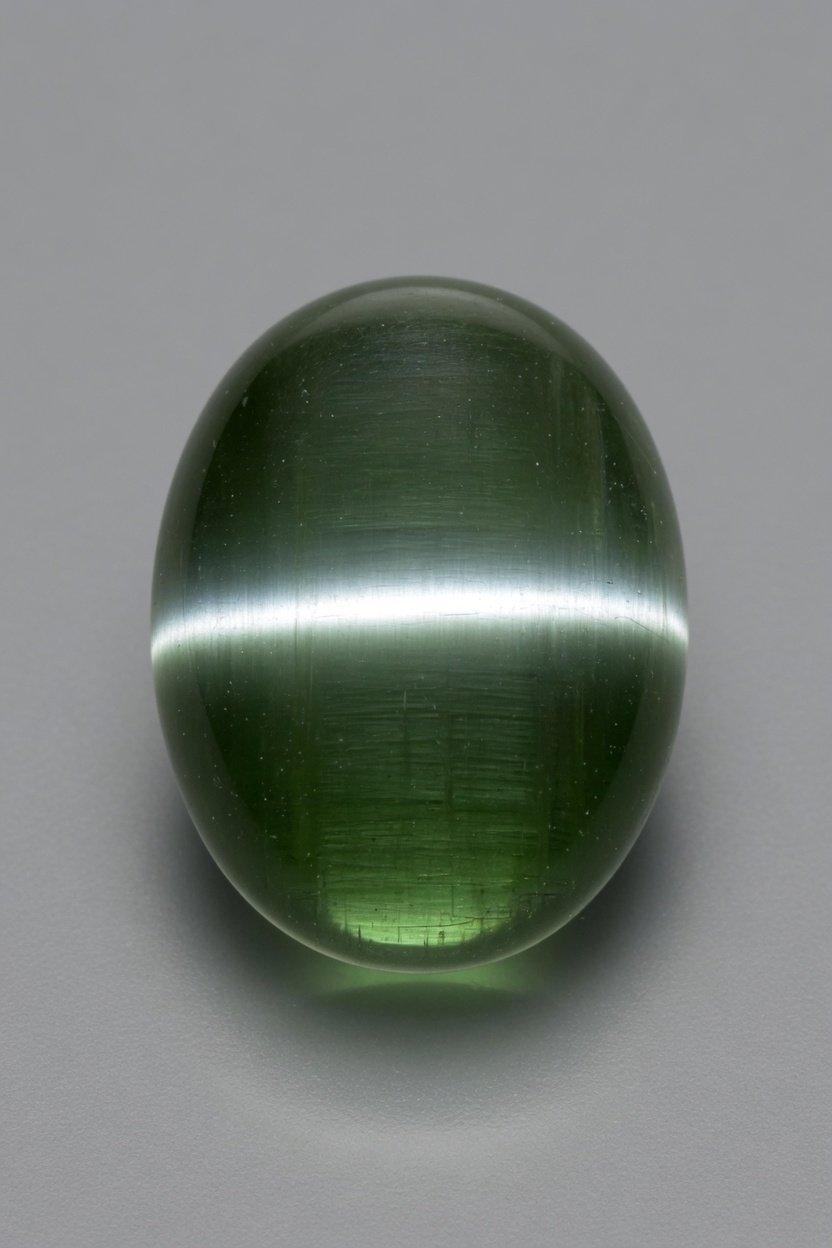
Cat's Eye Tourmaline catches the eye with its silky, moving band of light gliding across a deep green or brown dome, a living streak that seems to follow the viewer. This chatoyant variety of the tourmaline family forms in complex pegmatites where needle-like inclusions align perfectly to create the optical effect. Silversmiths prize the stone for its ability to shift from quiet glow to sharp flash depending on how light strikes the finished piece.
Physical Properties Cat's Eye Tourmaline belongs to the tourmaline group with a chemical makeup centered on complex borosilicates that incorporate sodium, aluminum, and varying amounts of iron or magnesium. On the Mohs scale it registers 7 to 7.5, giving it respectable durability for daily wear yet requiring care around harder materials. Specific gravity falls between 3.0 and 3.3, producing a satisfying heft in the hand. The defining feature remains the chatoyant band caused by dense parallel inclusions that reflect light in a single sharp line across a properly oriented cabochon. Always set the stone after all soldering is complete to avoid heat damage to the delicate internal structure, and caution wearers against ultrasonic cleaners or sudden temperature changes that could fracture the inclusions.
Origin and Sourcing Primary deposits lie in the pegmatite fields of Brazil, Madagascar, and Sri Lanka, where miners extract the rough from narrow veins using hand tools and controlled blasting. Alluvial concentrations along riverbeds in these regions also yield rounded crystals that have already been tumbled by nature. Ethical sourcing programs now track parcels from mine to market, ensuring traceability for silversmithing schools that teach responsible material selection. The finest cat's eye material typically comes from Brazil's Minas Gerais region, where the combination of color and sharp eye commands premium prices.
History and Significance Ancient traders carried tourmaline specimens along caravan routes from East Africa and India, though the cat's eye variety gained distinct recognition only in the nineteenth century when lapidaries learned to orient the inclusions for maximum effect. In Victorian jewelry the stone symbolized protection and clear vision, often mounted in mourning pieces where the moving eye was thought to watch over the wearer. Modern metaphysical traditions continue this thread, associating the chatoyant band with focused intention and inner sight.
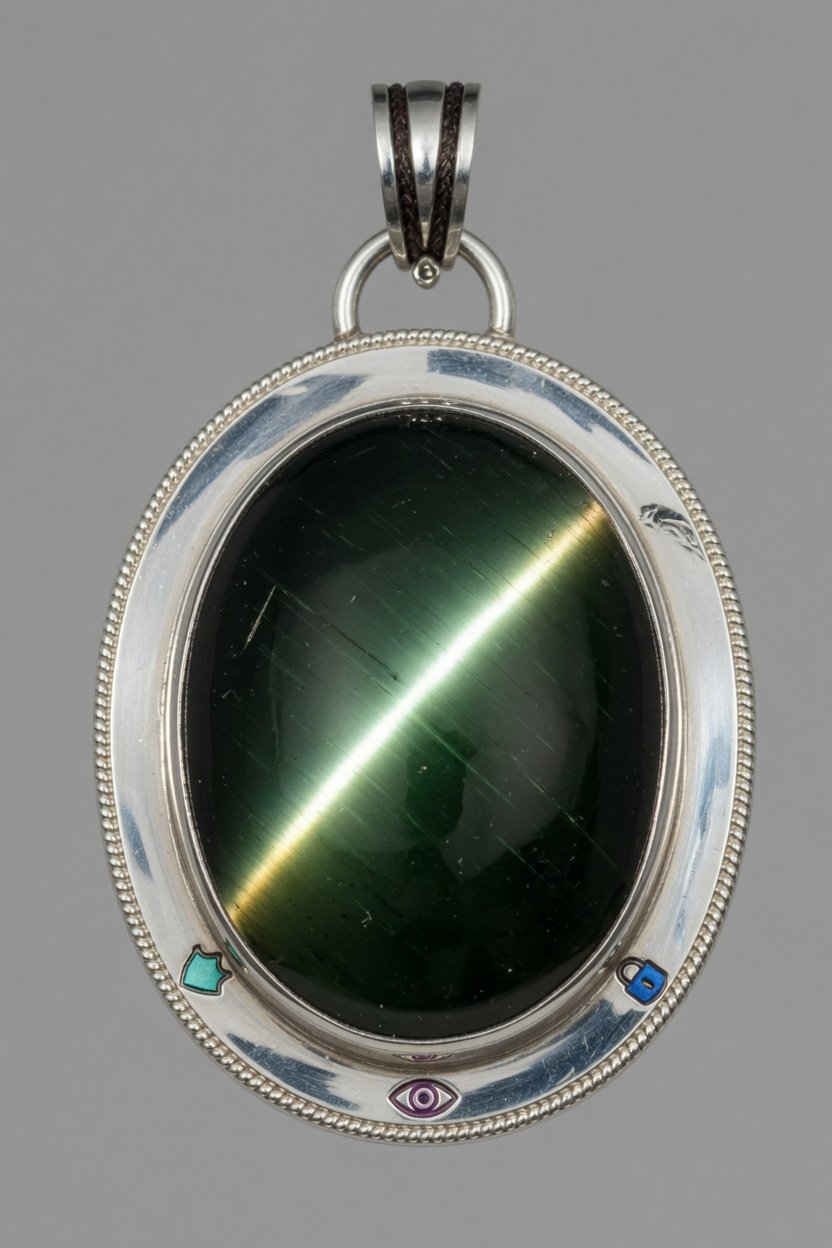
In Jewelry and Silversmithing The stone's chatoyancy demands a smooth, high-domed cabochon cut oriented precisely perpendicular to the inclusions; any facet would scatter the light and destroy the eye. Silversmiths favor low-profile bezel settings that protect the vulnerable dome while allowing the band to move freely under light. After all soldering, the stone is set and the bezel burnished gently to avoid pressure cracks. Care cautions include avoiding prolonged sunlight that can fade certain color zones and storing pieces separately to prevent abrasion from harder gems.
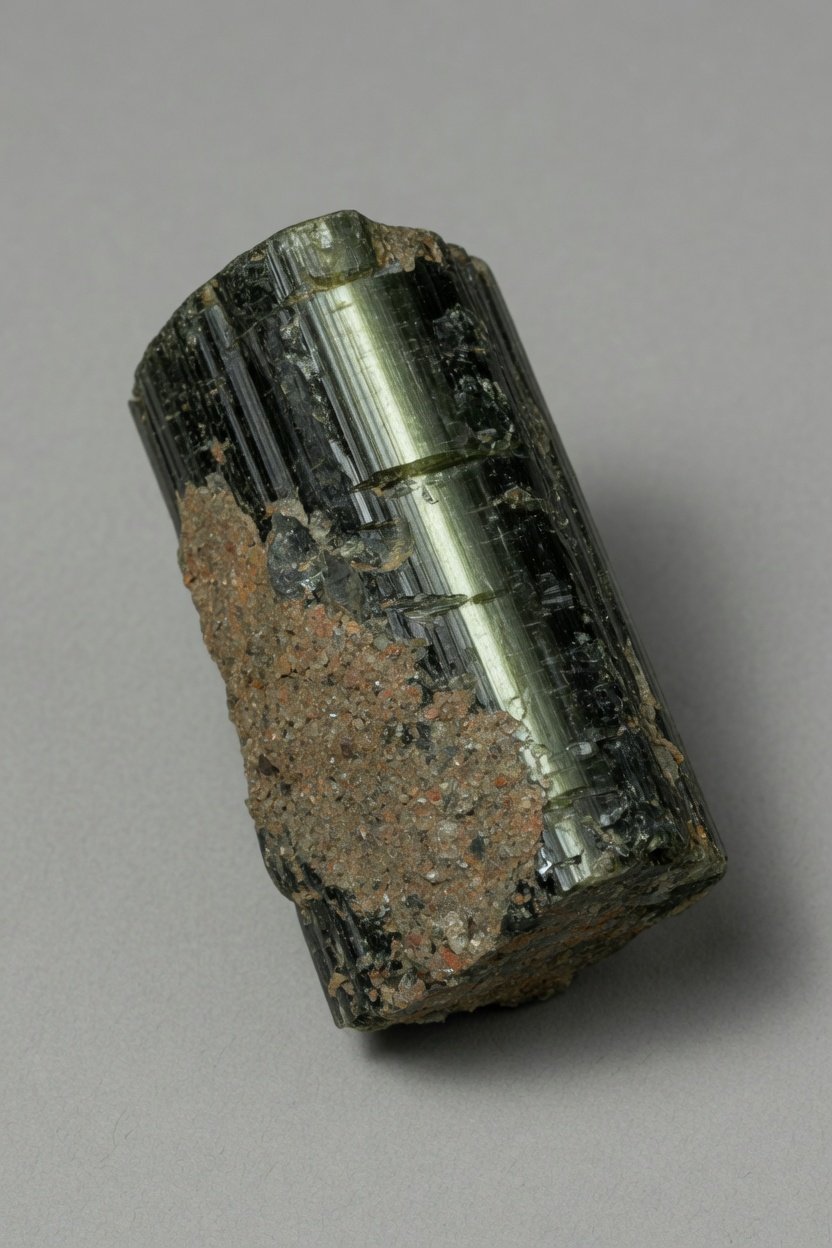
Identifying Cat's Eye Tourmaline in the Field In rough form the material shows a dark, striated exterior with a vitreous to sub-metallic luster along fracture surfaces. A quick test involves rotating the specimen under a single light source; a true cat's eye will display a narrow, bright line that travels smoothly across the surface only when the inclusions are aligned correctly. Hardness can be confirmed with a steel point that leaves no mark, while specific gravity testing distinguishes it from cheaper chatoyant imitations such as quartz or glass. Always examine the color zoning under magnification to confirm natural tourmaline growth patterns before purchase.
Quick Facts
Common names: Cat's Eye Tourmaline, Chatoyant Tourmaline
Chemical formula: (Na,Ca)(Mg,Fe,Li,Al,Mn)3Al6(BO3)3Si6O18(OH)4
Mohs hardness: 7–7.5
Specific gravity: 3.0–3.3
Color: Green, brown, blue-green with sharp white or golden chatoyant band
Crystal system: Trigonal
Luster: Vitreous to silky
Transparency: Translucent to opaque
Common cuts: Cabochon (oriented for chatoyancy)
Common treatments: None typical; occasional clarity enhancement
Best silver setting: Classic Silver Bezel Pendant
Birthstone month (if any): None (tourmaline is October)
Main sources: Brazil, Madagascar, Sri Lanka
Meaning & Intentions
FOCUS
Cat's Eye Tourmaline sharpens mental clarity by channeling scattered thoughts into a single luminous line of attention. Silversmiths set the stone in protective bezels so the wearer can carry this steadying influence through daily work and creative practice. The moving band acts as a visual anchor during meditation or detailed tasks.
Chakra: Third Eye — enhances perception and concentration INSIGHT
Worn close to the skin, the stone's reflective band encourages honest self-examination and reveals patterns previously hidden from view. In jewelry the cabochon is oriented so the eye opens directly toward the wearer, reinforcing personal awareness throughout the day. This intention draws on centuries of lore linking chatoyancy with inner vision.
Chakra: Third Eye — deepens intuition and pattern recognition BOUNDARIES
The stone's compact structure and strong chatoyant line create an energetic perimeter that helps maintain personal limits during demanding interactions. Silversmiths choose sturdy silver bezels to echo this protective quality in the finished piece. Wearers report feeling more grounded when the stone rests against the body.
Chakra: Root — grounds energy and reinforces stability Affirmation: "My focus remains steady and my vision clear." AT A GLANCE: Chakra: Third Eye Element: Water Energy: Receptive Zodiac: Pisces, Scorpio Planet: Moon Affirmation: "My focus remains steady and my vision clear."
Related Stones
Explore more stones from the Gemstone Library: Cobalt Blue Spinel · Pezzottaite · Sillimanite