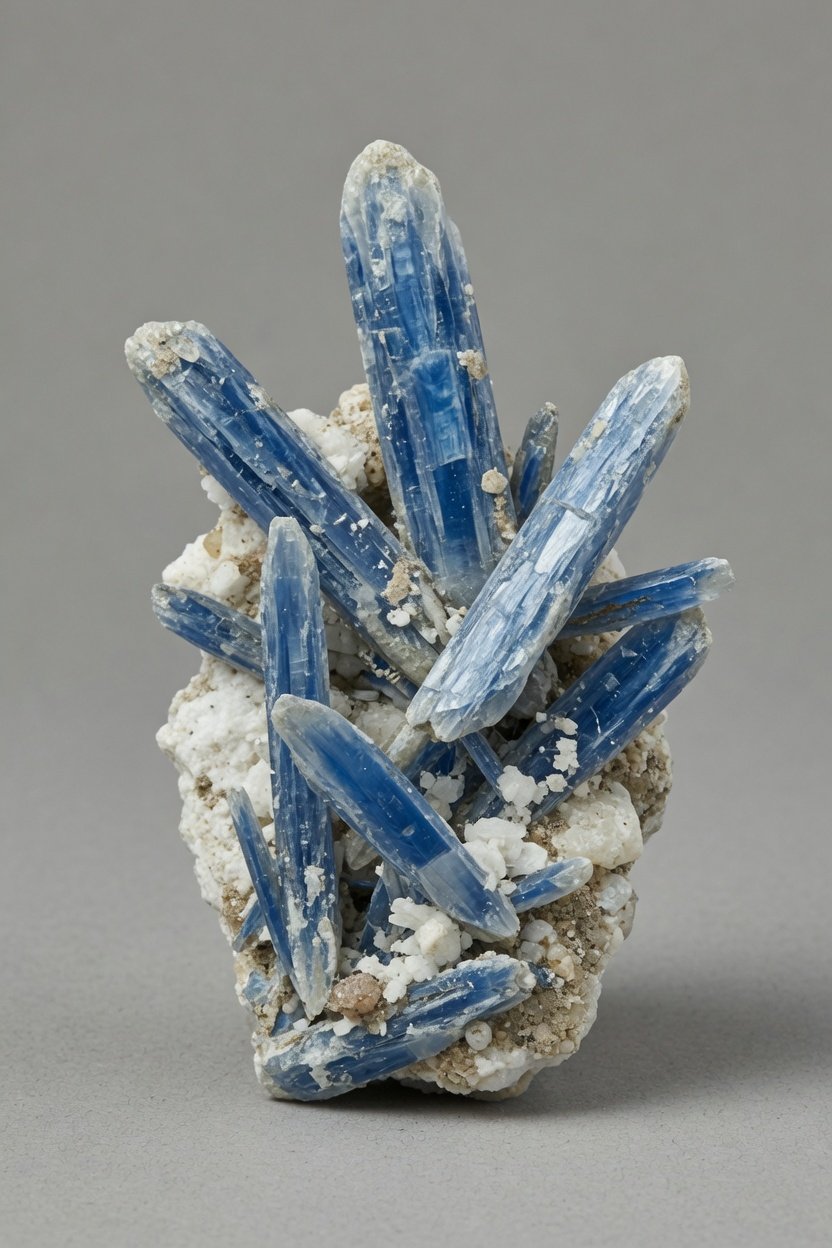
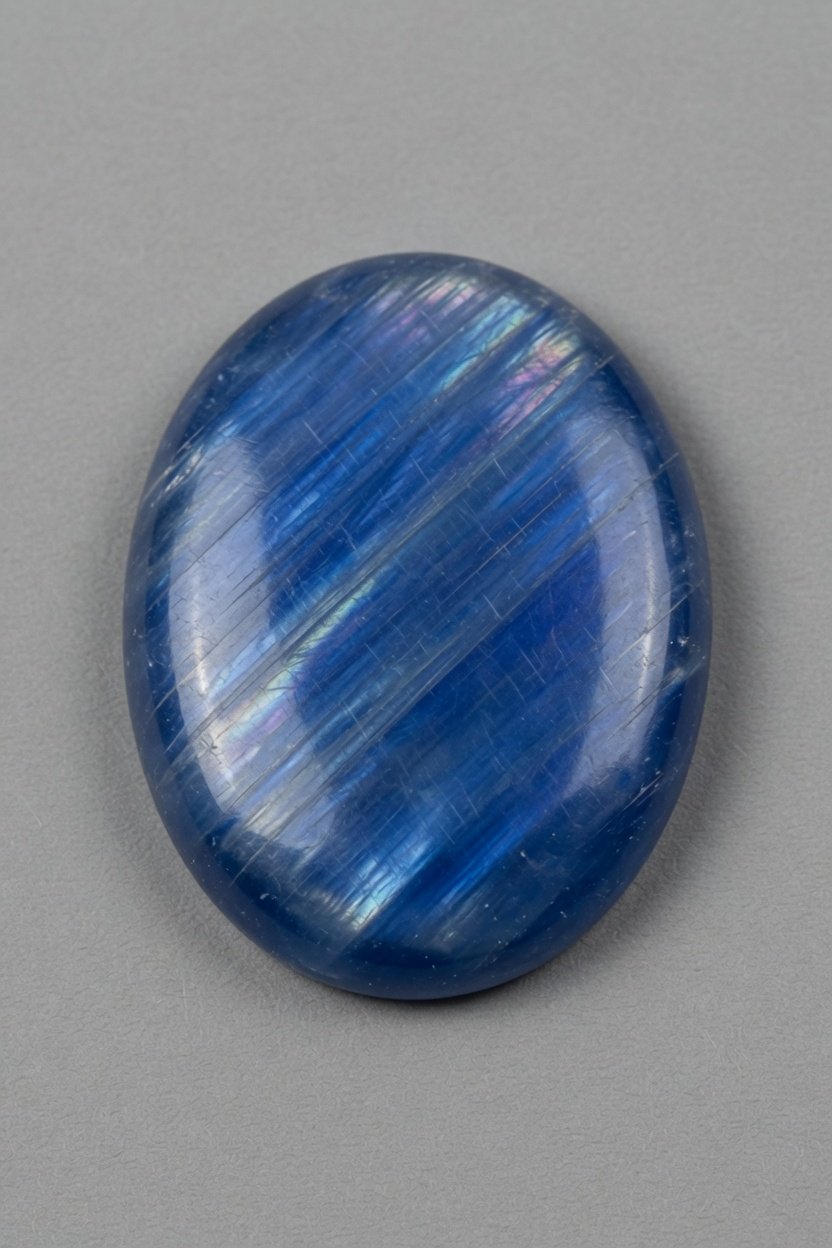
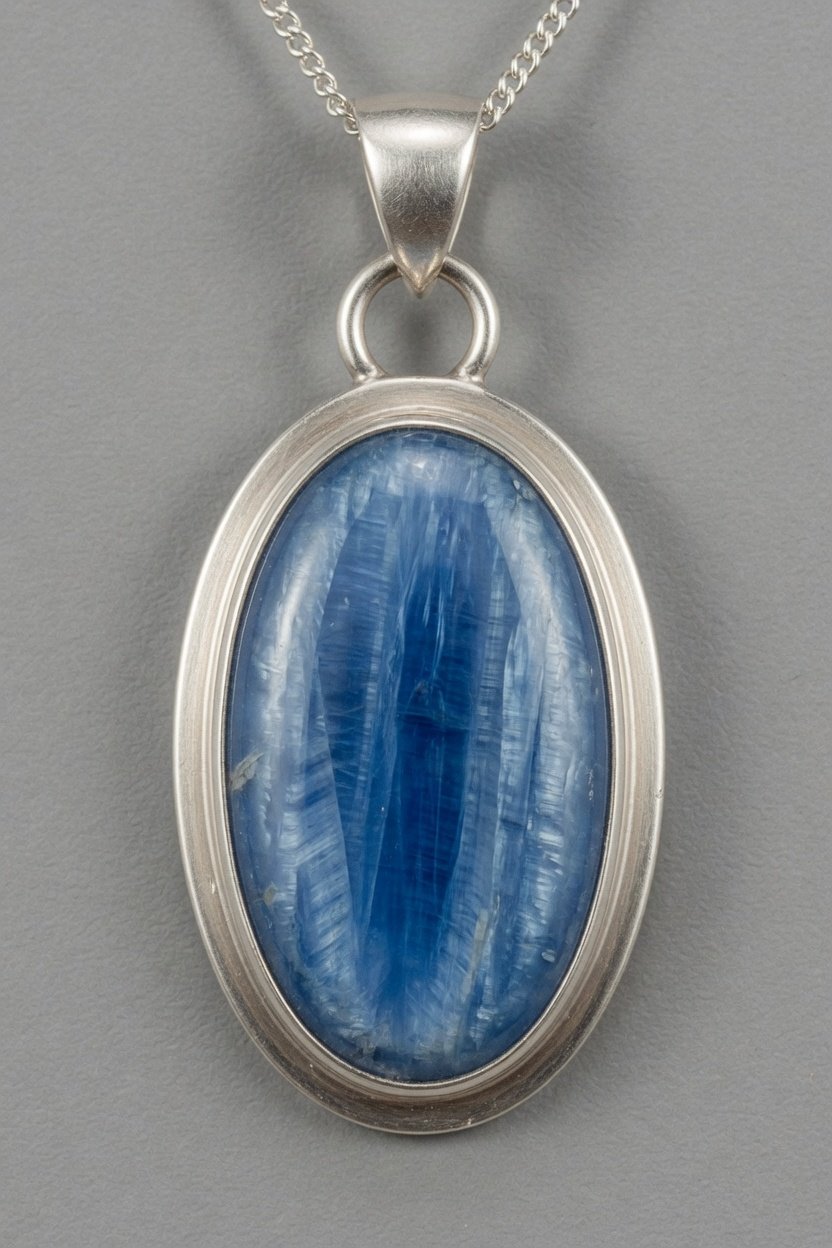
Kyanite forms in striking blades of electric blue that catch light like frozen water under a clear sky. Its distinctive color zoning and directional sheen have drawn silversmiths and collectors for generations. This aluminum silicate mineral reveals its true character only when examined closely, with properties that demand respect at the bench.
Physical Properties Kyanite displays perfect cleavage in one direction and good cleavage in another, producing thin splintery fragments when stressed. Hardness varies dramatically by axis: 4.5–5 parallel to the crystal length and 6–7 across it. Specific gravity ranges from 3.53 to 3.67, and the stone shows vitreous to pearly luster with transparent to translucent areas. Its triclinic crystals often appear as long, flattened blades with fine striations. Because kyanite contains no water of crystallization that would cause thermal shock, it survives typical bench processes, yet the pronounced cleavage planes require extreme care during setting. Always set the stone after all soldering and polishing are complete. Avoid pressure on the long axis; use a well-fitted bezel to protect the vulnerable directions.
Origin and Sourcing Primary commercial deposits occur in Brazil’s Minas Gerais region, Nepal’s Himalayan foothills, India’s states of Andhra Pradesh and Rajasthan, and smaller occurrences in Kenya and the United States. Most material is recovered from hard-rock metamorphic deposits where kyanite blades grow within schist and gneiss. Miners follow narrow veins with hand tools and light explosives, then sort the blue blades from the surrounding matrix on site. Alluvial concentrations appear in a few Brazilian drainages, but the majority of gem-quality blades still come from primary hard-rock sources.
History and Significance Ancient Greek miners named the stone after its cyan-blue hue and used it as a refractory material in ceramics. In the nineteenth century, European mineralogists documented its anisotropic hardness, which once puzzled cutters who found the same crystal soft in one direction and hard in another. Indigenous communities in the Himalayas have long collected the blades for ritual objects, associating the color with clear speech and steady thought. Today the stone appears in both contemporary studio jewelry and traditional talismanic pieces across South Asia and South America.
In Jewelry and Silversmithing Kyanite’s perfect cleavage makes it unsuitable for prong settings or any design that places pressure along the blade length. Silversmiths therefore favor full bezels or partial bezels that cradle the stone from all sides. The stone is cut as cabochons to preserve color and avoid facet-edge chipping. After fabrication, the piece is cleaned ultrasonically only if the stone is well protected; otherwise a mild soap solution is used. Store kyanite jewelry separately to prevent abrasion from harder gems. Its cool blue tones pair especially well with oxidized silver and textured surfaces that echo the stone’s natural striations.
Identifying Kyanite in the Field Look for elongated, blade-like crystals with a strong blue color that fades toward the edges. Test hardness with a steel point along and across the length; the difference is diagnostic. The stone shows no reaction to dilute acid and displays a white streak. In matrix, it often appears with quartz, mica, or garnet. Natural color zoning runs parallel to the blades rather than in concentric rings, distinguishing it from dyed materials.
Quick Facts
Common names: Kyanite, Cyanite, Disthene
Chemical formula: Al₂SiO₅
Mohs hardness: 4.5–5 // c-axis, 6–7 ⊥ c-axis
Specific gravity: 3.53–3.67
Color: Blue, gray, green, black, white
Crystal system: Triclinic
Luster: Vitreous to pearly
Transparency: Transparent to translucent
Common cuts: Cabochon, occasional faceted
Common treatments: None
Best silver setting: Classic Silver Bezel
Birthstone month (if any): None
Main sources: Brazil, Nepal, India, Kenya
Meaning & Intentions
CLEAR SPEECH
Kyanite supports steady, truthful communication by aligning thought and word. Silversmiths set the blue blades into pendants worn at the throat so the wearer carries a visual reminder to speak with precision during negotiations or creative discussions. The stone’s directional luster is said to cut through confusion the way its blades slice cleanly through matrix.
Chakra: Throat — clarity and honest expression FOCUSED VISION
Wearers turn to kyanite when they need to examine a situation from multiple angles without losing direction. The stone’s contrasting hardness along different axes becomes a metaphor for adapting perspective while remaining grounded in core values. In jewelry the cabochon’s smooth surface encourages calm scanning of possibilities rather than reactive judgment.
Chakra: Third Eye — insight and mental order BOUNDARY STRENGTH
Kyanite’s perfect cleavage teaches the value of knowing where one’s limits lie. The stone is used in protective talismans that mark personal space without aggression, allowing the wearer to maintain integrity during demanding work or travel. Its cool blue color visually reinforces calm resolve.
Chakra: Root — stability and self-definition Affirmation: "I speak clearly, see sharply, and hold my ground." AT A GLANCE: Chakra: Throat, Third Eye, Root Element: Air Energy: Receptive Zodiac: Aries, Libra, Taurus Planet: Venus Affirmation: "I speak clearly, see sharply, and hold my ground."
Related Stones
Explore more stones from the Gemstone Library: Chrysoprase · Chalcedony · Iolite