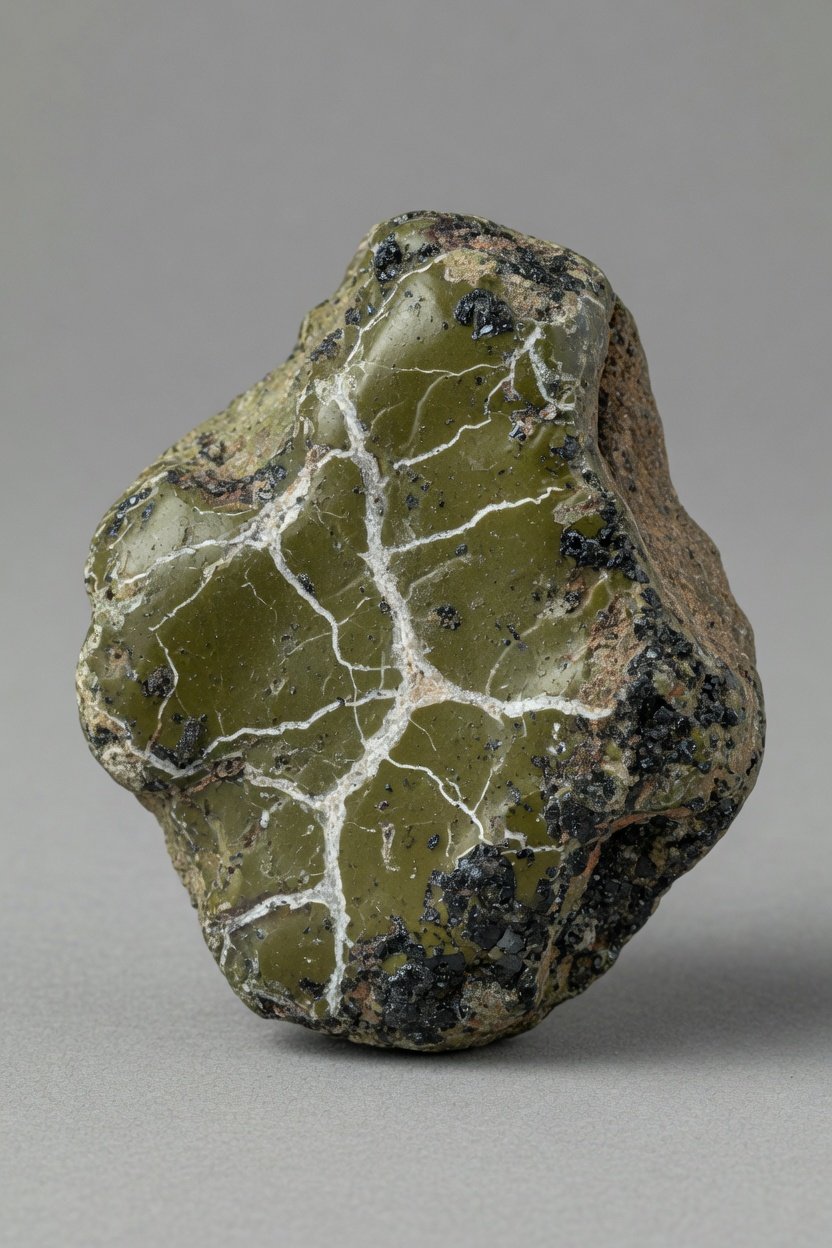
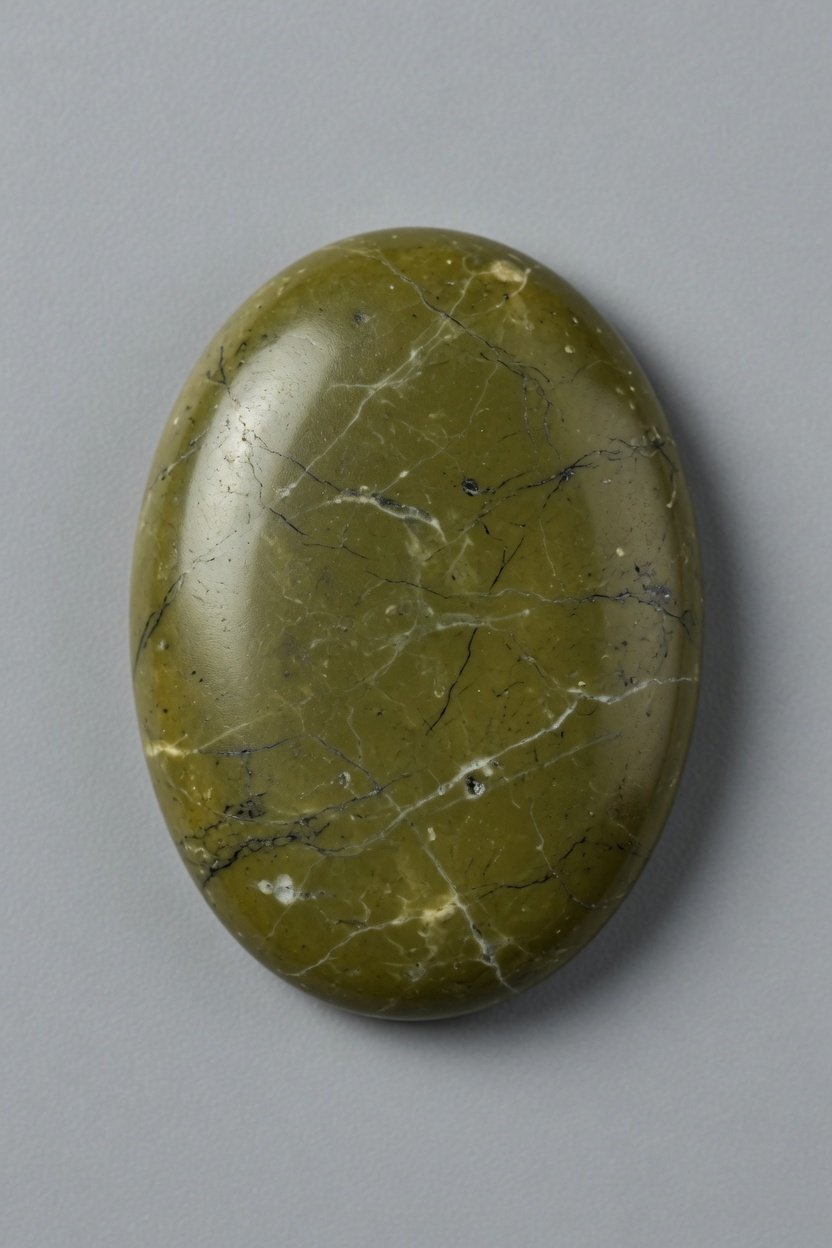
Serpentine draws the eye with its cool, waxy green surfaces that twist in subtle waves across the stone, hinting at ancient geological forces that shaped it deep within the earth. Its patterns evoke the smooth coils of a serpent without ever becoming literal, offering a quiet depth that silversmiths have long prized for both its color and its forgiving workability. This stone bridges the raw power of the planet with the refined touch of human craft.
Physical Properties Serpentine belongs to a group of magnesium-rich silicate minerals whose structure includes layers of silica tetrahedra and octahedral sheets, resulting in a Mohs hardness of 3 to 4 and a specific gravity between 2.5 and 2.6. The material typically displays a greasy to waxy luster and ranges from translucent to opaque, with colors dominated by olive, yellow-green, and dark forest tones often interrupted by white veins or black magnetite inclusions. Because of its modest hardness and perfect cleavage in some varieties, it polishes to a soft sheen rather than a brilliant sparkle. Silversmiths set the stone only after all soldering is complete to avoid heat damage that can cause cracking or dehydration; care cautions include avoiding prolonged ultrasonic cleaning and shielding the piece from sudden temperature changes that might exploit its water content.
Origin and Sourcing Commercial serpentine is extracted from several major regions, most notably the Coast Ranges of California, the Italian Alps, and parts of China and Canada. In hard-rock deposits it occurs as alteration products of ultramafic rocks where olivine and pyroxene have been hydrated under low-grade metamorphic conditions. Miners follow narrow veins with pneumatic drills and controlled blasting, then sort the rough by color and freedom from fractures before shipping it to lapidary workshops. The stone’s abundance keeps prices accessible, yet fine, evenly colored blocks with attractive veining remain sought after by artisans who value its ability to take a high polish without excessive effort.
History and Significance Ancient cultures carved serpentine into amulets and seals as early as the Minoan period on Crete, where its green hue was associated with renewal and protection. In the American Southwest, indigenous lapidaries shaped it into fetishes and beads long before European contact. Victorian jewelers later adopted the material for cameos and intaglios, appreciating the way its waxy surface held fine detail under the engraver’s tool. Throughout these eras the stone carried connotations of safeguarding the wearer from venomous creatures and negative energies, a reputation that persists in modern metaphysical circles.
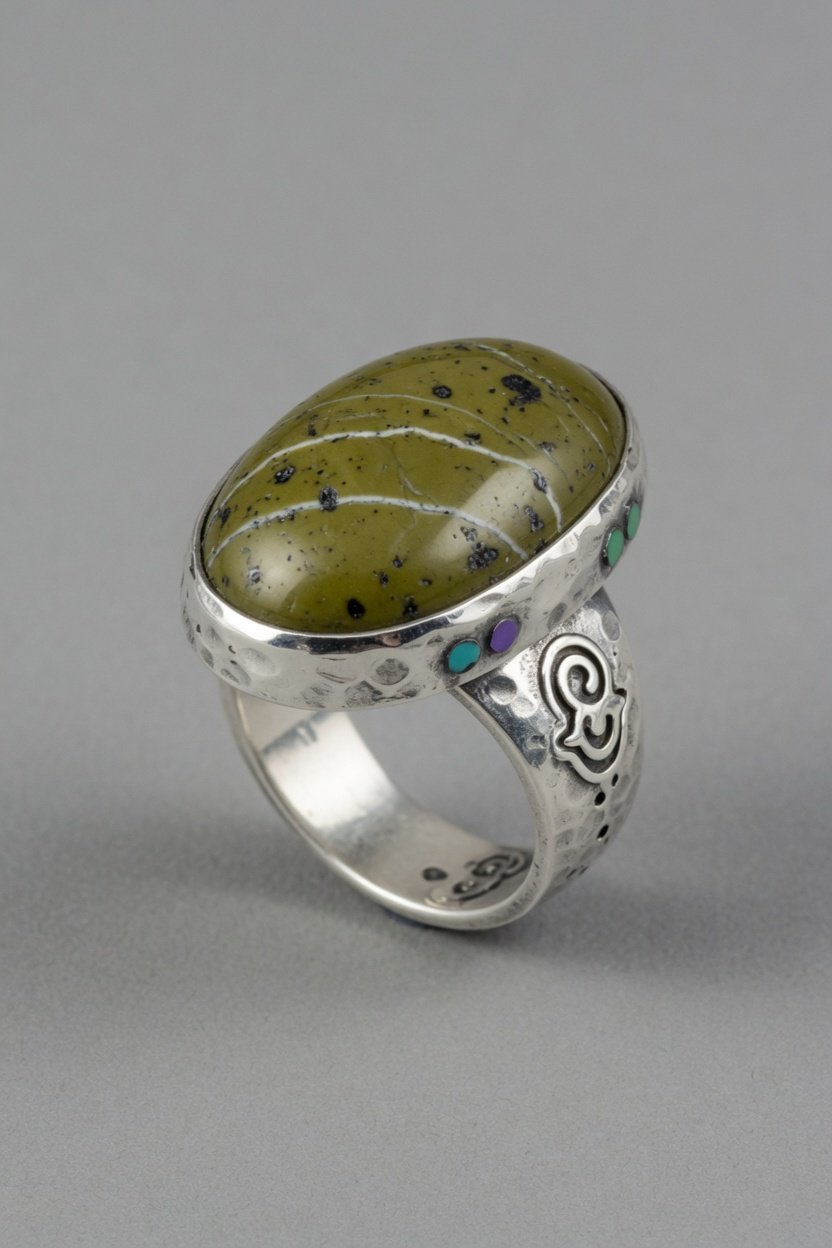
In Jewelry and Silversmithing Because serpentine is opaque and relatively soft, it is almost always finished as cabochons or simple freeform shapes rather than faceted gems. Its low thermal conductivity and tendency to dehydrate under direct flame require that the stone be set only after all soldering operations are finished and the piece has cooled completely. Artisans often choose a bezel or half-bezel that fully encloses the girdle, protecting the edges while allowing the stone’s subtle patterns to remain visible. Care cautions extend to everyday wear: remove serpentine jewelry before household chores involving heat or chemicals, and store pieces separately to prevent scratching from harder gems. The resulting jewelry offers a muted, organic elegance that complements both contemporary and heritage silver designs.
Identifying Serpentine in the Field In the field, serpentine can be recognized by its characteristic apple-green to olive color, soapy or waxy feel when touched, and the way it effervesces weakly or not at all with dilute hydrochloric acid, distinguishing it from calcite. A knife blade will scratch it easily, yet it resists crumbling the way many altered ultramafics do. Veins of white chrysotile or black magnetite are common companions, and the rock often forms slickensided surfaces in outcrop. These tactile and visual cues allow prospectors and students to confirm the mineral before committing time to extraction or purchase.
Quick Facts
Common names: Serpentine, New Jade, Verde Antique, Bowenite
Chemical formula: Mg₃Si₂O₅(OH)₄
Mohs hardness: 3–4
Specific gravity: 2.5–2.6
Color: Olive green, yellow-green, dark forest green with white or black veining
Crystal system: Monoclinic
Luster: Greasy to waxy
Transparency: Translucent to opaque
Common cuts: Cabochon, freeform, bead
Common treatments: None typical; occasional waxing or oiling to enhance luster
Best silver setting: Classic Silver Bezel Pendant
Birthstone month (if any): None
Main sources: USA (California), Italy, China, Canada
Meaning & Intentions
PROTECTION
Serpentine is carried or worn to create a steady energetic boundary that absorbs scattered or intrusive influences before they reach the wearer. In silversmithing practice the stone is cut as a broad, low cabochon and seated in a closed bezel so that its entire surface remains in contact with the skin, allowing the mineral’s layered structure to act as a quiet buffer throughout the day. The resulting piece becomes a tangible reminder to maintain personal space without aggression.
Chakra: Root — grounding and physical security CLARITY
When used for clarity, serpentine is chosen for its ability to reveal patterns beneath surface appearances, much as its own veining shows the history of geological stress. Silversmiths orient the cabochon so that the most pronounced veins run horizontally across the finished pendant, inviting the eye to follow natural lines and notice subtle connections. This visual cue supports focused observation during meditation or decision-making.
Chakra: Third Eye — insight and pattern recognition BOUNDARIES
Serpentine reinforces healthy limits by encouraging calm recognition of where one’s energy ends and another’s begins. In jewelry the stone is often paired with a simple silver frame that visually contains the cabochon, mirroring the intention of containment without constriction. Wearers report that the cool, solid feel against the sternum helps anchor this awareness during difficult conversations.
Chakra: Solar Plexus — personal power and discernment Affirmation: "I move through the world with steady boundaries and clear vision." AT A GLANCE: Chakra: Root, Third Eye, Solar Plexus Element: Earth Energy: Receptive Zodiac: Virgo, Capricorn Planet: Saturn Affirmation: "I move through the world with steady boundaries and clear vision."
Related Stones
Explore more stones from the Gemstone Library: Dendritic Agate · Smoky Quartz · Andalusite