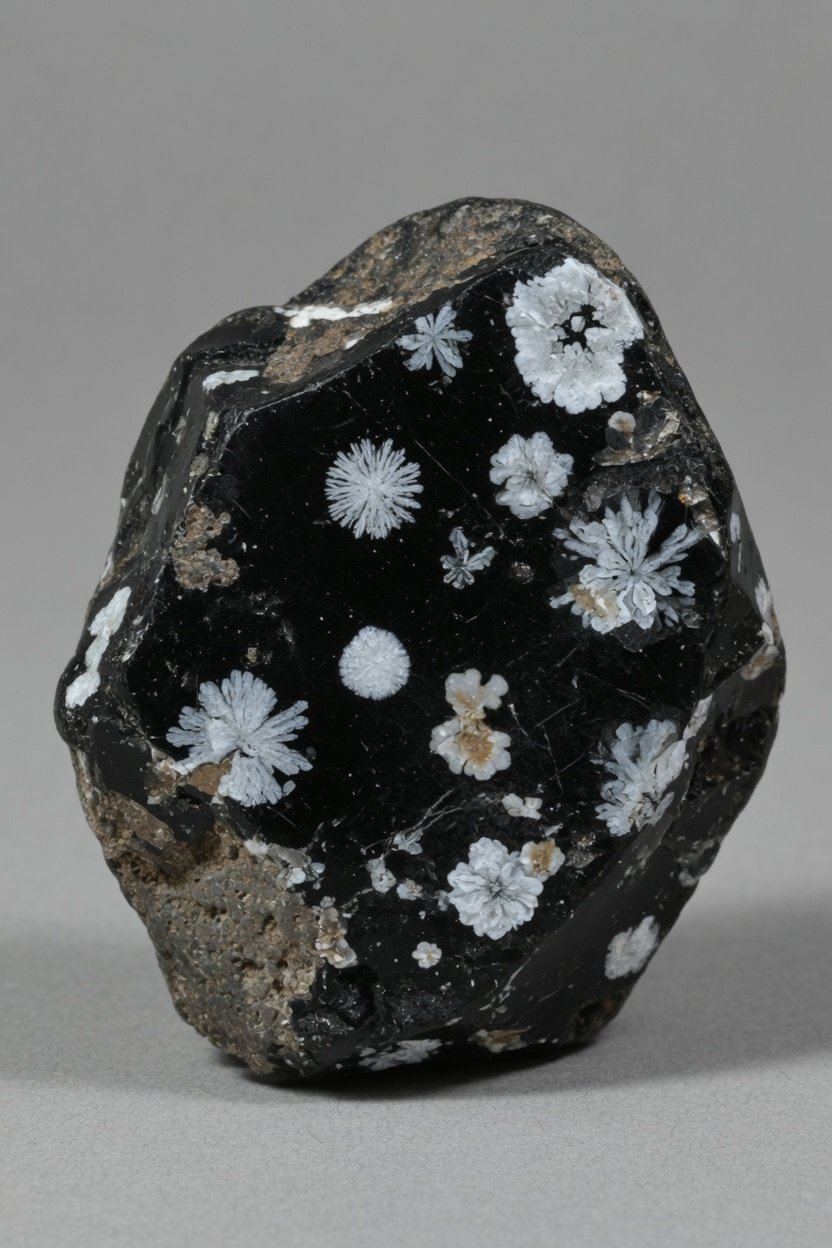
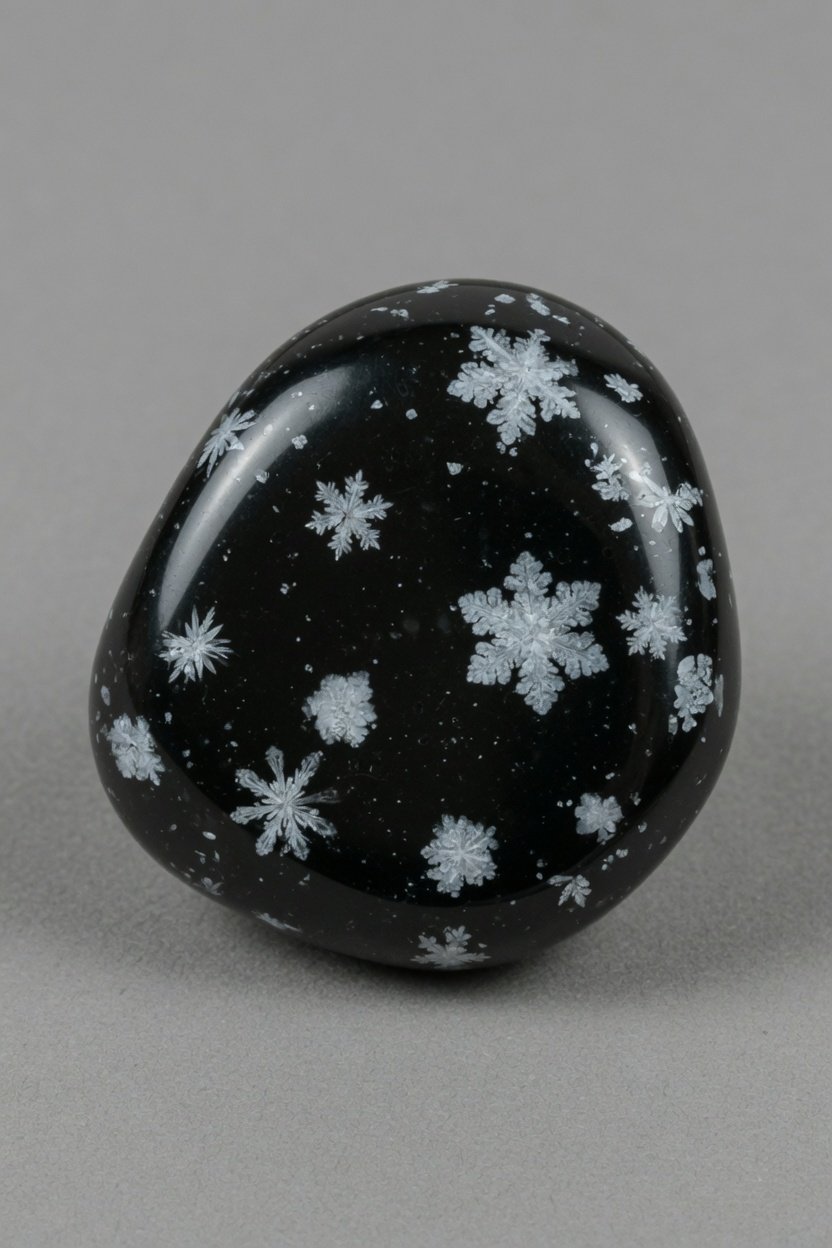
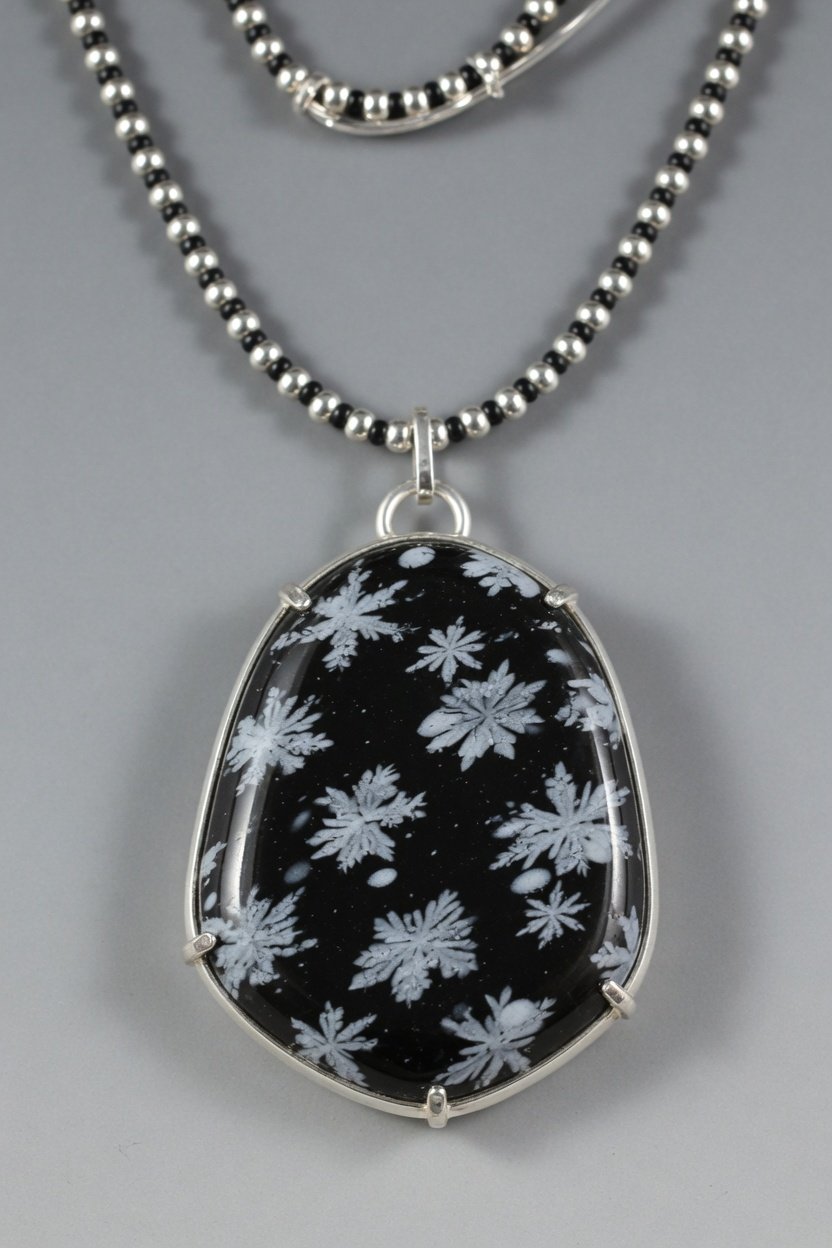
Snowflake obsidian forms when volcanic lava cools rapidly, trapping silica-rich inclusions that create distinctive white markings against a deep black glassy matrix. These markings appear as irregular white smudges rather than crystalline snowflakes, giving the stone its common name while revealing its volcanic origin. The material’s glassy texture and pattern contrast make it a striking choice for silversmiths seeking organic, high-contrast designs.
Physical Properties Snowflake obsidian is a natural volcanic glass with a chemical composition dominated by silicon dioxide. Its Mohs hardness ranges from 5 to 5.5, making it softer than many crystalline gems yet tough enough for everyday wear when properly set. Specific gravity sits between 2.3 and 2.5. The stone shows a vitreous luster on polished surfaces and remains fully opaque. White smudges of cristobalite create the signature pattern within the black base. Because the material contains water and can fracture under sudden temperature change, the stone must be set only after all soldering and torch work is complete. Avoid ultrasonic cleaners and prolonged heat exposure to prevent cracking.
Origin and Sourcing Primary commercial sources include Mexico’s volcanic regions, the western United States, and parts of Iceland. Material is typically recovered from open-pit or hard-rock deposits where obsidian flows are broken into manageable blocks. Miners select pieces showing clear white smudges against uniform black glass. Rough is then transported to lapidary workshops for tumbling or cutting. Ethical sourcing focuses on sites with controlled extraction that minimize environmental impact while preserving access for local communities.
History and Significance Obsidian tools and ornaments appear in archaeological records across Mesoamerica and the American Southwest. Ancient artisans valued the glass for its sharp edges and dark sheen. The white smudges were sometimes interpreted as symbols of winter or purity within volcanic fire. Modern collectors continue to appreciate the stone’s link to both geological violence and quiet pattern.
In Jewelry and Silversmithing Silversmiths favor tumbled freeform or cabochon cuts that showcase the white smudges against the black field. The material pairs especially well with sterling silver in bezel or southwestern stamped settings. Because obsidian is heat-sensitive, all soldering must finish before the stone is placed. Once set, the piece requires only gentle cleaning with mild soap and water. Care cautions include avoiding impact that could chip the glass edges and storing away from harder gems that might scratch the surface.
Identifying Snowflake Obsidian in the Field In rough form the stone appears as dark, glassy blocks with conchoidal fracture surfaces. Look for white smudges scattered across the black matrix; these inclusions are usually rounded or irregular rather than sharply crystalline. Fresh breaks show a brilliant vitreous sheen. Hardness testing with a steel file leaves a mark, while the stone feels noticeably lighter than crystalline quartz. Always confirm the pattern is natural white cristobalite rather than surface weathering before purchase.
Quick Facts
Common names: Snowflake Obsidian, Flowering Obsidian
Chemical formula: SiO₂ (with cristobalite inclusions)
Mohs hardness: 5–5.5
Specific gravity: 2.3–2.5
Color: Black with white smudges
Crystal system: Amorphous
Luster: Vitreous
Transparency: Opaque
Common cuts: Tumbled freeform, cabochon
Common treatments: None
Best silver setting: Bezel or southwestern stamped bezel
Birthstone month (if any): None
Main sources: Mexico, United States, Iceland
Meaning & Intentions
GROUNDING
Snowflake obsidian supports steady presence during change by anchoring scattered thoughts to the present moment. Silversmiths set the stone in protective talismans that rest against the skin, allowing the black matrix and white smudges to act as a visual reminder of balance between stillness and motion. Wearers report feeling more rooted when facing daily pressures.
Chakra: Root — stability and physical connection CLARITY
The contrasting white smudges on black glass encourage clear perception of patterns within complexity. When placed in a pendant or ring, the stone invites wearers to notice small details that might otherwise be overlooked, fostering thoughtful decision-making without emotional overload.
Chakra: Third Eye — insight and perception PROTECTION
Snowflake obsidian is used to create a quiet energetic boundary that filters unwanted influences. Crafted into earrings or a brooch, the stone’s dense glass structure is believed to absorb and neutralize disruptive energy, giving the wearer space to respond calmly rather than react.
Chakra: Root — security and containment Affirmation: "I remain steady amid shifting patterns." AT A GLANCE: Chakra: Root Element: Earth Energy: Receptive Zodiac: Scorpio Planet: Saturn Affirmation: "I remain steady amid shifting patterns."
Related Stones
Explore more stones from the Gemstone Library: Aragonite · Agate · Moss Agate