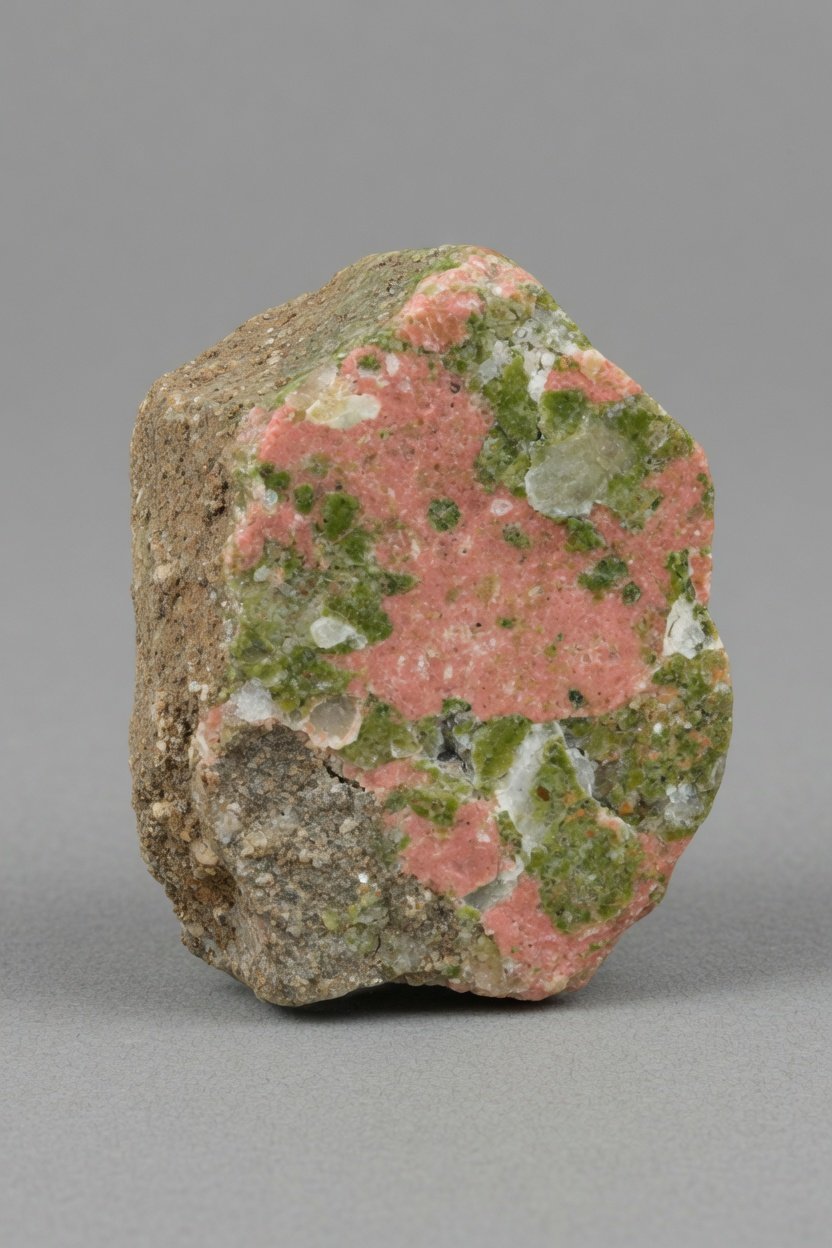
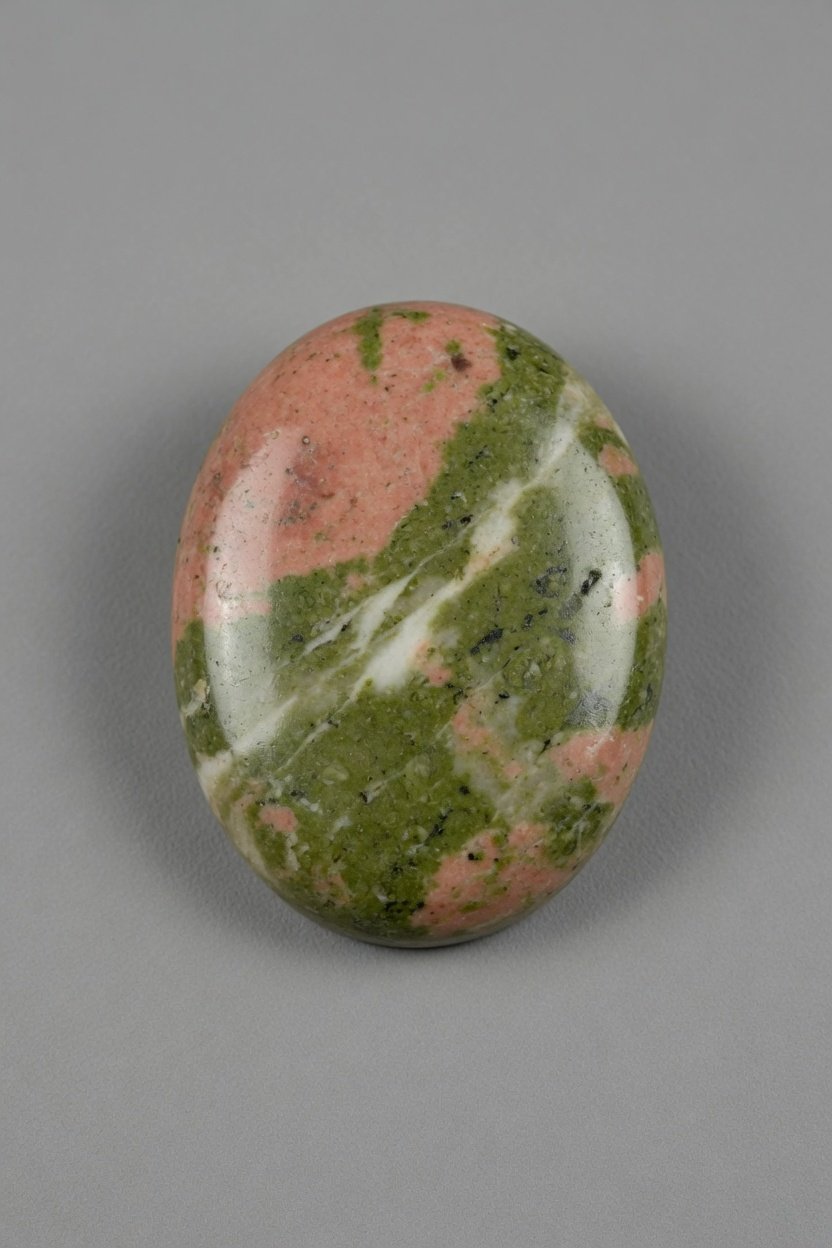
Unakite forms deep within ancient mountain roots where feldspar, epidote, and quartz intergrow under intense pressure and heat. Its distinctive mottled appearance immediately signals a stone shaped by long geological processes rather than sudden volcanic events. Silversmiths prize the material for its reliable workability once the rough has been properly identified and prepared.
Physical Properties Unakite is a metamorphic rock composed primarily of pink orthoclase feldspar, pistachio-green epidote, and clear quartz grains. Hardness ranges from 6 to 7 on the Mohs scale, giving it sufficient durability for everyday jewelry while remaining soft enough to shape with standard lapidary wheels. Specific gravity falls between 2.85 and 3.0, producing a solid, substantial feel in the hand. The stone displays a dull to waxy luster and is always opaque, with color patches that can range from salmon pink to deep forest green separated by milky quartz veins. Because unakite contains no water of crystallization or volatile components that degrade under moderate heat, it tolerates standard bench processes without special precautions beyond normal care.
Origin and Sourcing Primary commercial deposits occur in the Unaka Mountains of Virginia and North Carolina, with additional material coming from South Africa, Brazil, and parts of China. Miners extract the rock from weathered outcrops and shallow open pits rather than deep hard-rock tunnels. The stone is typically recovered as large, irregular boulders that are later sawn into workable slabs. Ethical sourcing focuses on small-scale operations that avoid heavy machinery and restore the land after extraction.
History and Significance Native American communities in the southeastern United States collected unakite for ceremonial objects long before European contact. In the nineteenth century the stone received its name from the Unaka range where it was first systematically studied. Modern lapidaries rediscovered it in the 1970s as interest in natural, untreated materials grew. Today it symbolizes grounded balance between heart and mind, a reputation built on its literal combination of calming green epidote and stabilizing pink feldspar.
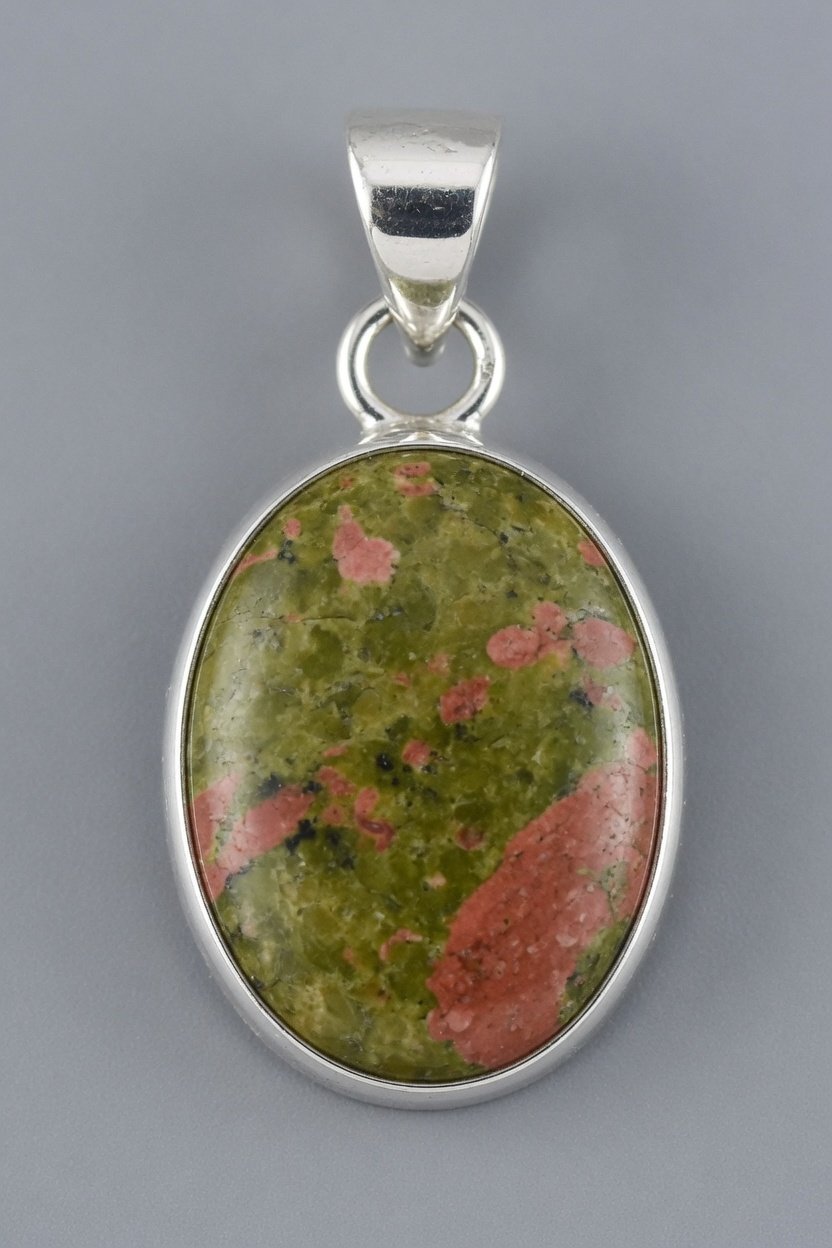
In Jewelry and Silversmithing Unakite is almost always cut as cabochons or freeform shapes because its opacity prevents faceting. The best silver setting is a classic bezel that fully supports the dome while allowing the mottled pattern to remain the visual focus. Set the stone only after all soldering and pickling steps are complete to avoid flux stains or minor surface etching. Clean finished pieces with mild soap and warm water; avoid prolonged ultrasonic exposure because the differing hardness of the mineral components can cause micro-chipping along grain boundaries over many years.
Identifying Unakite in the Field In outcrop the rock appears as a coarse-grained mass with clearly visible pink, green, and white zones. A steel point will scratch the feldspar portions but leave the epidote largely untouched, providing a quick field test. Freshly broken surfaces show a sugary texture from the quartz grains. Collectors should note that similar-looking rocks from other regions often lack the balanced pink-to-green ratio that defines true unakite.
Quick Facts
Common names: Unakite, Unakite Jasper
Chemical formula: (KAlSi₃O₈) + Ca₂(Al,Fe)₃(SiO₄)₃(OH) + SiO₂
Mohs hardness: 6–7
Specific gravity: 2.85–3.0
Color: Mottled pink, green, and white
Crystal system: Triclinic / monoclinic mixture
Luster: Dull to waxy
Transparency: Opaque
Common cuts: Cabochon, tumbled freeform
Common treatments: None
Best silver setting: Classic Silver Bezel Pendant
Birthstone month (if any): None
Main sources: USA (Virginia, North Carolina), South Africa, Brazil
Meaning & Intentions
GROUNDING BALANCE
Unakite anchors scattered emotions by combining the stabilizing pink feldspar with the heart-centered green epidote, helping wearers remain present during stressful transitions. Silversmiths set the stone low in a bezel so the palm can rest against its smooth dome, turning the finished piece into a portable grounding tool that strengthens resolve without dramatic change.
Chakra: Root — steady foundation and physical presence EMOTIONAL CLARITY
The stone’s contrasting colors act as a visual reminder to observe feelings without judgment, allowing the wearer to notice patterns of worry or resentment before they deepen. In a pendant the pink and green zones sit directly over the heart, encouraging quiet self-examination during daily routines.
Chakra: Heart — compassionate self-awareness PROTECTIVE BOUNDARIES
Unakite reinforces personal limits by blending epidote’s filtering quality with feldspar’s strength, so wearers feel less drained by external demands. A bezel-set cabochon worn at the throat or wrist creates a tangible boundary that supports calm refusal when needed.
Chakra: Solar Plexus — confident self-protection Affirmation: "I remain steady and open." AT A GLANCE: Chakra: Root Element: Earth Energy: Receptive Zodantine: Scorpio Planet: Mars Affirmation: "I remain steady and open."
Related Stones
Explore more stones from the Gemstone Library: Onyx · Bloodstone · Red Jasper