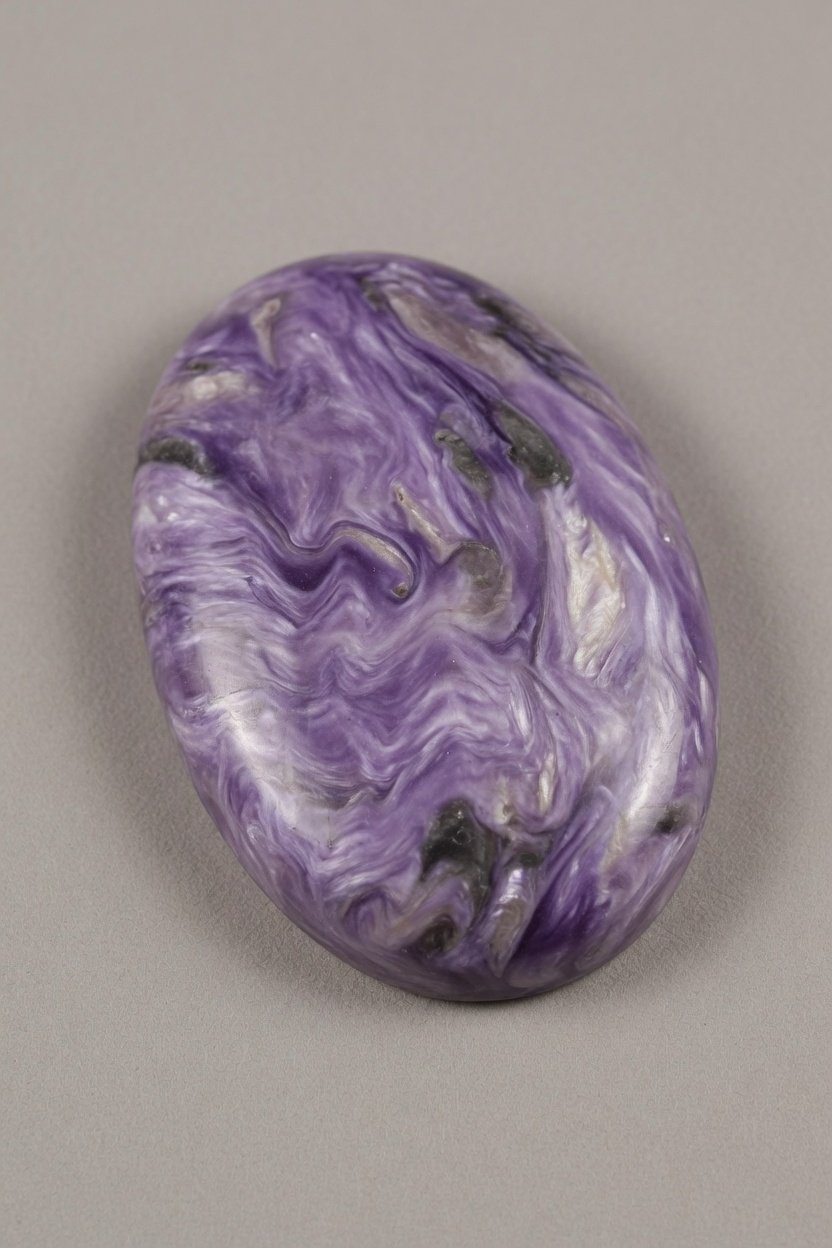
Charoite emerges from the frozen Siberian ground as a swirling tapestry of lavender, violet, and creamy white, its fibrous patterns catching the eye like frozen rivers of light. This rare silicate forms only in one remote Russian locale, where alkaline intrusions meet limestone, creating a stone prized by silversmiths for its depth and movement. Its chatoyant sheen and intricate veining make it instantly recognizable once set into silver.
Physical Properties Charoite registers 5 to 6 on the Mohs scale, placing it between apatite and orthoclase, with a specific gravity around 2.54 to 2.78. The stone exhibits a vitreous to silky luster and ranges from translucent to opaque, often displaying fibrous aggregates that create a distinctive chatoyancy. Because it contains water and is sensitive to prolonged heat, the stone must be set into silver only after all soldering and torch work are complete; avoid ultrasonic cleaners and store away from direct sunlight to prevent fading.
Origin and Sourcing The sole commercial source lies in the Murun massif of the Sakha Republic in eastern Siberia, where charoite occurs in narrow veins within syenite and limestone. Miners extract it through small-scale hard-rock methods, following the irregular seams by hand to preserve the best material. No other locality has produced comparable quantities or quality, making every specimen traceable to this single remote region.
History and Significance Discovered in the 1940s and named after the nearby Chara River, charoite remained largely unknown outside Russia until the 1970s. Indigenous Evenki and Yakut peoples had long noticed the purple rock but attributed little spiritual weight until lapidaries began carving it. Today it symbolizes transformation and inner vision, valued by collectors for its singular appearance rather than ancient lore.
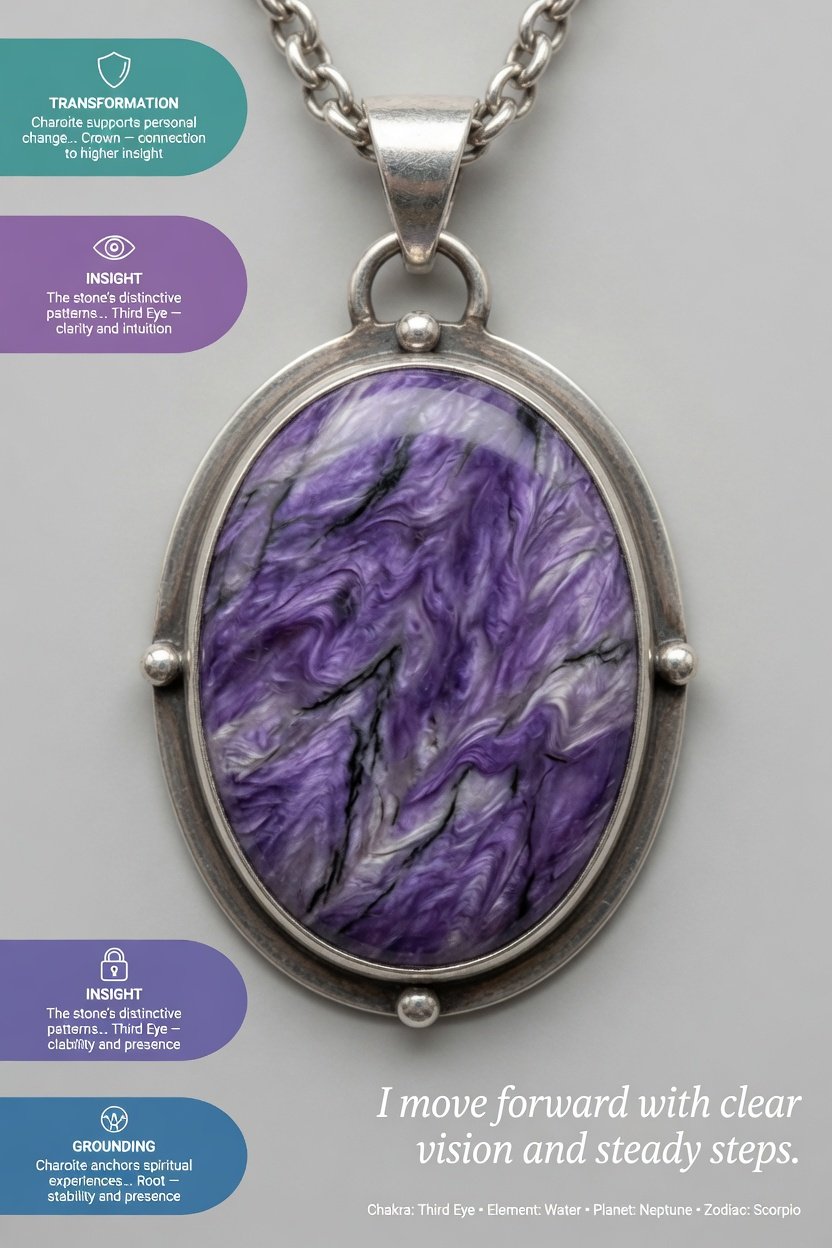
In Jewelry and Silversmithing Silversmiths favor charoite for cabochons that highlight its swirling patterns against oxidized or polished silver. The fibrous structure takes a high polish yet remains vulnerable to impact, so bezel settings provide the necessary protection. Setting must occur only after soldering is finished and the piece has cooled completely; a light oiling occasionally revives luster on worn surfaces.
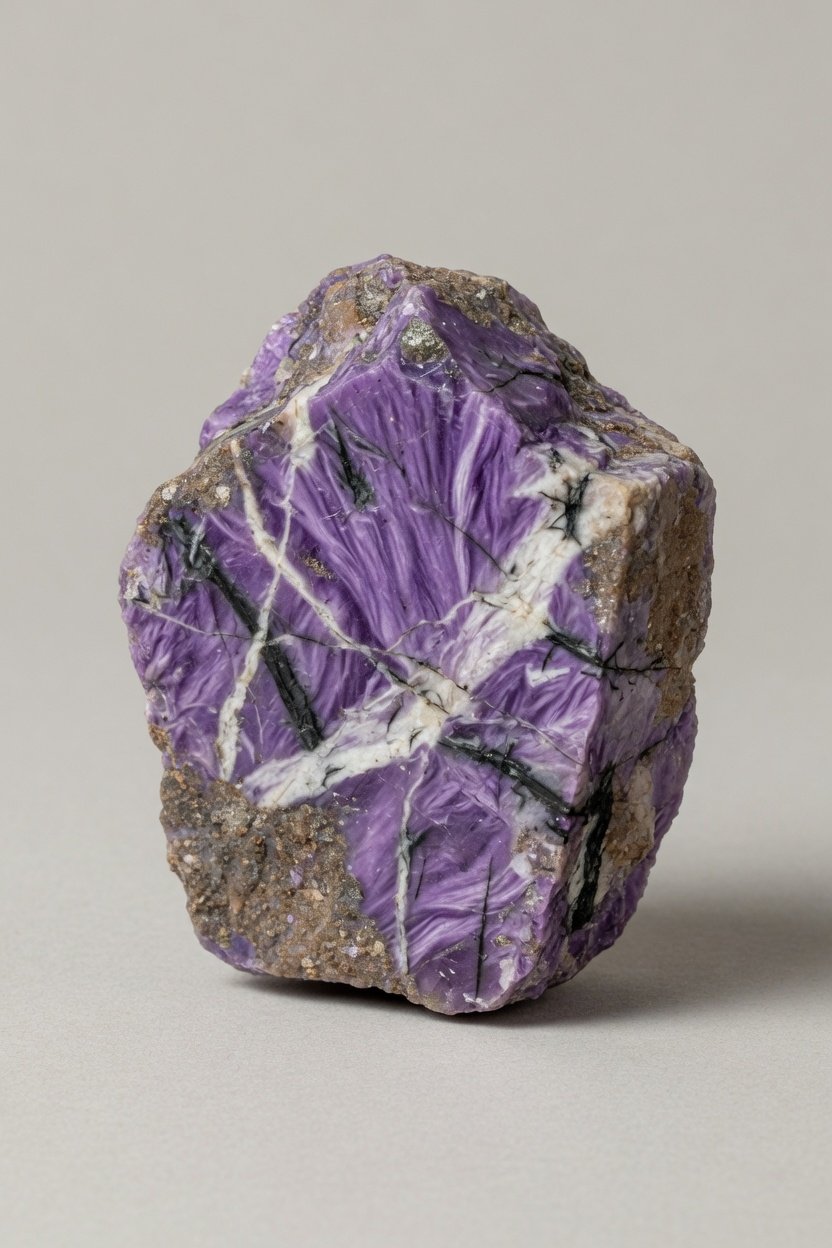
Identifying Charoite in the Field In rough form, charoite appears as lilac to deep purple masses with white feldspar and black aegirine inclusions, lacking the sharp cleavage of similar-looking sugilite. Its fibrous texture produces a silky rather than glassy surface when broken, and a drop of dilute acid produces no reaction, distinguishing it from carbonate-rich purple rocks. Always examine the matrix for the characteristic Russian syenite association.
Quick Facts
Common names: Charoite
Chemical formula: (K,Sr)5(Ca,Na)8(Si6O15)4(OH,F)·3.5H2O
Mohs hardness: 5–6
Specific gravity: 2.54–2.78
Color: Lavender to deep violet with white and black veining
Crystal system: Monoclinic
Luster: Vitreous to silky
Transparency: Translucent to opaque
Common cuts: Cabochon
Common treatments: None
Best silver setting: Classic Silver Bezel Pendant
Birthstone month (if any): None
Main sources: Russia (Sakha Republic)
Meaning & Intentions
TRANSFORMATION
Charoite supports personal change by encouraging release of old patterns while its swirling fibers visually mirror the flow of inner shifts. Silversmiths set the stone in protective bezels so the wearer can carry this steady reminder against the skin during times of growth.
Chakra: Crown — connection to higher insight INSIGHT
The stone’s distinctive patterns are said to sharpen perception, helping the wearer notice subtle truths in daily life. When placed in silver jewelry the chatoyant bands catch light at different angles, prompting fresh perspectives throughout the day.
Chakra: Third Eye — clarity and intuition GROUNDING
Charoite anchors spiritual experiences in practical reality, its dense fibrous structure offering a sense of stability during intense personal work. Set after all heat is finished, the silver bezel further secures this anchoring energy against daily movement.
Chakra: Root — stability and presence Affirmation: "I move forward with clear vision and steady steps." AT A GLANCE: Chakra: Third Eye Element: Water Energy: Receptive Zodiac: Scorpio Planet: Neptune Affirmation: "I move forward with clear vision and steady steps."
Related Stones
Explore more stones from the Gemstone Library: Danburite · Boulder Opal · Benitoite