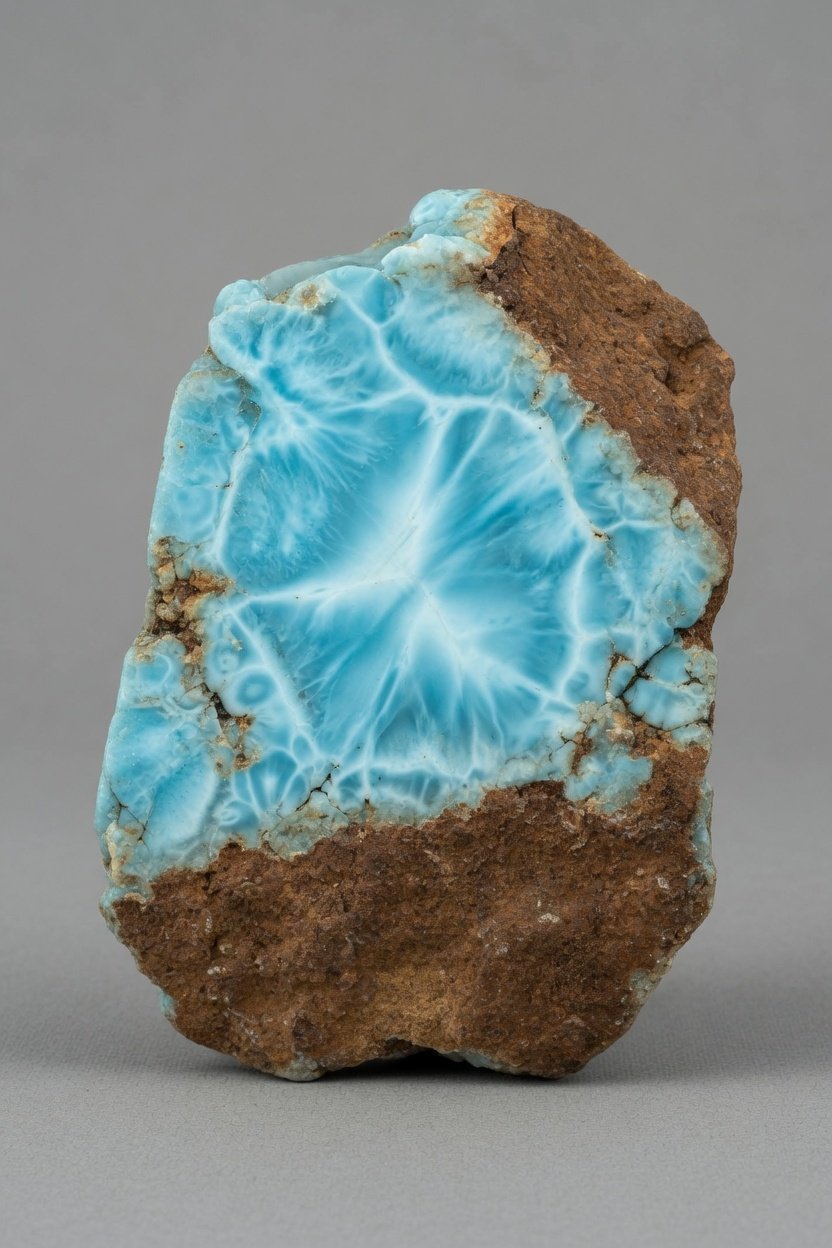
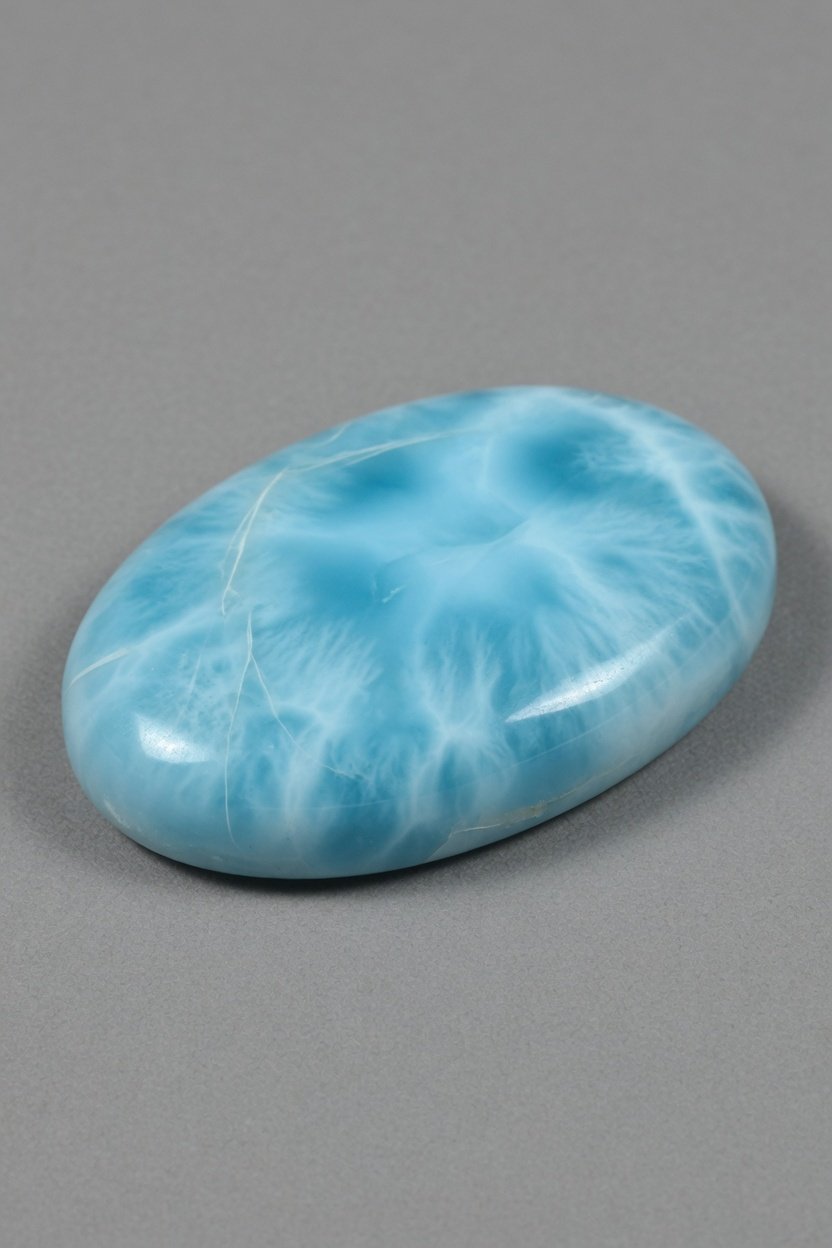
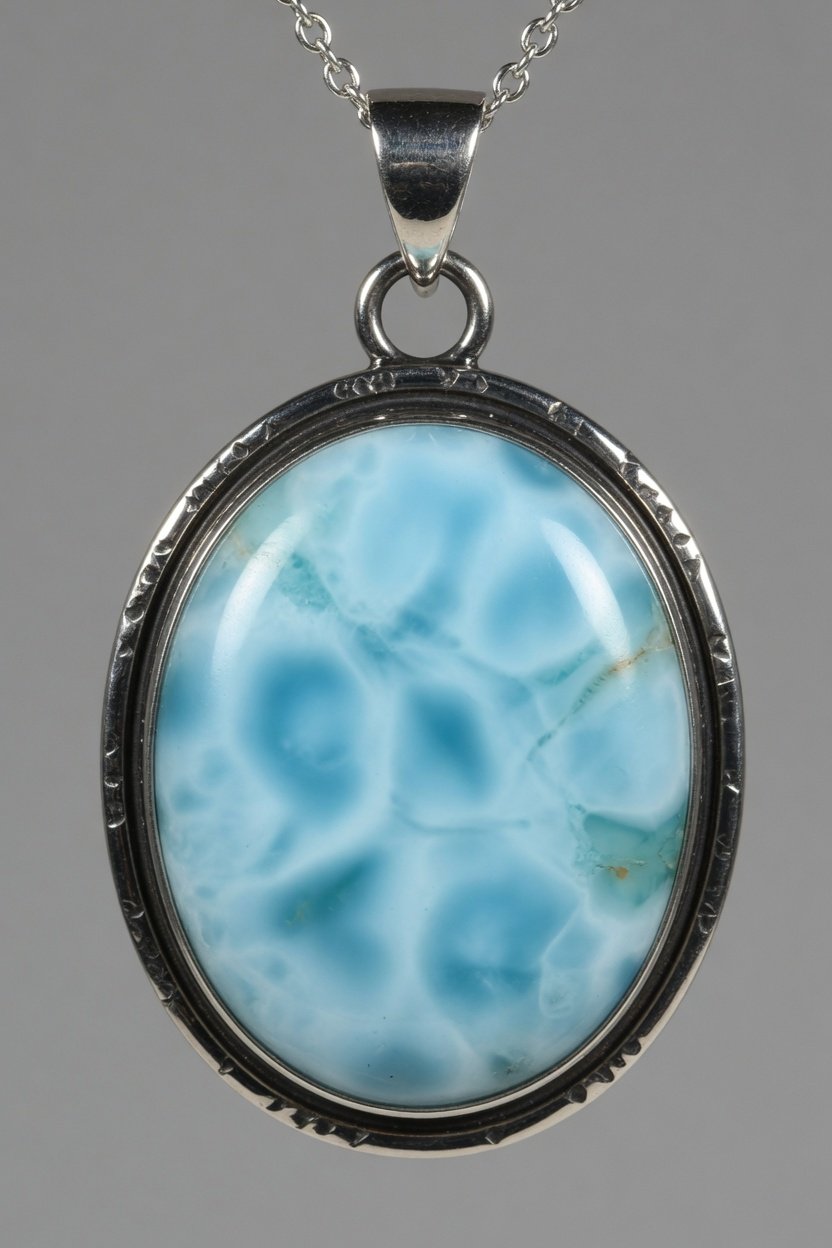
Larimar emerges from the Caribbean like captured sea and sky, its swirling blues evoking the exact moment sunlight pierces shallow waves over white sand. This rare pectolite variety forms only in one narrow volcanic region, making every finished piece a direct link to that singular birthplace. Silversmiths prize it for the way its oceanic palette pairs with oxidized silver, creating jewelry that feels both ancient and alive.
Physical Properties Larimar registers 4.5–5 on the Mohs scale and shows a specific gravity near 2.7, placing it in the softer range that requires careful handling during fabrication. Its chemical makeup is sodium calcium silicate hydroxide, producing a fibrous structure that yields a silky, pearly luster when polished. The stone is heat-sensitive because of its water content, so it must be set only after all soldering and torch work are complete; prolonged heat can cause whitening or cracking along cleavage planes. Care cautions include avoiding ultrasonic cleaners, prolonged sunlight exposure, and harsh chemicals that could dull its distinctive color.
Origin and Sourcing Larimar occurs exclusively in the mountainous southwest of the Dominican Republic, where Miocene volcanic activity created the precise conditions for its formation. Miners extract it through small-scale hard-rock operations that follow narrow veins in altered basalt, often working by hand to preserve the delicate material. No other commercial source exists worldwide, which keeps supply limited and prices reflective of that single-origin reality.
History and Significance Local residents first collected the stone along the Barahona coast in the early twentieth century, though organized mining began only in the 1970s after a rediscovery by Miguel Méndez. The name combines “Larissa,” his daughter’s name, with “mar,” the Spanish word for sea. Indigenous Taíno people may have encountered similar blue stones, yet modern appreciation centers on its visual resemblance to Caribbean waters rather than ancient lore.
In Jewelry and Silversmithing Larimar is almost always cut as cabochons to display its sky-blue color and white veining without the risk of chipping that faceting would invite. Silversmiths set the finished cabochons only after all soldering is complete, typically choosing bezel or scalloped-bezel mounts that protect the edges while allowing light to play across the surface. The stone’s moderate toughness makes it suitable for pendants and earrings but less ideal for daily-wear rings unless the design includes a protective frame. Care cautions remain the same: remove jewelry before heavy work or cleaning, and store away from other gems that could scratch its surface.
Identifying Larimar in the Field In rough form Larimar appears as blue-gray masses with white veining inside basalt matrix; a simple scratch test with a steel point leaves a mark because of its softness. The color is diagnostic—only the Dominican locality produces this exact sky-to-turquoise blue in pectolite. When polished, the stone shows a distinctive chatoyant or silky sheen rather than the glassy brilliance of harder gems.
Quick Facts
Common names: Larimar, Atlantis Stone, Dolphin Stone
Chemical formula: NaCa₂Si₃O₈(OH)
Mohs hardness: 4.5–5
Specific gravity: 2.70–2.90
Color: Sky blue to turquoise with white veining
Crystal system: Triclinic
Luster: Silky to pearly
Transparency: Opaque to translucent
Common cuts: Cabochon
Common treatments: None
Best silver setting: Classic Silver Bezel
Birthstone month (if any): None
Main sources: Dominican Republic
Meaning & Intentions
CALM COMMUNICATION
Larimar supports clear, peaceful expression by helping the wearer release tension that blocks honest dialogue. Silversmiths set the cabochon after soldering so the stone’s tranquil color remains undamaged and ready to serve as a daily reminder during conversations.
Chakra: Throat — supports honest expression and calm speech INNER VISION
The stone’s oceanic patterns encourage quiet reflection and insight, guiding users toward deeper self-understanding without forcing outcomes. Its cool blues are believed to still mental chatter so intuitive messages can surface more readily.
Chakra: Third Eye — enhances intuition and inner sight EMOTIONAL PROTECTION
Larimar is thought to create a gentle energetic boundary that shields sensitive emotions while still allowing connection with others. The stone’s single-source origin adds a layer of rarity that many wearers find grounding during times of change.
Chakra: Heart — fosters emotional safety and compassion Affirmation: "I speak my truth with calm clarity and move through life protected by peaceful waters." AT A GLANCE: Chakra: Throat Element: Water Energy: Calming Zodiac: Leo, Pisces Planet: Neptune Affirmation: "I speak my truth with calm clarity and move through life protected by peaceful waters."
Related Stones
Explore more stones from the Gemstone Library: Grandidierite · Paraiba Tourmaline · Aquamarine