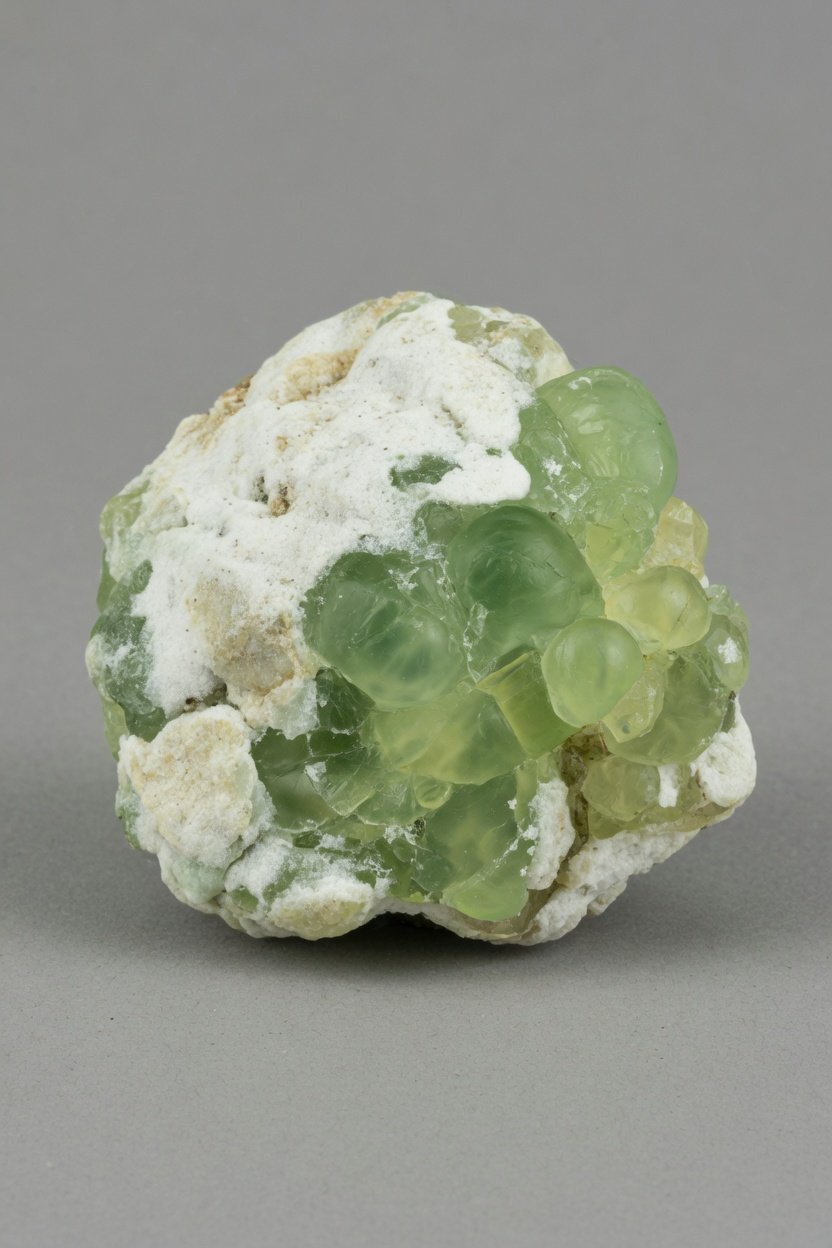
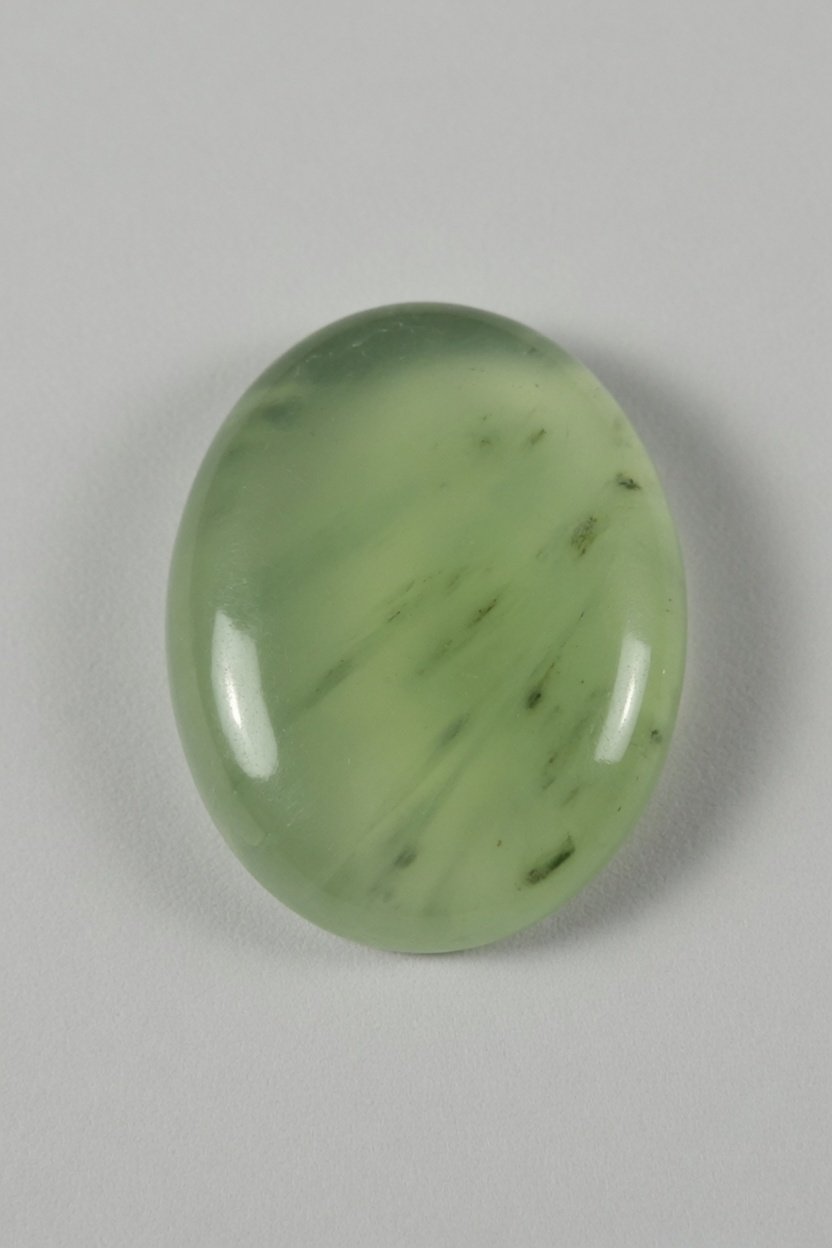
Prehnite emerges from the earth with a soft, apple-green glow that hints at ancient mineral processes locked deep within the crust. This translucent silicate forms in cavities where silica-rich fluids cooled slowly, creating stones prized for their gentle light transmission and vitreous sheen. Silversmiths value its subtle color shifts that catch studio light without overwhelming a design.
Physical Properties Prehnite is a calcium aluminum silicate hydroxide with the formula Ca2Al2Si3O10(OH)2. It registers 6 to 6.5 on the Mohs scale, sufficient for everyday wear yet soft enough to require careful handling during fabrication. Specific gravity ranges from 2.80 to 2.95, and its orthorhombic crystals often appear as radiating aggregates or botryoidal masses. The stone contains structural water, making it sensitive to sudden temperature changes; always set Prehnite after all soldering and polishing steps are complete to avoid cracking or clouding from heat.
Origin and Sourcing Primary deposits occur in South Africa’s Cape Province, where the mineral was first described, along with notable occurrences in Australia, China, and parts of the United States. Material is extracted from both open-pit operations and narrow hard-rock veins using hand tools and small machinery to preserve crystal integrity. Rough is typically sorted on site before export to lapidaries who select pieces showing even color and minimal fracturing.
History and Significance Dutch mineralogist Hendrik von Prehn brought the first specimens to Europe in the late eighteenth century, giving the stone its name. Indigenous communities in southern Africa had long collected similar green stones for adornment and trade. Over time Prehnite gained a reputation among collectors for its ability to display a soft internal glow reminiscent of moonlight on water, a quality that later attracted jewelry makers seeking understated elegance.
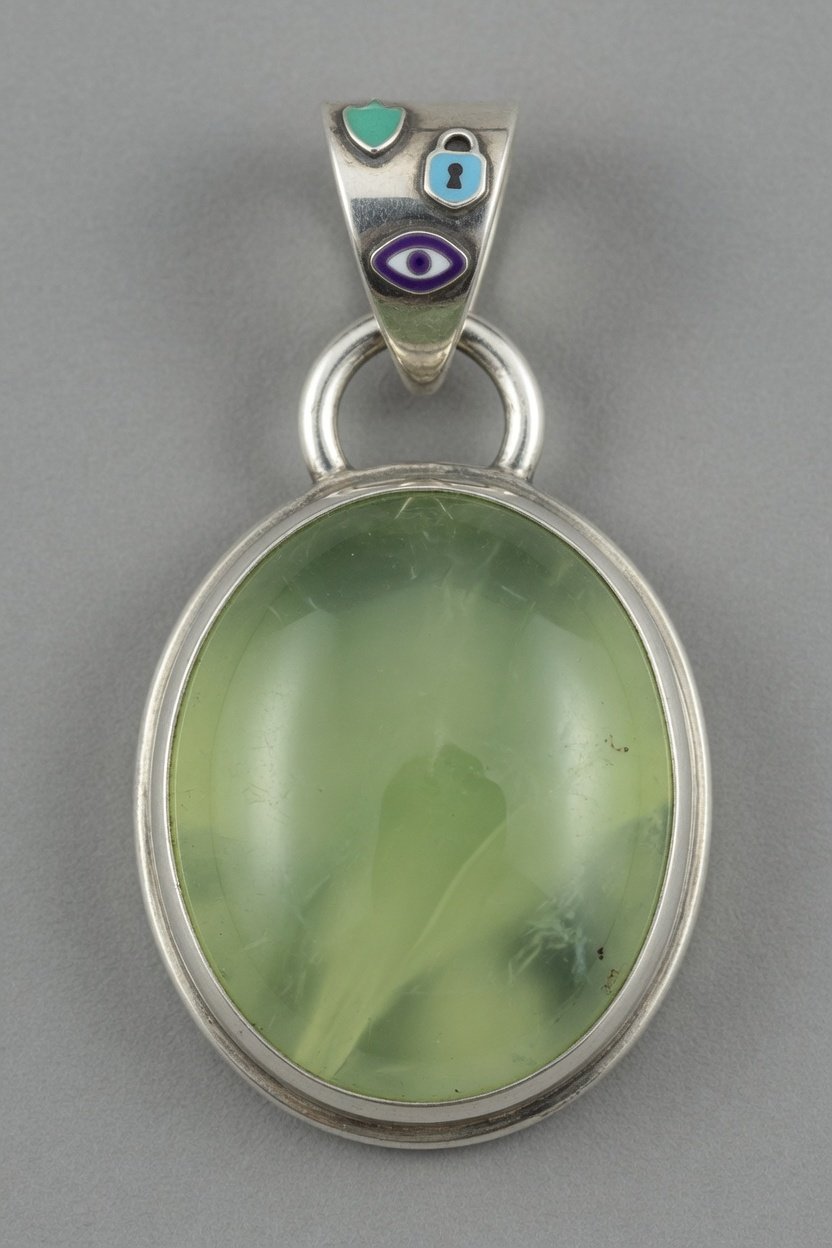
In Jewelry and Silversmithing In contemporary work Prehnite is most often cut as cabochons to emphasize its translucency and gentle color zoning. Silversmiths set these stones in bezels that fully enclose the girdle, protecting the edges while allowing light to enter from above. Because the material contains bound water, the stone must be set only after all soldering, pickling, and final polishing are finished; avoid prolonged exposure to ultrasonic cleaners or steam to prevent dehydration and surface dulling.
Identifying Prehnite in the Field Field identification relies on its distinctive apple-green to yellowish-green hue combined with a waxy to vitreous luster on broken surfaces. Hardness testing with a steel point leaves only a faint scratch, and the stone feels slightly warmer to the touch than quartz. When held against strong light, genuine Prehnite transmits a soft glow without the sharp sparkle of harder gems; matrix remnants often appear as white or brownish crusts that help distinguish it from similar-colored feldspars.
Quick Facts
Common names: Prehnite, Cape emerald
Chemical formula: Ca₂Al₂Si₃O₁₀(OH)₂
Mohs hardness: 6–6.5
Specific gravity: 2.80–2.95
Color: Apple-green to yellowish-green, sometimes with white inclusions
Crystal system: Orthorhombic
Luster: Vitreous to waxy
Transparency: Translucent to semi-transparent
Common cuts: Cabochon, occasionally faceted or beads
Common treatments: None typical; occasionally stabilized
Best silver setting: Bezel
Birthstone month (if any): None
Main sources: South Africa, Australia, China, USA
Meaning & Intentions
PROTECTION
Prehnite is carried or worn to create a quiet energetic boundary that deflects scattered thoughts and external pressures during daily routines. Silversmiths often place a cabochon in a closed bezel so the stone rests directly against the skin, allowing its gentle field to remain uninterrupted by metal edges. The resulting piece functions as a steady companion for those who work in crowded studios or travel frequently.
Chakra: Root for grounding and stability INSIGHT
Wearers use Prehnite to sharpen inner perception, especially when reviewing designs or making decisions that require calm clarity. The stone’s soft translucency is thought to filter mental noise, helping the user notice subtle patterns in both creative work and personal reflection. A simple pendant keeps the color near the throat and heart for continuous subtle support.
Chakra: Third Eye for intuitive vision SECURITY
Prehnite is valued for reinforcing a sense of inner steadiness, particularly when facing change or uncertainty in craft practice. Its presence in a finished bracelet or ring serves as a tactile reminder of continuity and resilience throughout the making process. The cabochon’s smooth dome invites repeated touch that reinforces the intention without distraction.
Chakra: Heart for emotional steadiness Affirmation: "I move forward with quiet strength and clear vision." AT A GLANCE: Chakra: Root, Third Eye, Heart Element: Earth Energy: Receptive Zodiac: Libra, Virgo Planet: Venus Affirmation: "I move forward with quiet strength and clear vision."
Related Stones
Explore more stones from the Gemstone Library: Jade · Tourmaline · Variscite