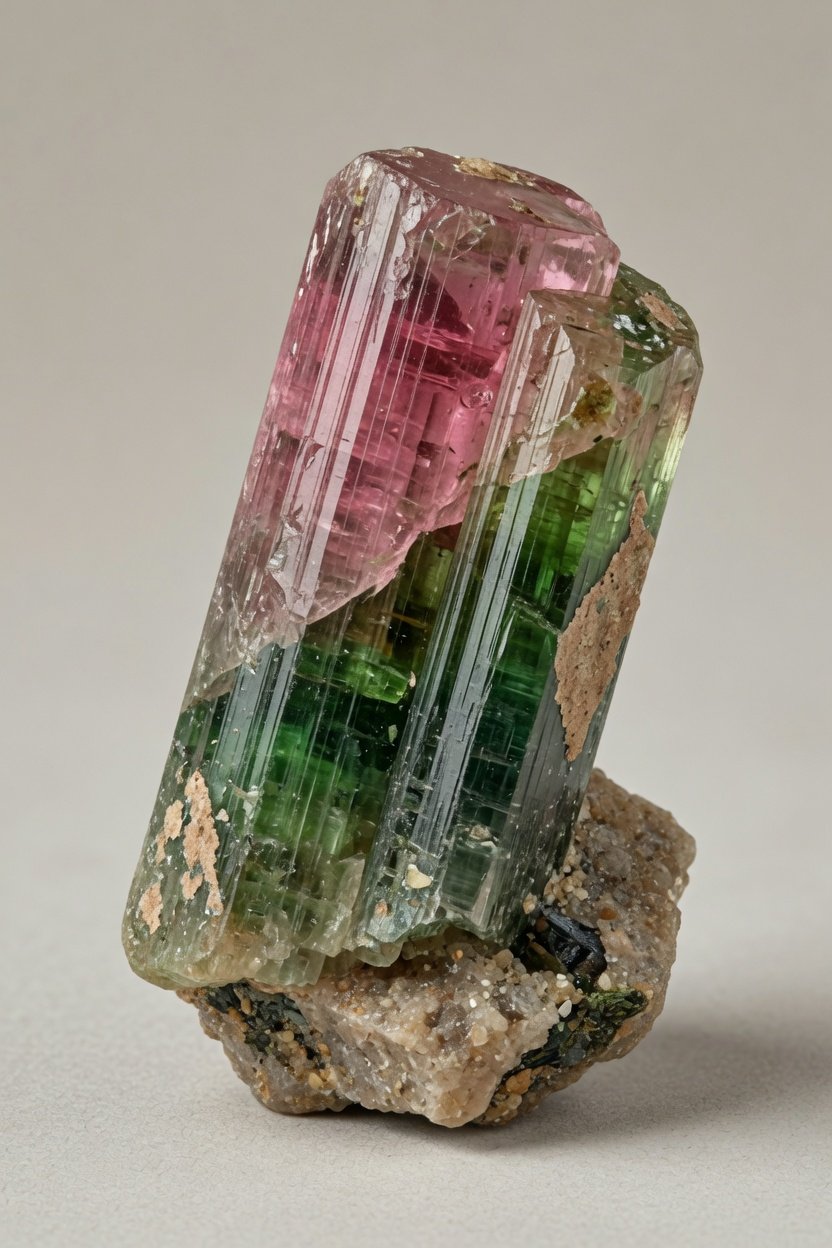
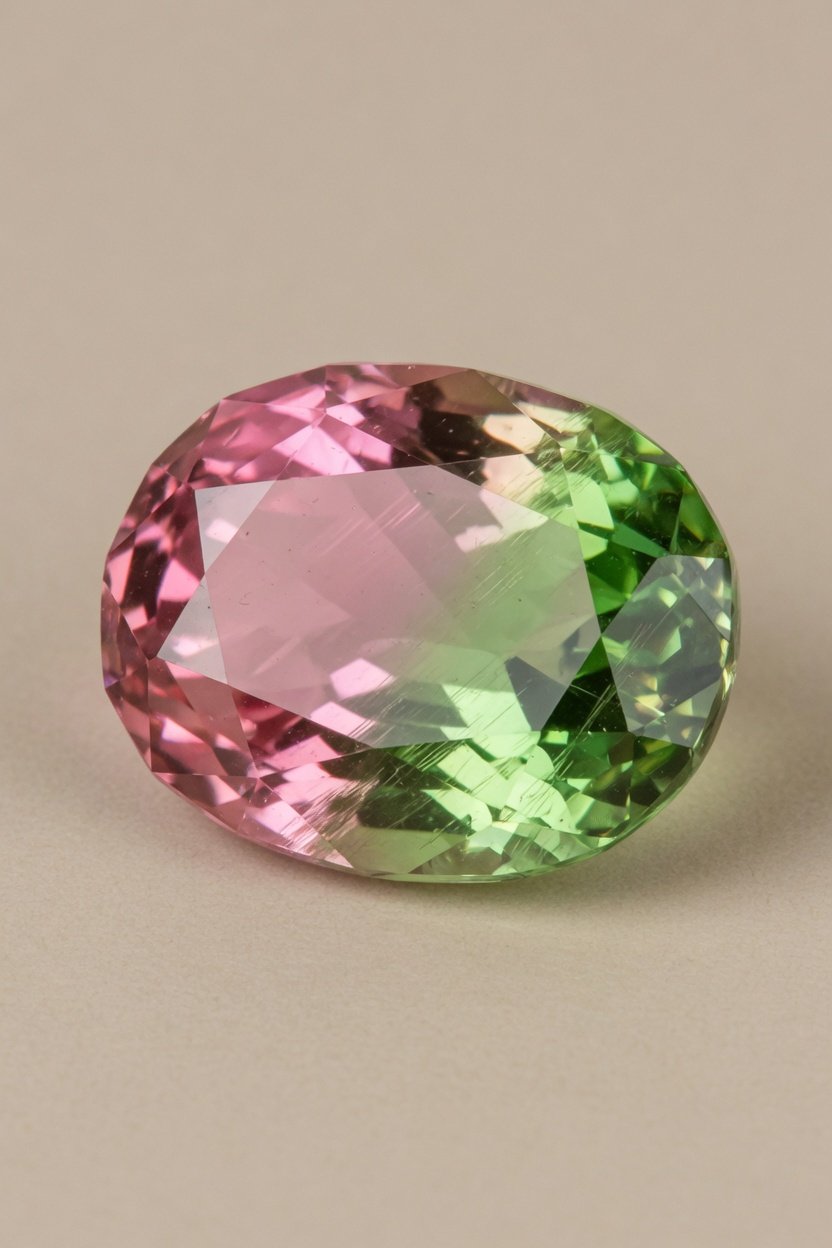
Bi-Color Tourmaline captures attention the moment light strikes its zoned interior, revealing vivid bands of pink, green, and sometimes yellow or blue that shift with every angle. This natural color zoning forms inside the crystal during growth, creating a single stone that displays two or more distinct hues without any artificial layering. Jewelers prize the material for its ability to bring multiple colors into one compact gem.
Physical Properties Bi-Color Tourmaline registers 7 to 7.5 on the Mohs scale and crystallizes in the trigonal system with strong pleochroism that can make the same stone appear darker or lighter depending on orientation. Specific gravity ranges from 3.0 to 3.3, giving pieces a satisfying heft in hand. The stone shows vitreous luster and remains transparent to translucent in gem-quality specimens. Its elongated prismatic habit often produces long, slender crystals that lapidaries orient carefully to display the color transition across the table. Always set Bi-Color Tourmaline after all soldering is complete to avoid color shifts from prolonged heat; store pieces away from ultrasonic cleaners and sudden temperature changes that could stress internal fractures.
Origin and Sourcing Primary deposits occur in Brazil’s Minas Gerais region, Madagascar’s pegmatite fields, and parts of Nigeria and Afghanistan. Miners extract the crystals from coarse-grained igneous rocks where tourmaline grows alongside quartz and feldspar. Alluvial deposits in river gravels also yield rounded pebbles that still retain sharp color boundaries. Ethical sourcing programs now track material from these locations to ensure traceability for silversmiths who select stones for custom work.
History and Significance European lapidaries first documented Bi-Color Tourmaline in the late eighteenth century, though indigenous communities in Brazil had long collected the colorful crystals. By the Victorian era the stone appeared in mourning jewelry because its pink and green zones evoked both life and remembrance. Modern metaphysical traditions associate the dual colors with balance between heart and growth energies, yet the mineral’s documented value rests in its optical properties rather than folklore.
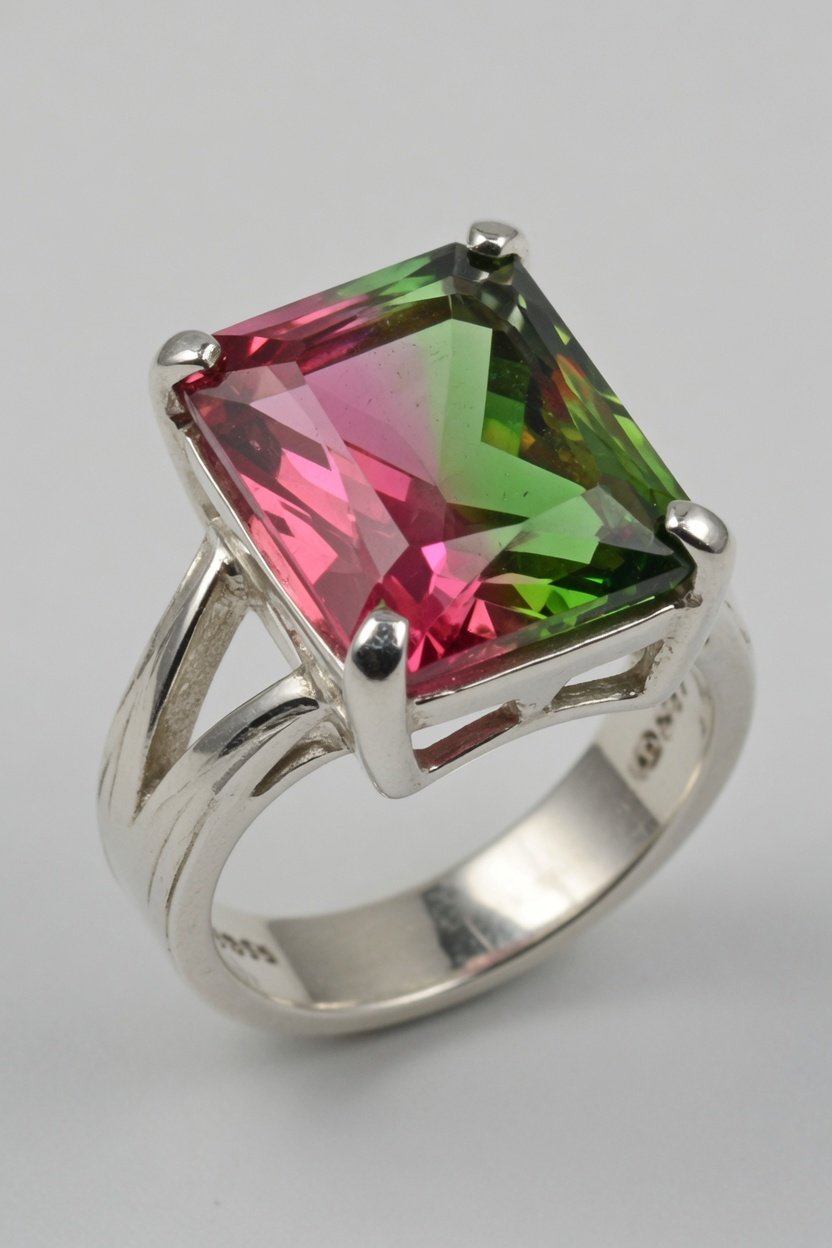
In Jewelry and Silversmithing Silversmiths favor Bi-Color Tourmaline for rings, pendants, and earrings because the color zones create natural contrast against sterling silver. Faceted stones are oriented so the pink-to-green transition runs across the face rather than along the girdle. After final polishing, the gem is set once all torch work is finished. Care cautions include avoiding prolonged sunlight that can fade certain pink zones and keeping the piece separate from harder gems that might scratch its surface during storage.
Identifying Bi-Color Tourmaline in the Field Field identification relies on the stone’s strong color zoning visible even in rough crystals, combined with its moderate hardness that resists scratching by a steel knife yet yields to a file. The typical striated prism faces and lack of cleavage help distinguish it from beryl or topaz. A quick check with a dichroscope reveals the pleochroic shift between the two main colors, confirming the identity before any cutting decisions are made.
Quick Facts
Common names: Bi-Color Tourmaline, Watermelon Tourmaline
Chemical formula: (Na,Ca)(Fe,Li,Mg,Al)3Al6(BO3)3Si6O18(OH)4
Mohs hardness: 7–7.5
Specific gravity: 3.0–3.3
Color: Pink-green zoning, occasionally with yellow or blue bands
Crystal system: Trigonal
Luster: Vitreous
Transparency: Transparent to translucent
Common cuts: Faceted oval, emerald, trillion; occasional cabochon
Common treatments: Heat, irradiation for color enhancement
Best silver setting: Contemporary Prong Ring
Birthstone month (if any): October (alternative)
Main sources: Brazil, Madagascar, Nigeria, Afghanistan
Meaning & Intentions
BALANCE
Bi-Color Tourmaline supports emotional equilibrium by uniting contrasting energies within one crystal. Wearers carry the stone during transitions to maintain steady perspective when external pressures shift rapidly. The natural color boundary acts as a visual reminder that opposing qualities can coexist without conflict.
Chakra: Heart — centers compassion and relational harmony CLARITY
The stone’s zoned structure encourages clear observation of personal patterns. Users keep polished specimens on desks or altars to prompt honest self-assessment during decision-making periods. Its optical depth rewards sustained attention with fresh insights.
Chakra: Third Eye — sharpens intuitive perception PROTECTION
Bi-Color Tourmaline forms an energetic boundary that deflects scattered influences. Travelers and performers carry it to preserve focus amid changing environments. The dual colors reinforce both grounding and uplift without requiring separate stones.
Chakra: Root — anchors physical stability Affirmation: "I hold space for every color within me." AT A GLANCE: Chakra: Heart, Third Eye, Root Element: Water and Earth Energy: Balancing and protective Zodiac: Libra, Scorpio Planet: Venus and Mars Affirmation: "I hold space for every color within me."
Related Stones
Explore more stones from the Gemstone Library: Rose Quartz · Chrome Diopside · Rubellite (Pink Tourmaline)