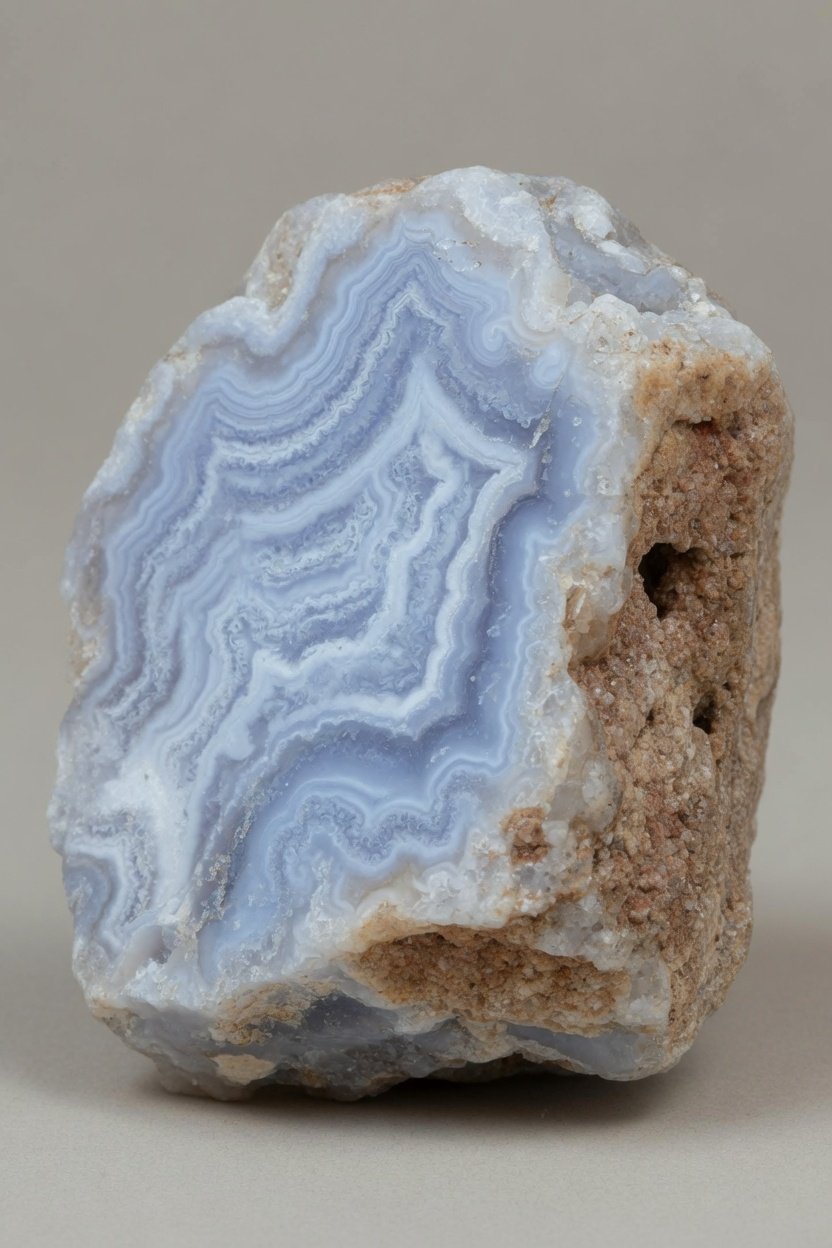
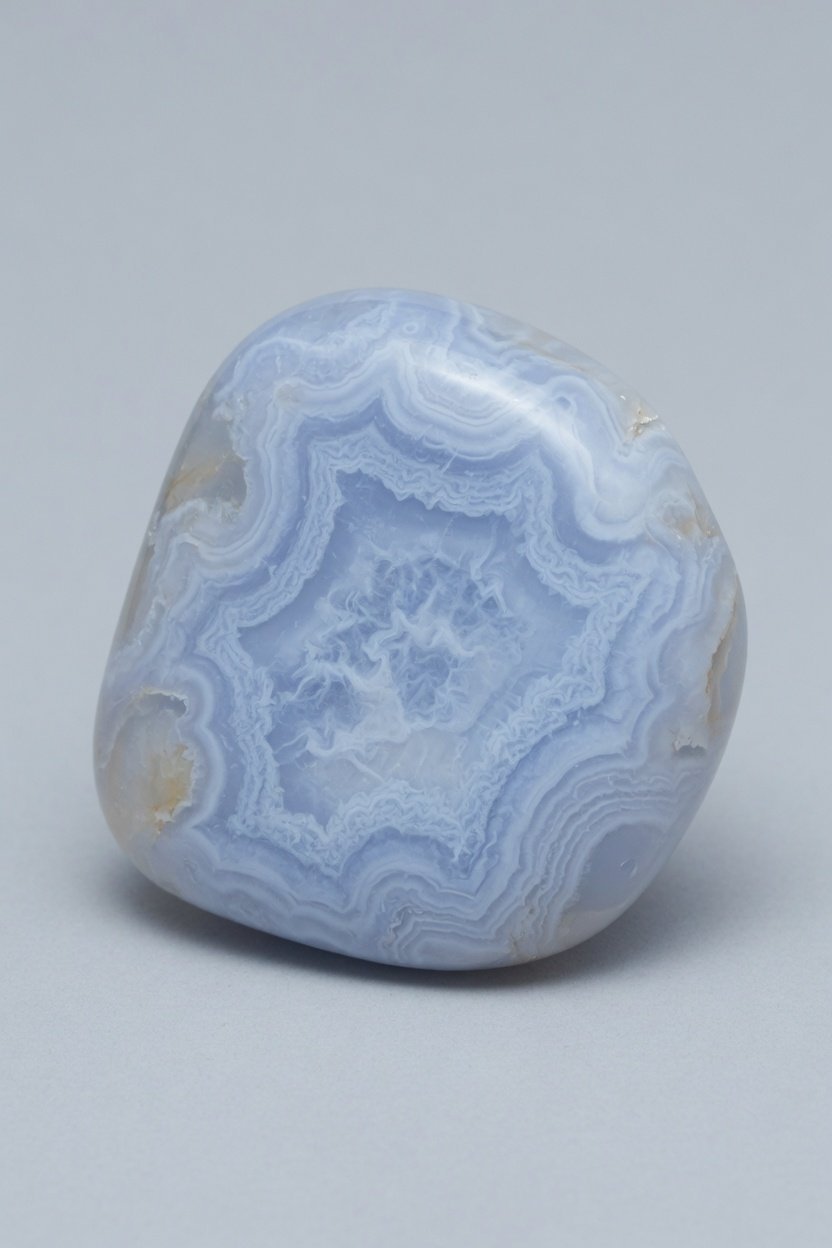
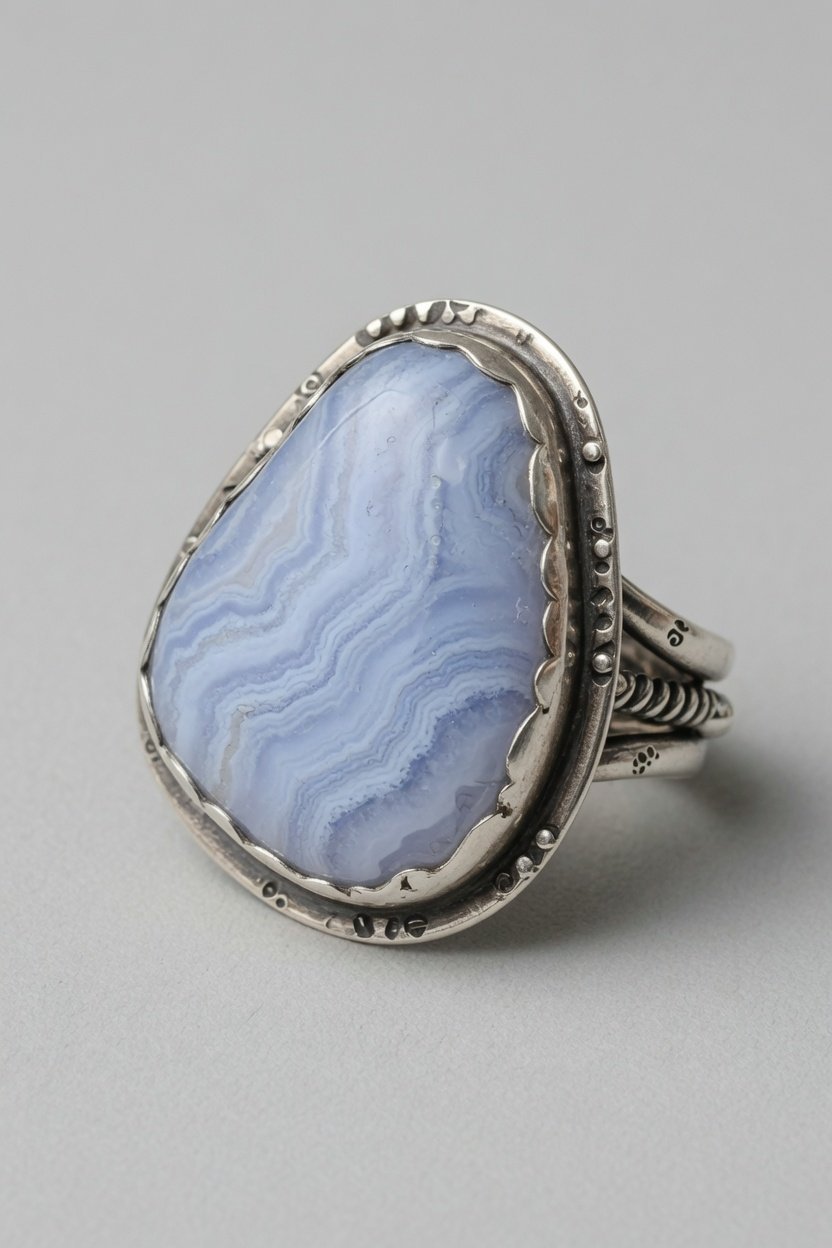
Blue Lace Agate forms in delicate layers of pale sky-blue chalcedony separated by crisp white banding that resembles fine lace. The stone’s gentle translucency and cool palette make it instantly recognizable among agates. Silversmiths prize its tranquil appearance and reliable workability when set correctly.
Physical Properties Blue Lace Agate is a banded variety of chalcedony with a Mohs hardness of 6.5–7 and specific gravity near 2.6. Its cryptocrystalline structure gives it a waxy luster and moderate toughness that resists everyday wear yet remains workable with standard lapidary tools. The stone contains microscopic water layers that produce its signature color zoning; these layers also make the material slightly heat-sensitive, so it must be set only after all soldering and torch work are complete. Avoid prolonged ultrasonic cleaning or sudden temperature changes that could cause internal fractures along the banding planes.
Origin and Sourcing Most commercial Blue Lace Agate comes from the volcanic terrains of Namibia, where silica-rich fluids filled gas cavities in ancient lava flows. Smaller quantities appear in South Africa and occasional deposits in India. Miners extract the nodules through hard-rock tunneling rather than surface collection, following narrow veins that preserve the fine banding. Rough material is typically sorted at the mine face before transport to cutting centers.
History and Significance Victorian-era collectors first documented the stone in the late nineteenth century, though local Namibian communities had long gathered it for adornment. In the twentieth century it gained popularity among lapidary artists who valued its soft palette for cameos and intaglios. Today the stone carries associations with calm communication and steady emotional balance, qualities that trace back to its visual resemblance to peaceful skies and flowing water.
In Jewelry and Silversmithing Blue Lace Agate is almost always cut as cabochons to showcase its banding and then set in silver bezels that protect the edges. Because the material can craze under direct flame, every piece is fabricated completely before the stone is introduced; prongs or bezels are formed, soldered, and polished first. Once cool, the cabochon is seated with gentle pressure and secured. Finished jewelry benefits from periodic wiping with a soft cloth; harsh chemicals or steam cleaners are avoided to preserve the delicate color layers.
Identifying Blue Lace Agate in the Field Look for pale blue-gray nodules with fine, concentric white lines that resemble lace when broken or sliced. The matrix is usually a fine-grained volcanic rock rather than the coarse basalt that hosts many other agates. Fresh fractures show a waxy sheen without the sugary sparkle of quartz. When held to light, the bands remain distinct and do not blur into a single color as they do in dyed or lower-grade material.
Quick Facts
Common names: Blue Lace Agate
Chemical formula: SiO₂
Mohs hardness: 6.5–7
Specific gravity: 2.58–2.64
Color: Pale blue with white banding
Crystal system: Trigonal
Luster: Waxy to vitreous
Transparency: Translucent
Common cuts: Cabochon
Common treatments: Occasional dye stabilization
Best silver setting: Classic Silver Bezel Pendant
Birthstone month: None
Main sources: Namibia, South Africa
Meaning & Intentions
CALM COMMUNICATION
Blue Lace Agate is carried or worn to quiet racing thoughts and encourage measured speech. Silversmiths set the stone in pendants that rest near the throat so the wearer can touch it during tense conversations, reinforcing a steady voice and patient listening.
Chakra: Throat – supports clear expression and attentive listening PEACEFUL FOCUS
The stone’s rhythmic banding is said to steady the mind during meditation or detailed bench work. Artisans keep a small polished piece on the bench to glance at between tasks, using its visual rhythm to return quickly to calm concentration.
Chakra: Third Eye – aids quiet observation without distraction EMOTIONAL BOUNDARIES
Blue Lace Agate is used to maintain composure when surrounded by strong emotions. Wearers report that the cool color and pattern help them stay centered and respond rather than react during difficult exchanges.
Chakra: Throat – reinforces respectful limits while remaining open Affirmation: "My words flow with clarity and kindness." AT A GLANCE: Chakra: Throat Element: Water Energy: Receptive Zodiac: Gemini Planet: Moon Affirmation: "My words flow with clarity and kindness."
Related Stones
Explore more stones from the Gemstone Library: Chalcedony · Sodalite · Amazonite