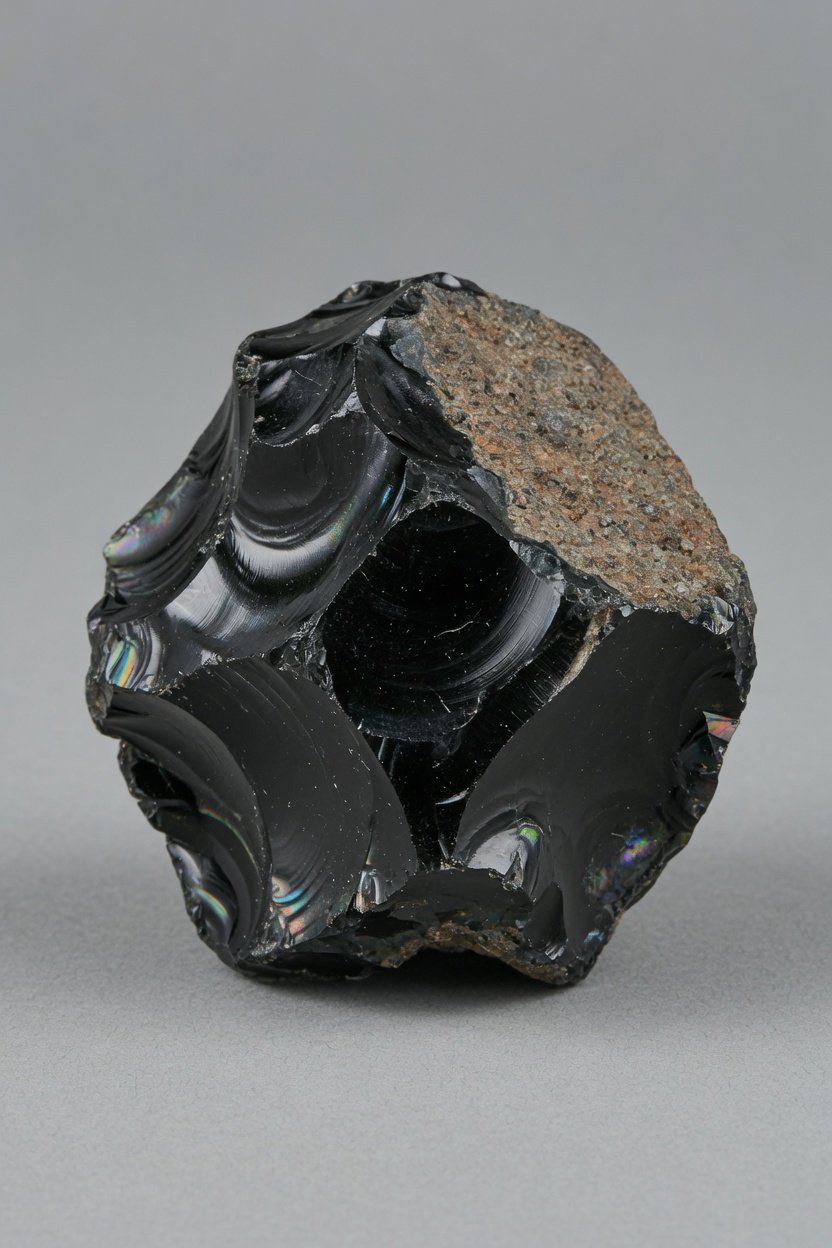
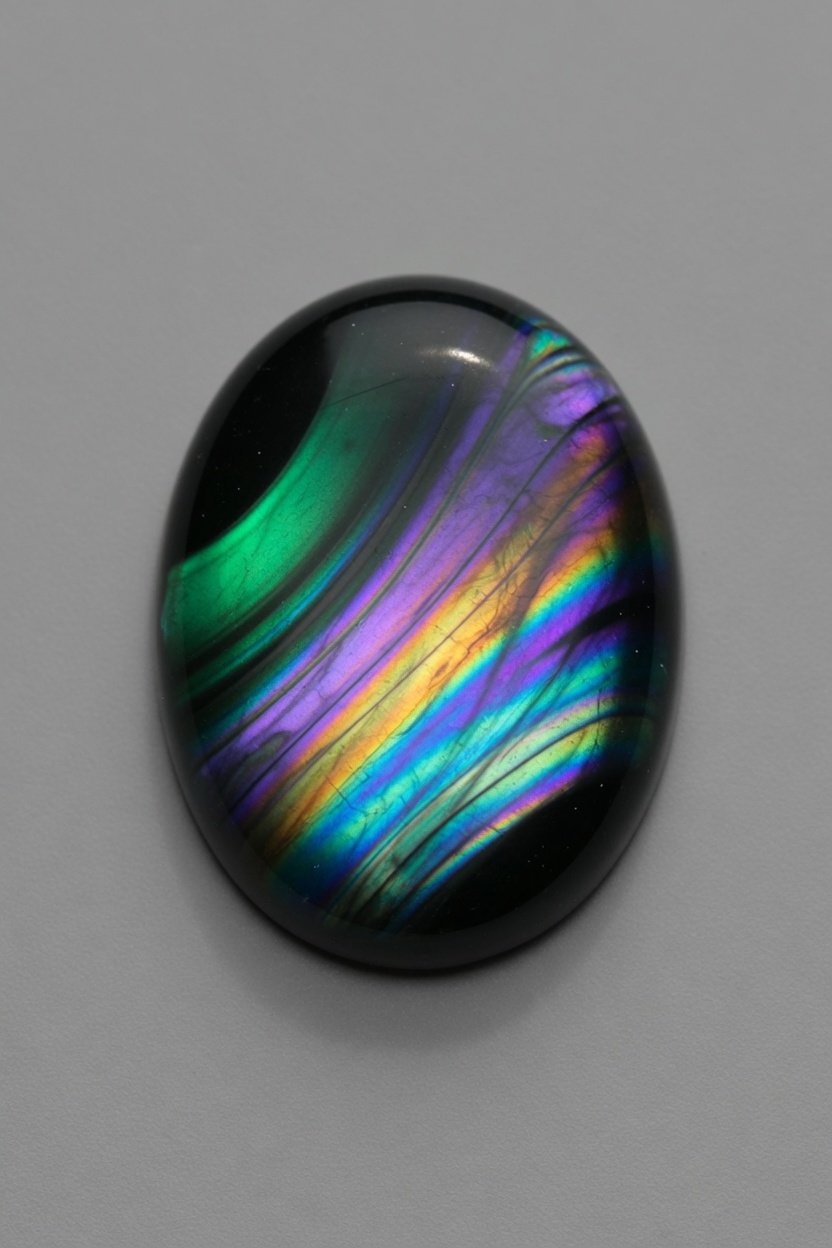
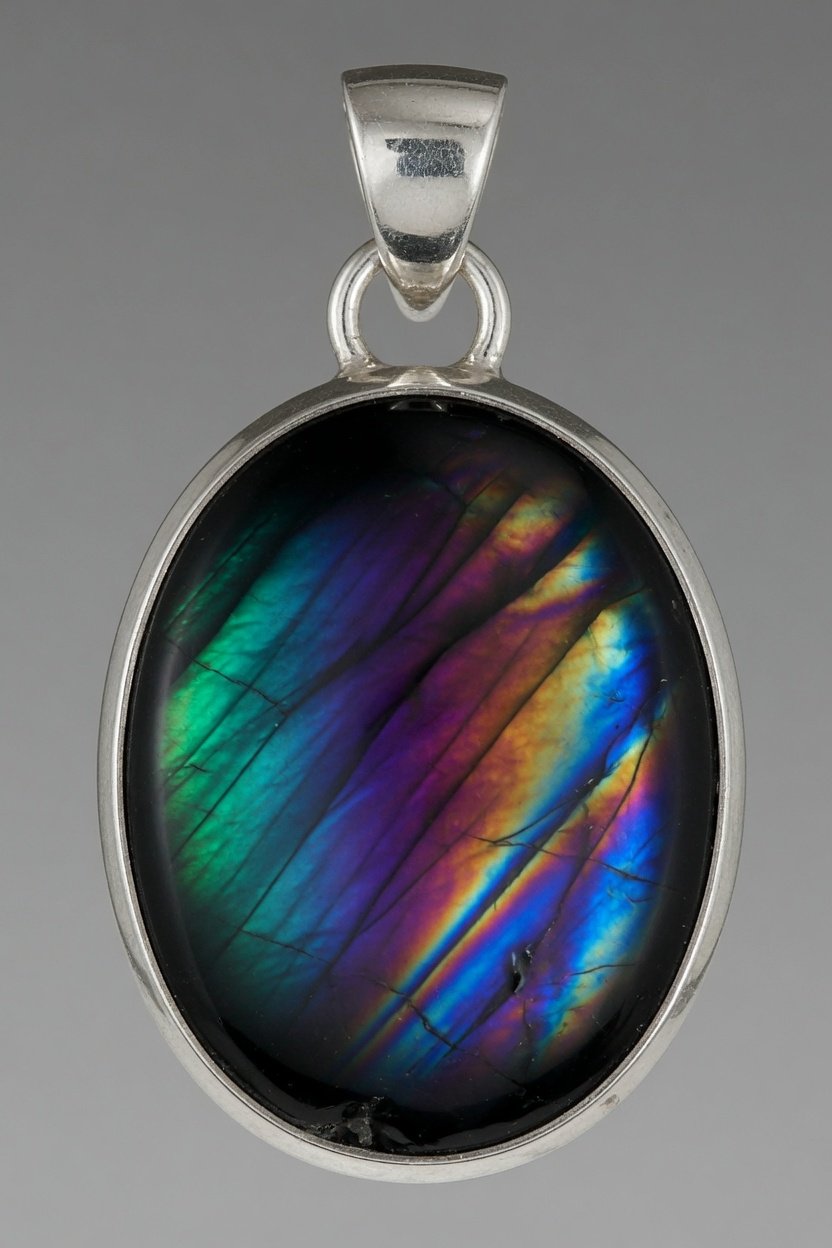
Rainbow Obsidian forms deep within volcanic flows where silica-rich lava cools rapidly into glass, trapping thin layers of magnetite that split light into vivid bands of color. The result is a stone that appears solid black until light strikes its surface at the right angle, revealing flashes of green, purple, gold, and blue that shift like oil on water. Silversmiths prize this material for its dramatic contrast against sterling silver once the stone is properly set after all soldering is complete.
Physical Properties Rainbow Obsidian is a natural volcanic glass with a chemical composition dominated by silicon dioxide. It registers 5 to 5.5 on the Mohs scale and has a specific gravity near 2.4, making it lighter than many crystalline gems yet tough enough for everyday wear. The stone is opaque with a glassy to sub-vitreous luster and displays no crystal structure because it cooled too quickly for mineral grains to form. Thin films of magnetite or hematite create the signature iridescence through thin-film interference rather than pigmentation. Because the material contains microscopic water and is sensitive to thermal shock, the stone must always be set after all soldering, ultrasonic cleaning, and steam cleaning are finished; prolonged heat or sudden temperature changes can cause internal fractures or surface crazing.
Origin and Sourcing The finest Rainbow Obsidian originates in the volcanic highlands of Mexico, particularly near the states of Jalisco and Michoacán, and in several locations across the western United States including Oregon and northern California. These deposits formed during relatively recent volcanic activity where rhyolitic lava flows created thick glass layers. Miners extract the material from open-pit benches or shallow hard-rock adits, breaking away the weathered crust to reach the iridescent core. Rough is then transported to lapidary shops where it is slabbed perpendicular to the flow banding to maximize the rainbow effect in finished stones.
History and Significance Indigenous peoples of Mesoamerica valued obsidian for tools and ritual objects long before European contact; the rainbow variety was especially prized for ceremonial mirrors believed to reveal hidden truths. In the 20th century, lapidaries rediscovered the stone’s optical properties and began cutting it into cabochons that highlight the colorful sheen. Today Rainbow Obsidian is regarded as a grounding yet visionary material, its dark body symbolizing protection while the shifting colors represent insight emerging from darkness. Modern silversmiths continue this tradition by pairing the stone with oxidized silver to intensify the contrast between the black matrix and the luminous bands.
In Jewelry and Silversmithing Because Rainbow Obsidian is opaque and relatively soft, it is almost always cut as a cabochon with a smooth, high dome that best displays the iridescence. The stone is set only after all soldering, pickling, and polishing steps are complete to avoid heat damage. Jewelers often choose low-profile bezels or southwestern-style stamped bezels that protect the edges while allowing light to graze the surface at multiple angles. Care cautions include avoiding ultrasonic and steam cleaners; gentle wiping with a soft cloth and mild soap is sufficient. The material is tough enough for rings and bracelets yet benefits from occasional re-polishing if the surface becomes scratched.
Identifying Rainbow Obsidian in the Field In hand specimens the stone shows a fresh black conchoidal fracture and a waxy to glassy luster on broken surfaces. When rotated under direct sunlight, the characteristic rainbow bands appear only at shallow angles; turning the piece reveals that the color is an optical effect rather than a surface coating. Unlike man-made glass, natural Rainbow Obsidian frequently contains tiny gas bubbles or flow lines visible under magnification. Its specific gravity is noticeably lower than that of crystalline black stones such as onyx or jet, and it feels warmer to the touch than most crystalline gems of similar size.
Quick Facts
Common names: Rainbow Obsidian, Peacock Obsidian
Chemical formula: SiO₂ with magnetite inclusions
Mohs hardness: 5–5.5
Specific gravity: 2.35–2.45
Color: Black body with iridescent rainbow sheen
Crystal system: Amorphous
Luster: Glassy to sub-vitreous
Transparency: Opaque
Common cuts: Cabochon, tumbled freeform
Common treatments: None
Best silver setting: Classic Silver Bezel Pendant
Birthstone month (if any): None
Main sources: Mexico, United States (Oregon, California)
Meaning & Intentions
GROUNDING VISION
Rainbow Obsidian anchors scattered thoughts while its rainbow layers gently illuminate inner patterns, allowing wearers to see situations clearly without losing emotional stability. Silversmiths set the stone low in protective bezels so the dark body remains in contact with skin, reinforcing a sense of safety during meditation or difficult conversations.
Chakra: Root — steady presence and safety CLARITY THROUGH SHADOW
The stone’s shifting colors encourage honest self-examination by reflecting hidden aspects of the self back in a non-judgmental way. When used in jewelry the iridescence acts as a visual reminder to look beyond surface appearances toward deeper understanding.
Chakra: Third Eye — insight and intuition PROTECTIVE BOUNDARIES
Rainbow Obsidian creates an energetic filter that absorbs negativity before it reaches the wearer, making it popular for those working in emotionally demanding environments. The stone’s toughness supports this role by physically enduring daily wear while maintaining its reflective surface.
Chakra: Root — shielding and containment Affirmation: "I see clearly and remain rooted." AT A GLANCE: Chakra: Root and Third Eye Element: Earth and Fire Energy: Protective and revealing Zodiac: Scorpio, Sagittarius Planet: Pluto, Saturn Affirmation: "I see clearly and remain rooted."
Related Stones
Explore more stones from the Gemstone Library: Obsidian · Star Ruby · Unakite