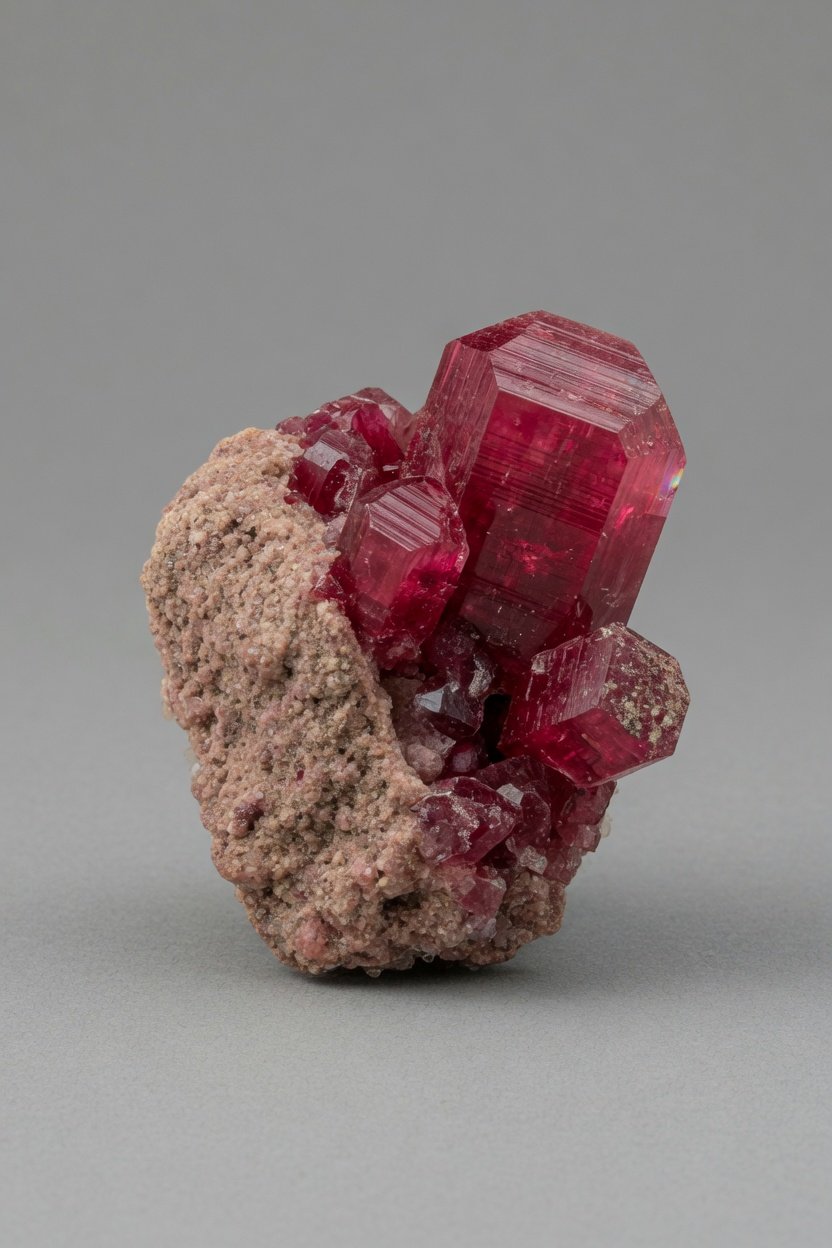
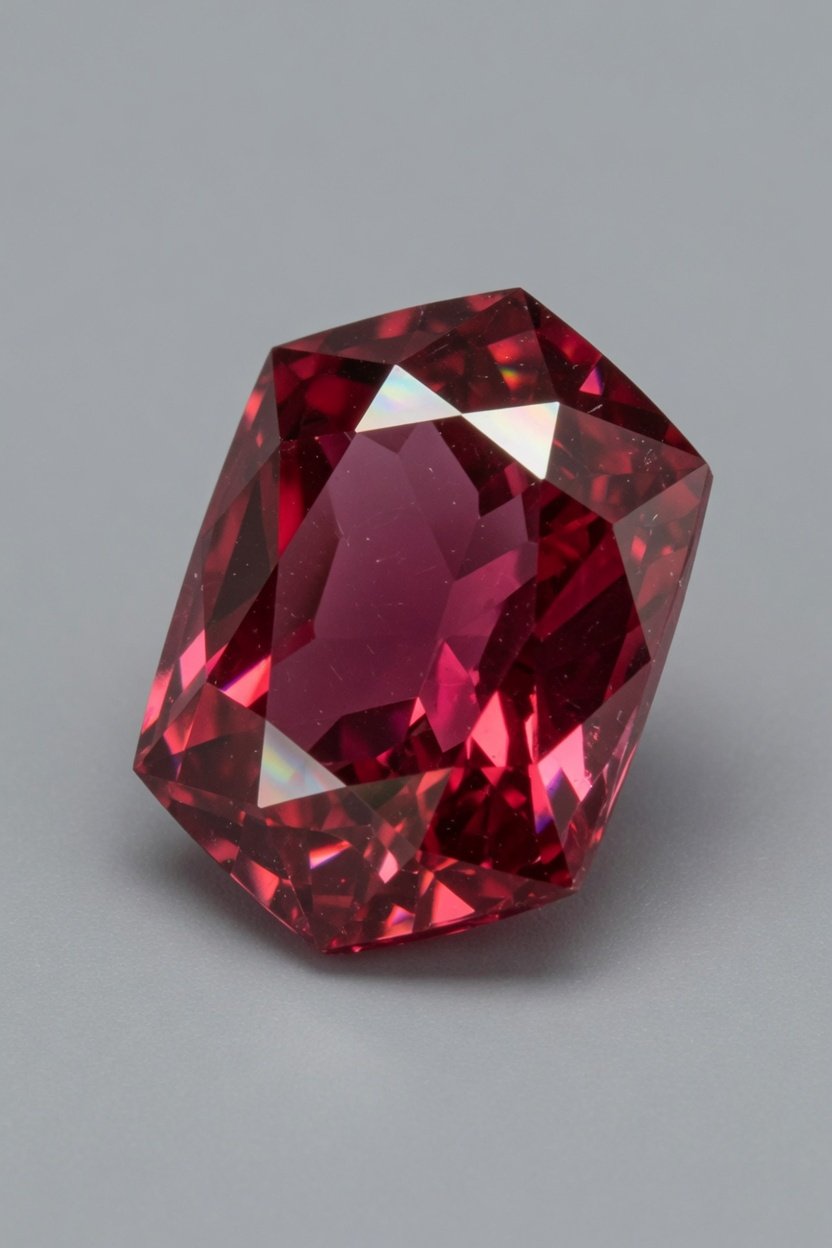
Bixbite, also called red beryl, emerges from the volcanic rhyolite of Utah’s Wah Wah Mountains as one of the rarest colored gems on the planet, its raspberry-red crystals forming in tiny pockets that yield only a handful of facetable stones each year. The color arises from manganese ions within the beryl structure, producing a saturated hue that shifts from deep scarlet to vivid rose depending on light angle and crystal thickness. Collectors and silversmiths prize these stones for their scarcity and the way their transparency allows light to travel through the hexagonal lattice, creating an internal glow that no other beryl variety matches.
Physical Properties Bixbite registers 7.5–8 on the Mohs scale, making it durable enough for everyday wear yet requiring careful handling during fabrication. Its specific gravity of 2.66–2.70 and hexagonal crystal system produce prismatic crystals that often show faint color zoning from core to rim. Because the stone contains no water of crystallization and is chemically stable, it tolerates standard polishing compounds, but prolonged ultrasonic cleaning is discouraged. Silversmiths always set bixbite after every soldering operation is complete and the piece has cooled to room temperature, then advise owners to avoid steam cleaners and sudden temperature changes that could exploit any microscopic cleavage planes.
Origin and Sourcing Commercial quantities occur almost exclusively in the Wah Wah Mountains of Beaver County, Utah, inside gas cavities of topaz-bearing rhyolite flows. A second, far smaller deposit exists in the Thomas Range, yet production remains negligible. Miners extract the host rock by hand, splitting boulders along natural fractures to free the fragile red crystals before they are trimmed and sent to lapidaries. Because annual yields rarely exceed a few thousand carats of gem quality, every finished bixbite represents years of selective mining and meticulous sorting.
History and Significance Maynard Bixby first described the mineral in 1904, and the name “bixbite” honors his discovery even though the gem trade later adopted “red beryl” for marketing clarity. Native American artisans of the region encountered the vivid red crystals centuries earlier and incorporated them into ceremonial objects. Today the stone’s extreme rarity—estimated at one red beryl for every 150,000 emeralds—has elevated it to collector status comparable with alexandrite or fine ruby.
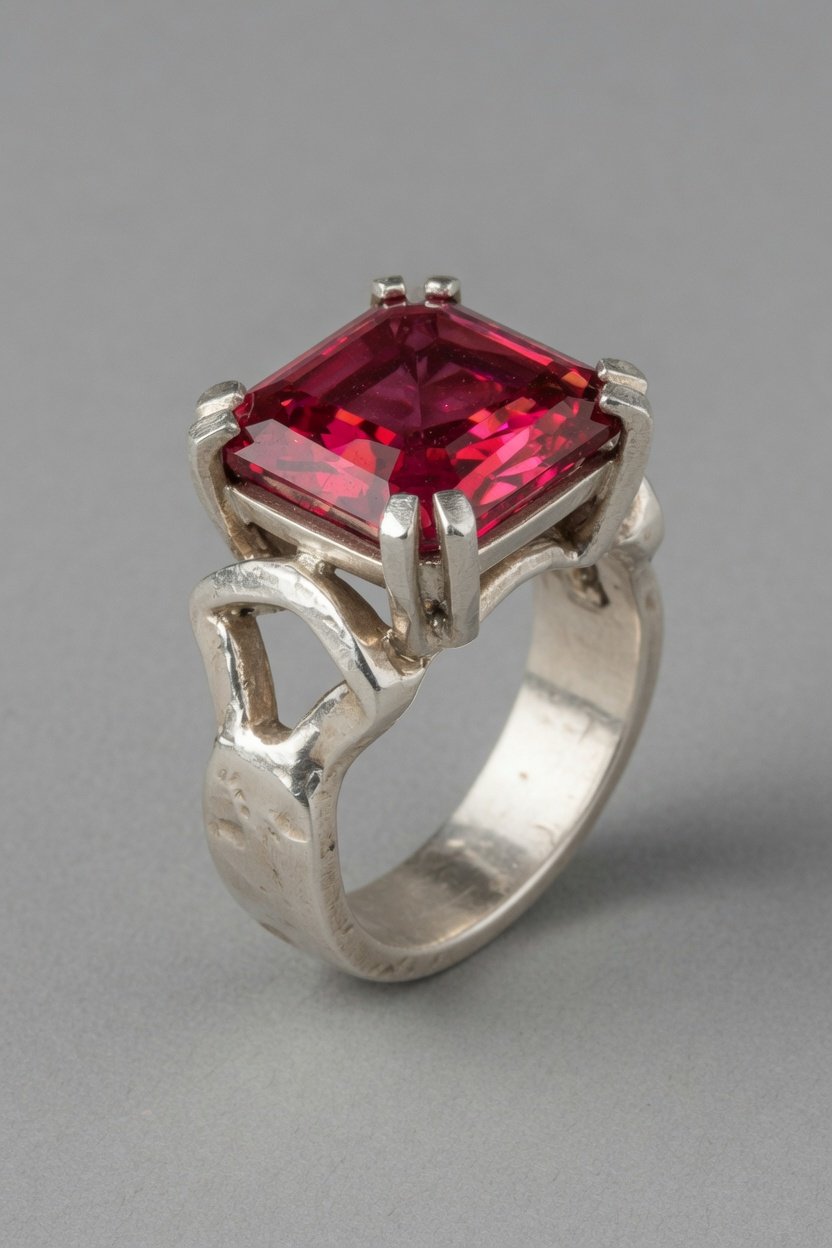
In Jewelry and Silversmithing Facetors orient the table perpendicular to the c-axis to maximize color saturation, then cut stones between 0.5 and 2 carats because larger clean crystals are virtually nonexistent. Once faceted, the gem is set only after all soldering, annealing, and polishing steps are finished so that heat never reaches the stone. Contemporary prong or bezel settings in sterling silver protect the pavilion while allowing maximum light return. Owners should remove bixbite jewelry before heavy work or exposure to strong solvents; a soft cloth wipe after wear preserves the high vitreous polish.
Identifying Bixbite (Red Beryl) in the Field In matrix, the stone appears as small, bright red prisms contrasting sharply against the pale gray rhyolite. A pocket knife cannot scratch the crystal faces, and a strong light held behind a thin fragment reveals the characteristic hexagonal outline and uniform raspberry transmission. No other red mineral in the same environment shares beryl’s refractive index or lack of pleochroism in this vivid tone.
Quick Facts
Common names: Red Beryl, Bixbite
Chemical formula: Be₃Al₂Si₆O₁₈ with manganese
Mohs hardness: 7.5–8
Specific gravity: 2.66–2.70
Color: Raspberry red to deep scarlet
Crystal system: Hexagonal
Luster: Vitreous
Transparency: Transparent to translucent
Common cuts: Faceted
Common treatments: None
Best silver setting: Contemporary Prong Ring
Birthstone month (if any): None
Main sources: Utah, USA
Meaning & Intentions
VITALITY
Bixbite channels steady life force into the wearer, its manganese-driven red reinforcing physical stamina and quiet courage during demanding creative work. Silversmiths keep a small faceted piece on the bench to maintain focus through long polishing sessions and to remind themselves that rarity rewards patient craft.
Chakra: Root — grounding and physical endurance CLARITY
The stone’s transparent red lattice sharpens perception, helping artisans discern subtle color shifts in silver oxides and foresee how a finished piece will interact with light. Wearers report clearer decision-making when the gem rests near the workspace.
Chakra: Third Eye — insight and focused vision PROTECTION
Bixbite forms an energetic boundary around personal energy, shielding against creative burnout and external criticism while the silversmith brings delicate work to completion. Its hardness supports this steady containment without absorbing surrounding influences.
Chakra: Root — secure foundation and resilience Affirmation: "I hold rare fire with steady hands." AT A GLANCE: Chakra: Root Element: Fire Energy: Projective Zodiac: Aries Planet: Mars Affirmation: "I hold rare fire with steady hands."
Related Stones
Explore more stones from the Gemstone Library: Mahenge Spinel · Ruby · Spinel