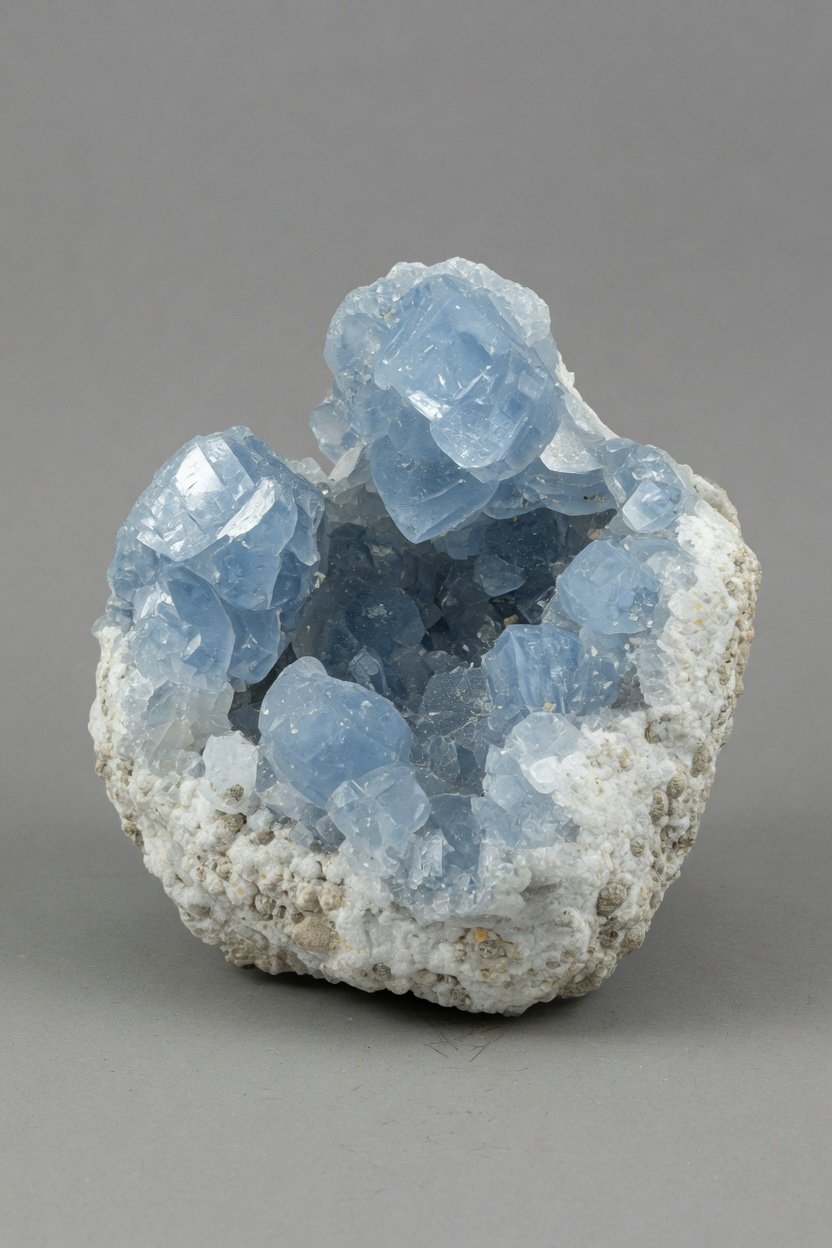
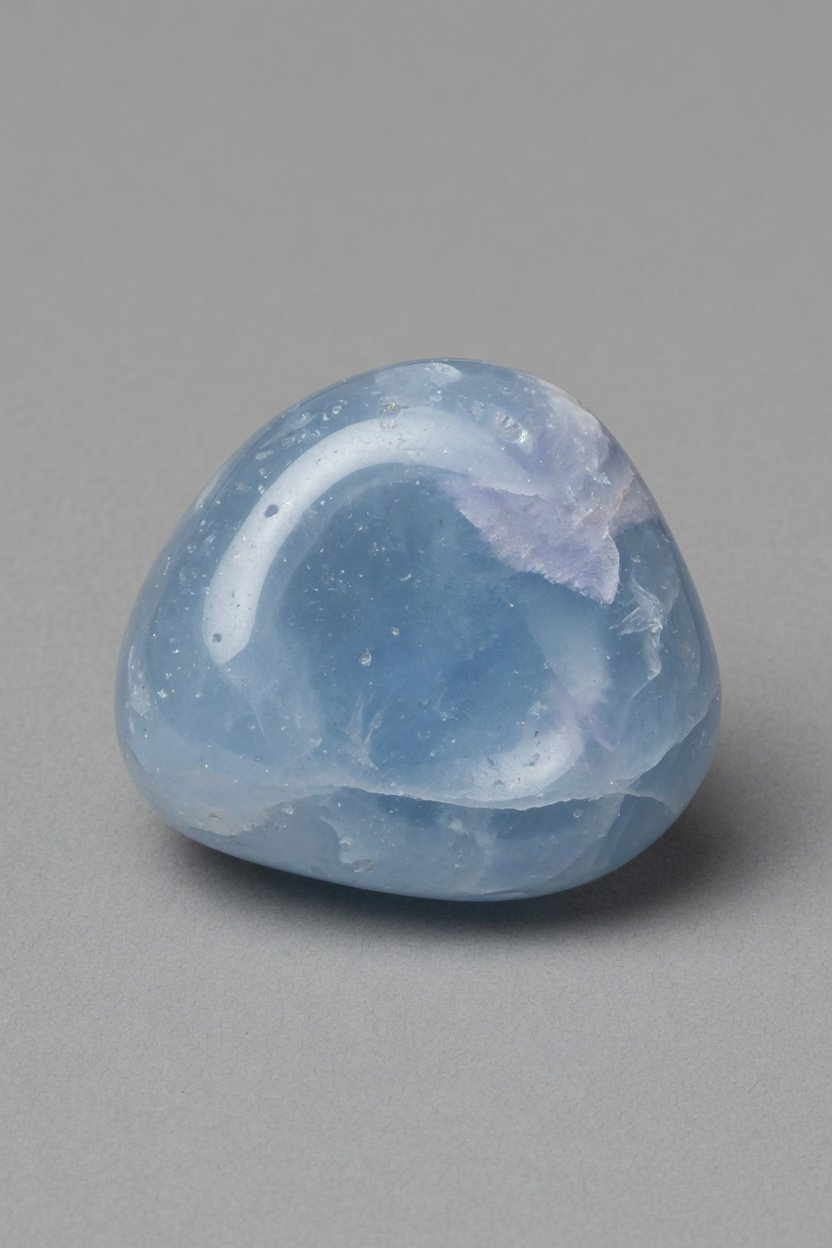
Celestite forms in delicate sky-blue crystals that seem to capture fragments of dawn light within their transparent depths. These strontium sulfate geodes and clusters emerge quietly from sedimentary layers, offering a mineral whose gentle color and fragile structure have long invited both scientific study and artistic use. Silversmiths prize the stone for its luminous quality yet must handle it with precision because of its low hardness and perfect cleavage.
Physical Properties Celestite registers 3 to 3.5 on the Mohs scale and displays a specific gravity near 3.97. Its orthorhombic crystals often grow in radiating clusters or inside geodes, producing a vitreous luster that ranges from transparent to translucent. The stone’s perfect cleavage along one plane makes it prone to splitting under pressure, while its strontium sulfate composition renders it sensitive to strong acids. Silversmiths always set Celestite after all soldering is complete, seating the finished piece into a protective bezel or prong that shields the edges from impact. Daily care requires avoiding ultrasonic cleaners and storing the stone separately from harder gems to prevent abrasion.
Origin and Sourcing Major deposits occur in Madagascar, Mexico, and parts of the United States. In Madagascar, Celestite fills cavities within limestone and basalt, often extracted by hand from narrow adits. Mexican material frequently appears in large geodes lined with pale blue blades, while Ohio specimens form smaller, more compact clusters. Artisanal miners select only the clearest crystals for export, leaving matrix-covered pieces for specimen collectors. Trace amounts of strontium give the characteristic color, and occasional iron staining produces subtle lavender zones within otherwise colorless sections.
History and Significance Ancient Mediterranean cultures associated the mineral with the heavens because of its celestial hue, though they rarely distinguished it from other blue stones. In the nineteenth century, mineralogists formally named it after the Latin “caelestis” for its sky-like tone. During the Victorian era, polished Celestite spheres appeared in curiosity cabinets across Europe. Contemporary metaphysical practitioners continue to link the stone with calm communication and higher awareness, echoing older symbolic traditions without altering its physical identity.
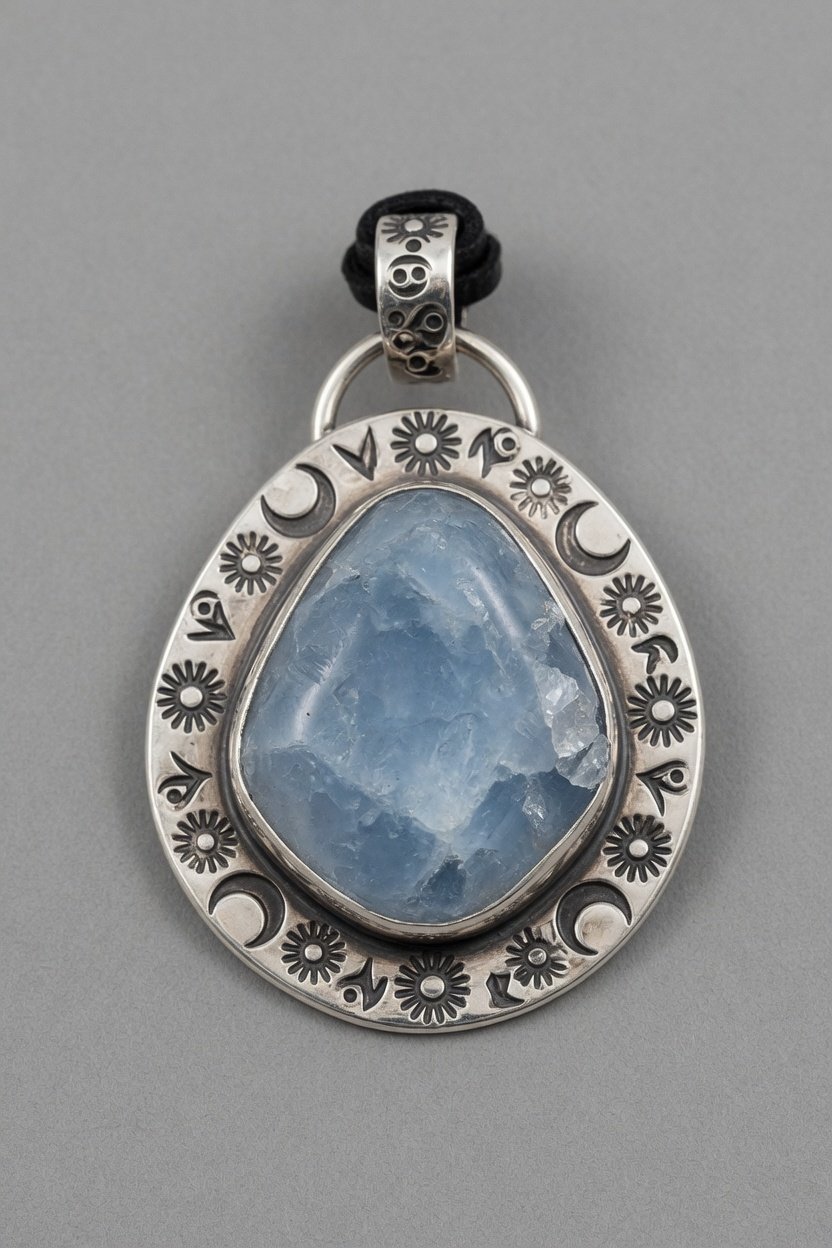
In Jewelry and Silversmithing Because of its softness, Celestite is rarely faceted and instead receives a light polish that preserves natural terminations or produces rounded freeforms. Silversmiths favor bezel settings that fully encircle the stone, protecting cleavage planes while allowing light to pass through the translucent body. After soldering, the cooled mounting receives the stone, which is then burnished gently into place. Prolonged exposure to sunlight may fade the blue over decades, so finished pieces are best worn indoors or stored away from direct rays.
Identifying Celestite in the Field Field collectors recognize Celestite by its pale blue color, tabular or prismatic habit, and tendency to form inside geodes or vugs. A hardness test with a copper coin leaves a faint scratch, while dilute hydrochloric acid produces no effervescence, distinguishing it from calcite. The stone’s high strontium content can be confirmed with a flame test yielding a crimson color, though this method is reserved for laboratory settings rather than field identification.
Quick Facts
Common names: Celestite, Celestine
Chemical formula: SrSO4
Mohs hardness: 3–3.5
Specific gravity: 3.96–3.98
Color: Pale blue, white, colorless
Crystal system: Orthorhombic
Luster: Vitreous
Transparency: Transparent to translucent
Common cuts: Tumbled freeform, cabochon, geode sections
Common treatments: None
Best silver setting: Southwestern Stamped Bezel
Birthstone month (if any): None
Main sources: Madagascar, Mexico, United States
Meaning & Intentions
CALM COMMUNICATION
Celestite supports clear and peaceful dialogue by encouraging speakers to choose words that reduce tension rather than escalate it. In practice, a small polished piece is held during conversation or placed on a desk where its soft blue tone serves as a visual reminder to pause before responding. The stone’s strontium sulfate structure is believed to resonate with throat energies, helping users articulate thoughts without aggression while remaining receptive to differing viewpoints.
Chakra: Throat – fosters honest yet gentle expression ANGELIC AWARENESS
Users turn to Celestite when seeking connection with higher guidance or a sense of expanded perspective during meditation. The translucent crystals are placed near a journal or altar so that their sky-like hue becomes a focal point for quiet reflection. Over time the stone is thought to heighten intuitive perception, allowing subtle insights to surface without forcing interpretation or dramatic revelation.
Chakra: Crown – opens pathways to expanded perception EMOTIONAL PROTECTION
Celestite creates a subtle energetic boundary that helps sensitive individuals maintain composure amid external stress. A tumbled piece carried in a pocket or worn in jewelry is said to absorb discordant impressions before they reach the wearer. The mineral’s gentle vibration encourages emotional equilibrium, allowing the user to observe difficult situations without becoming overwhelmed by them.
Chakra: Throat – maintains steady emotional boundaries Affirmation: "I speak with clarity and remain centered in peace." AT A GLANCE: Chakra: Throat Element: Air Energy: Receptive Zodiac: Gemini Planet: Neptune Affirmation: "I speak with clarity and remain centered in peace."
Related Stones
Explore more stones from the Gemstone Library: Chalcedony · Grandidierite · Amazonite